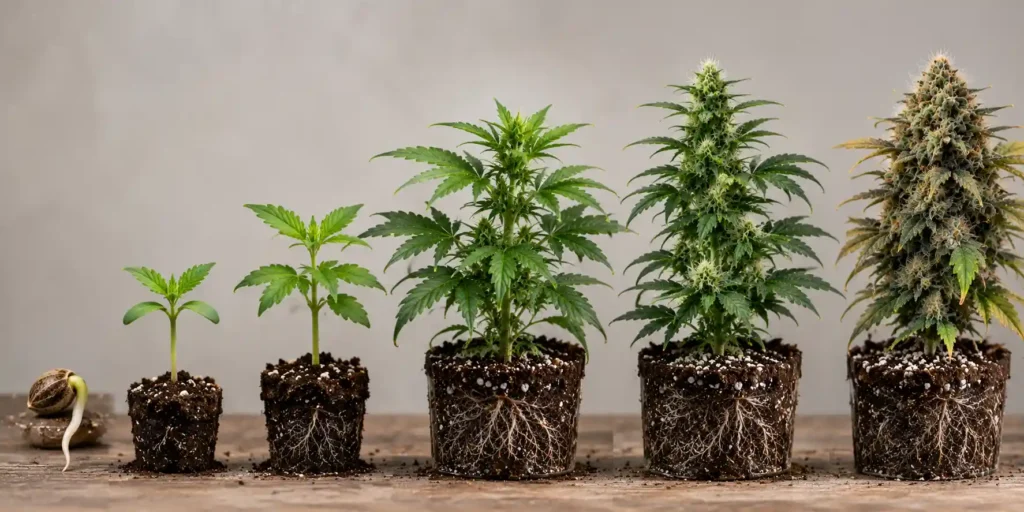
Most photoperiod cannabis plants take roughly three to six months to go from seed to harvest. The biggest reason for that spread is how long the grower chooses to keep the plant in vegetative growth. That’s why so many people search “is my plant behind schedule?” and get answers that don’t match what they see in the tent or the garden.
This guide walks through each stage in order and shows what a healthy plant looks like at that point. It also flags the moments when a plant may need a closer look. Some timings are fixed by biology and some are your call, and the guide says which is which. For the wider picture of how these stages connect to harvest, see the growth and harvest guide.
The quick version
| Stage | Typical length | What sets the length |
| Germination | About 1–10 days | Seed quality, moisture, temperature |
| Seedling | About 1–3 weeks | Genetics, light, early care |
| Vegetative | About 2–8 weeks in practice | Grower’s choice (photoperiod) or genetics (autoflower) |
| Flowering | About 7–14 weeks | Cultivar, environment |
| Harvest | Decided by the plant’s trichomes, not the calendar | Direct observation |
How to use this guide (and why “week 6” means different things)
Two counting systems are in use, and they’re the main reason advice online seems to contradict itself. Some growers count weeks from germination. Others restart the count when they switch the lights to 12 hours on, 12 hours off, so “week 3” means the third week of flowering.
Both are valid. This guide counts from germination unless it says “weeks of flower.” When you compare this page to another source, check which convention it uses first.
Here’s one plausible photoperiod grow with a four-week veg. It’s an illustration, not a schedule, because your veg length may differ.
| Week from germination | What’s typically happening |
| 1 | Germination and first cotyledons |
| 2–3 | Seedling stage, first true leaves |
| 4–7 | Vegetative growth; pre-flowers may start to appear |
| 8–10 | Switch to 12/12; the stretch (flower weeks 1–3) |
| 11–14 | Bud development |
| 15–17 | Ripening; harvest decided by trichomes |
[Visual suggestion: horizontal timeline graphic of the table above, with the veg segment shown as adjustable]
Germination: from dry seed to taproot
Germination usually takes anywhere from one to ten days, and the spread itself is normal. A seed that shows a taproot on day 3 and one that takes until day 8 are both on track.
The process starts with imbibition, which is the seed soaking up water. That water softens the seed coat and wakes the embryo. The first root, called the taproot (technically the radicle), pushes out, and that visible root is your sign that germination has happened.
Temperature affects this more than “warmer is faster” suggests. A study of eight cannabis landraces compared three day/night temperature settings. Germination speed was generally higher at the middle setting (30/25 °C) than the cool one (20/15 °C).
Total germination percentage, however, was generally higher at the cool setting and lowest at the hottest. Individual landraces differed, so the study doesn’t give a single perfect number. A separate study of industrial hemp found the best speed and success between 19 and 30 °C. The practical takeaway is a steady, moderately warm spot rather than the hottest one you can find.
If nothing has happened after a couple of weeks, the cause is usually the seed or its moisture level, not the stage itself. Method details, such as paper towel versus planting straight into soil, are in the seeds guide and the step-by-step growing guide.
Seedling stage: the first one to three weeks
A healthy seedling has two round, smooth leaves called cotyledons, followed by its first true leaves. The whole stage typically lasts one to three weeks.
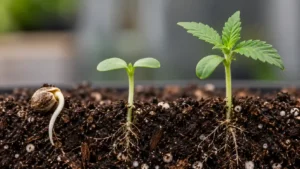
The cotyledons are the seed’s packed lunch. They feed the plant early on, then fade as the plant grows real leaves. You’ll spot the true leaves by their serrated edges.
The first true leaves often have a single blade. The next set has three, then five, and the finger count keeps rising as the plant matures. That progression is a handy marker. A seedling with one single-bladed true leaf at day 10 and another already showing a three-fingered leaf are both normal, because genetics and light exposure account for the difference.
[Visual suggestion: photo sequence of cotyledons, first single-blade leaf, three-finger leaf]
This is the stage where first-time growers tend to worry most. A common result is overwatering out of good intentions, which leaves the plant limp and struggling. If that’s what you’re seeing, read why cannabis plants droop. If something looks off beyond normal variation, the problems and solutions guide is the place to start.
Vegetative stage: the part with no deadline
The vegetative stage is when the plant builds its structure: stems, branches, and leaves. In practice it runs from about two to eight weeks, but nothing in the biology sets a correct length. It’s a grower’s decision.
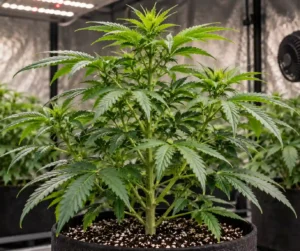
A longer veg generally gives a bigger plant with more places for buds to form. A shorter veg gives a faster cycle and a smaller plant. Someone who vegs three weeks to save space and someone who vegs eight weeks for size are both doing it right. Beyond basic establishment, I’m not aware of any evidence for a required minimum.
That means “am I behind?” has no timeline-based answer. Judge by how the plant looks: steady new nodes, healthy color, and growth that matches your setup. A node is the point where leaves and branches attach, and the space between two nodes is the internode. Environment and feeding during this stage are covered in the ideal conditions guide and the plant food guide. If you plan to train the plant, the training guide explains when to start.
| If you choose… | You typically get… |
| A shorter veg | Faster turnaround, smaller plant, less space needed |
| A longer veg | More time to build structure, larger plant, more bud sites |
Pre-flowers and the stipule mix-up
Pre-flowers are tiny early flower structures that form at the nodes and can show whether a plant is male or female. They commonly become identifiable somewhere between weeks 3 and 6, though that window is wide and depends on the cultivar and light schedule. This timing comes from consistent grower experience rather than a controlled study, so treat it as a rough guide.
Don’t confuse pre-flowers with stipules. Stipules are small, pointed growths at the base of the leaf stem, and every plant has them regardless of sex. Beginners often mistake them for an early sign of sex, which is the most common error at this stage. Real pre-flowers are small structures that form at the node itself, and the male vs. female guide shows exactly what to look for.
The autoflower fork
Autoflowering plants work differently. A photoperiod plant stays in veg until you change the light schedule. An autoflower ends veg on its own after a few weeks, no matter what schedule it’s on. That trait is commonly traced to Cannabis ruderalis genetics, and such plants are called “day-neutral” because light length doesn’t control their timing. So the “how long should I veg?” question mostly doesn’t apply to them.
Flowering stage: the mechanism, then the weeks
Why darkness triggers flowering
Cannabis is called a short-day plant, but it’s really a long-night plant. What matters is how long the uninterrupted darkness lasts, not the length of the day.
The plant senses this with light-detecting proteins called phytochromes. When the night stays longer than a cultivar-specific threshold, the signal changes and switches on a gene called FLOWERING LOCUS T (FT).
That gene tells the growing tip to stop making leaves and stems and start making flowers. A 2025 University of Connecticut study describes this chain and puts the critical night length near 10 to 11 hours, varying by cultivar. Another research paper says photoperiod-sensitive cannabis tends to flower once nights pass ten hours.
This explains why 12/12 works. Twelve hours of darkness clears the threshold with room to spare. It also explains why light leaks matter. In that same study, a one-hour pulse of light in the middle of the dark period was enough to keep plants in vegetative growth.
So a light leak during the dark period can interfere with flowering, and it isn’t just a rule for its own sake. For more on why darkness matters to the plant, see do cannabis plants grow at night.
[Visual suggestion: simple diagram: night length passes threshold → phytochrome signal → FT gene → switch to flowering]
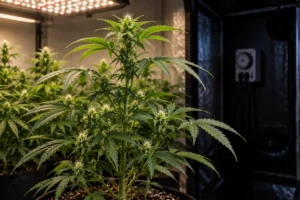
Photoperiod plants start flowering when you change the light schedule. Once the nights are long enough, expect the first signs within about a couple of weeks.
The stretch (weeks 1–3 of flower)
Right after the switch, plants grow fast. Height gain ranges from a modest bump to roughly doubling, depending on genetics. That range comes from grower experience, so don’t rely on a precise figure. The useful takeaway is headroom: leave space above the canopy before you flip the lights.
Bud development (mid-flower)
Growth slows and the plant puts its energy into flowers. Pistils, the small hair-like structures on the flowers, develop and change over time.
Ripening (late flower)
Calendar counting matters less here, and trichomes matter more. Trichomes are the tiny resin glands on the flowers. Some lower-leaf yellowing is expected at this point as the plant recycles nutrients.
That’s senescence, the normal aging of leaves, and it doesn’t always signal a problem. If yellowing shows up early or spreads quickly, why cannabis leaves turn yellow covers the possibilities.
How long flowering really lasts
Expect about 7 to 14 weeks, depending mostly on the cultivar. The flowering time on a seed pack is usually measured under near-ideal breeder conditions, and growers often report it running longer at home. Treat the number as a starting estimate. If you’re getting ready for the end, how to flush cannabis plants is worth reading first.
Autoflower flowering
Autoflowers move into flower on their own schedule, on whatever light cycle they’re already under. No switch is needed, and the full cycle from seed tends to be shorter and more fixed.
Harvest and beyond
From this point, stop counting weeks and start looking at the flowers. Trichomes are the most commonly used signal. Under magnification, they shift from clear to cloudy to amber. This is well-established grower practice rather than the result of a specific study, so treat the color stages as a guide, not a formula.
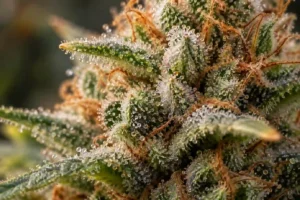
After harvest come drying and curing. Timing and technique are covered in when to harvest cannabis plants, how to harvest, and how to cut plants for harvest.
[Visual suggestion: clear / cloudy / amber trichome reference photos]
Autoflower vs. photoperiod timelines at a glance
Everything below repeats points made above, in one place.
| Photoperiod | Autoflower | |
| Germination and seedling | Same appearance | Same appearance |
| Veg length | Grower’s choice | Fixed by genetics |
| What triggers flowering | Long enough nights (light schedule) | Age and development |
| Light schedule needed to flower | 12/12 or similar | None; runs on its existing cycle |
| Overall timeline | Longer and more flexible | Shorter and more fixed |
FAQ
How long does it take to grow cannabis from seed to harvest?
Photoperiod plants commonly take about three to six months, and most of the variation comes from veg length. Autoflowers are usually shorter overall.
What week does cannabis start flowering?
It depends on the type. A photoperiod plant flowers after you change the light schedule, so the week is your choice. An autoflower flowers on its own, usually a few weeks after germination.
When should I switch to 12/12?
When the plant has reached the size you want, allowing for the stretch. Plants can grow up to roughly double in height after the switch, so leave headroom.
How can I tell if my plant is behind schedule?
Compare it to itself, not to a calendar. Steady new growth and healthy color are better signs than an exact week count.
When do cannabis plants show their sex?
Often somewhere between weeks 3 and 6, though timing varies a lot. Look for real pre-flowers at the nodes, not stipules.
Why hasn’t my plant started flowering after 12/12?
Give it a week or two, since the plant needs time to respond after the switch. If nothing changes, a light leak during the dark period is one possibility. The problems guide can help you narrow it down.
Do autoflowers need 12/12?
No. They flower on their own schedule under whatever light cycle they’re already on.
Can I harvest on the strain’s listed flowering date?
Use it as a rough guide only. Home growing often runs longer, so check the trichomes instead.
Is it normal for a plant to double in height during the stretch?
It can be, depending on genetics. This is why leaving headroom matters.
Are stipules the same as pre-flowers?
No. Stipules appear on every plant and don’t indicate sex. Pre-flowers form at the node and can.
Key takeaways
- Count from germination, and expect other sources to count differently.
- Germination and seedling timing varies, and a spread of several days is normal.
- Veg length is your choice on a photoperiod plant, not a deadline.
- Pre-flowers tell you sex, and stipules don’t.
- Flowering depends on uninterrupted darkness, which is why light leaks matter.
- Autoflowers follow their own genetics-driven clock.
- Let trichomes, not the calendar, decide when to harvest.
Note: This article is educational and focused on plant care. Cultivation laws vary by location, so check your local rules and official government sources. The site’s legal awareness page is a starting point.
Source:
-
Cockson, P., Landis, H., Smith, T., Hicks, K., & Whipker, B. E. (2019). Characterization of nutrient disorders of Cannabis sativa. Applied Sciences, 9(20), Article 4432. https://doi.org/10.3390/app9204432
-
Llewellyn, D., Golem, S., Jones, A. M. P., & Zheng, Y. (2023). Foliar symptomology, nutrient content, yield, and secondary metabolite variability of cannabis grown hydroponically with different single-element nutrient deficiencies. Plants, 12(3), Article 422. https://doi.org/10.3390/plants12030422
-
Lesilolo, M. K., Nkomo, M., & Moyo, M. (2024). Temperature effects on seed germination and seedling biochemical profile of cannabis landraces. Plants, 13(20), Article 2873. https://doi.org/10.3390/plants13202873
-
O’Brien, M. J., Reed, K., & Ferguson, R. (2022). Temperature limits for seed germination in industrial hemp (Cannabis sativa L.). Crops, 2(4), 29. https://doi.org/10.3390/crops2040029
-
Danziger, N., Bernstein, N., & others. (2023). Is twelve hours really the optimum photoperiod for promoting flowering in Cannabis sativa? Plants, 12(14), Article 2632. https://doi.org/10.3390/plants12142632
-
Jannat, A., & others. (2025). Transcriptomic analysis of CDL-gated photoperiodic flowering mechanisms in cannabis and their responsiveness to red:far-red ratios in controlled-environment agriculture. Frontiers in Plant Science, 16, Article 1586400. https://pmc.ncbi.nlm.nih.gov/articles/PMC12095668/
-
Hernandez, C., & others. (2025). Examining the “night break” method in Cannabis sativa horticulture: Vegetative daily light integral affects yield of extractable biomass in C. sativa. Horticulturae, 11(10), Article 1175. https://doi.org/10.3390/horticulturae11101175
-
Dowling, C. A., Shi, J., Toth, J., Quade, M., Smart, L. B., McCabe, P., et al. (2024). A FLOWERING LOCUS T ortholog is associated with photoperiod-insensitive flowering in hemp (Cannabis sativa L.). The Plant Journal, 118(5), 1203–1219. https://doi.org/10.1111/tpj.16691
-
Woods, C. A., & others. (2023). Comparative genomics of flowering behavior in Cannabis sativa. Frontiers in Plant Science, 14, Article 1220173. https://pmc.ncbi.nlm.nih.gov/articles/PMC10421669/
-
Corr, B. (2022). Growth & flowering. GrowerTalks. https://www.growertalks.com/Article/?articleid=25850
-
Cockson, P., Veazie, P., Logan, D., & Whipker, B. E. (2024, April 18). How to troubleshoot cannabis nutrient disorders. Cannabis Business Times. https://www.cannabisbusinesstimes.com/columns/cultivation-matters/news/15686755/how-to-troubleshoot-cannabis-nutrient-disorders
-
Cockson, P., Veazie, P., Logan, D., & Whipker, B. E. (2024, November 6). 3 tips to avoid nutrient lockout. Cannabis Business Times. https://www.cannabisbusinesstimes.com/nutrition-plant-health/cannabis-plant-nutrition/article/15690403/3-tips-to-avoid-nutrient-lockout
-
AROYA. (n.d.). Cannabis nutrient burn: Signs, causes, and solutions. https://aroya.io/education-guides/nutrient-burn
-
Grow Weed Easy. (2016, September 15). How to flush a sick cannabis plant. https://www.growweedeasy.com/flushing-sick-cannabis