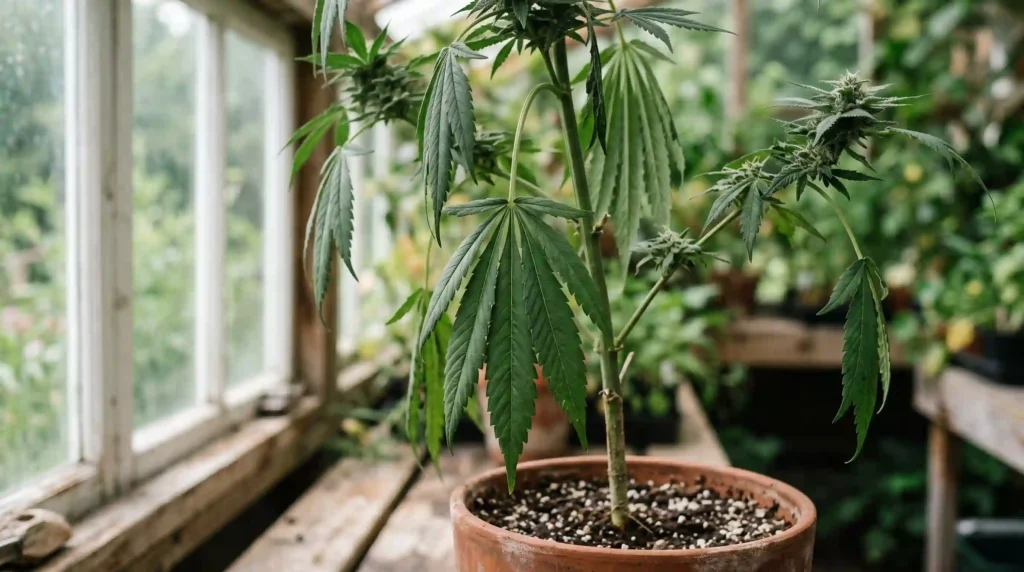
You checked your plants this morning and something looked off. The leaves are hanging down, the whole plant looks tired, and you are not sure what went wrong. A drooping cannabis plant is one of the most common concerns among beginner growers, and the good news is that in most cases, it is completely fixable once you identify the cause.
The tricky part is that drooping does not always mean the same thing. A plant droops for several different reasons, and treating the wrong cause can actually make things worse. Giving more water to an already overwatered plant, for example, is one of the most common beginner mistakes there is.
This guide is going to walk you through everything you need to know why cannabis plants droop, how to identify which specific cause is behind it, what to do to fix it, and how to prevent it from happening again. By the end, you will have a clear, confident plan of action.
What Does Drooping Actually Mean?
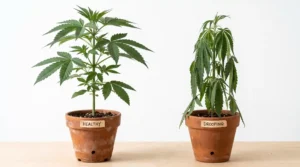
When a cannabis plant droops, its leaves and sometimes its stems lose their usual firmness and start sagging downward. Healthy cannabis leaves have what growers call “turgor pressure” the internal water pressure inside plant cells that keeps them rigid and upright. When something disrupts that pressure, either through too much water, too little water, heat, or other stressors, the leaves lose their stiffness and begin to hang.
Think of it like a balloon. When it is properly inflated, it holds its shape. Let some air out or overfill it to the point of strain and it starts to look wrong. Cannabis cells behave in a similar way. They need the right balance of water and air to stay firm.
Understanding this basic plant biology helps you read the signs more accurately. The way a plant droops, and what the rest of the plant looks like alongside it, tells you a lot about the underlying cause.
The Most Common Reasons a Cannabis Plant Droops
1. Overwatering — The Number One Culprit
Overwatering is by far the most frequent reason cannabis plants droop, especially among new growers. It seems counterintuitive you are giving the plant more of what it needs, so why is it suffering? The issue is not the water itself. It is the lack of oxygen.
Cannabis roots need both water and air to function properly. When soil is constantly saturated, the air pockets between soil particles fill with water, and the roots essentially begin to suffocate. This leads to a condition called root hypoxia, where the roots cannot absorb nutrients and water efficiently even though the soil is wet. The result is a plant that droops despite being surrounded by moisture.
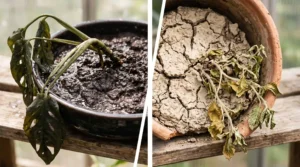
How overwatered drooping looks: The leaves droop downward but feel firm or slightly swollen, almost like they are heavy. The soil feels wet or damp well below the surface. The pot feels noticeably heavy when you lift it. You may also notice yellowing lower leaves over time if the problem continues.
The fix: Stop watering and let the soil dry out properly before watering again. Lift the pot when it feels light, that is usually a reliable indicator that the roots have used most of the available water. Going forward, water only when the top inch or two of soil is dry to the touch.
2. Underwatering — Less Common but Just as Damaging
On the other side of the spectrum, a plant that has not received enough water will also droop. This happens simply because the cells do not have enough water to maintain their pressure. Unlike overwatering, this version is usually easy to fix quickly.
How underwatered drooping looks: The leaves droop and also feel thin, papery, or limp almost wilted. The soil is bone dry, often pulling away from the edges of the pot. The pot feels very light when lifted. The plant may look dull rather than vibrant.
The fix: Water thoroughly and evenly until water drains from the bottom of the pot. Most plants recover within a few hours of proper watering. If the soil has become hydrophobic (water-repellent due to extreme dryness), try watering slowly in small amounts over time, or place the pot in a shallow tray of water for 20 to 30 minutes so the soil can absorb moisture from the bottom up.
3. Root Problems — When the Foundation Fails
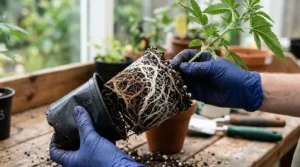
The roots are the foundation of a healthy plant. If they are damaged, diseased, or cramped, the plant above ground will show it through drooping and general decline.
Root bound: When a plant has outgrown its container, the roots become tangled and compacted. They circle the inside of the pot with nowhere to go, and the plant can no longer absorb water and nutrients effectively. Drooping is often the first visible sign.
Root rot: This is a fungal condition caused by consistently wet, poorly draining soil. Affected roots turn brown or dark and begin to decompose. The plant droops, often worsens even after watering, and may smell musty at the root zone. Root rot is serious and needs to be addressed quickly. The Royal Horticultural Society provides detailed guidance on identifying and managing root rot across plant species (https://www.rhs.org.uk/advice/profile?pid=221), which applies broadly to container-grown plants.
The fix for root bound: Transplant into a larger container with fresh soil, handling the roots gently.
The fix for root rot: Remove the plant from the pot, trim away any visibly dark or mushy roots with sterile scissors, and repot into fresh, well-draining soil. Reduce watering going forward and improve drainage.
4. Heat Stress — When Temperatures Get Too High
Cannabis plants prefer a moderate temperature range. When temperatures climb too high particularly above 85 to 90 degrees Fahrenheit (30 to 32 degrees Celsius) the plant can go into heat stress. It begins to lose water through its leaves faster than its roots can replace it, causing wilting and drooping.
How heat stress drooping looks: Leaves curl upward along the edges (sometimes called “taco-ing”) and then droop. The plant may look dry even if the soil is adequately moist. Damage is often worse on the upper leaves, which are closest to a heat source or direct sun.
The fix: Improve airflow, provide shade during peak heat hours, or move the plant to a cooler location. For indoor growers, check that grow lights are not too close to the canopy a common mistake that combines heat stress and light stress simultaneously.
5. Transplant Shock — A Temporary but Real Setback
Moving a plant from one container to another, or from indoors to outdoors, disrupts its root system. Roots that were settled into a familiar environment suddenly have to adjust. During this adjustment period, which can last anywhere from a few days to a week or more, the plant may droop as it works to re-establish itself.
How transplant shock drooping looks: The plant droops relatively soon after being moved or repotted. It may look generally unhappy but without any specific yellowing or pest damage. The soil moisture and conditions seem fine.
The fix: Be patient, keep the plant in stable, moderate conditions, avoid overwatering during recovery, and do not stress it further with heavy feeding or aggressive pruning. Most healthy plants bounce back on their own with minimal intervention.
6. Nutrient Issues — Too Much or Too Little
Nutrient deficiencies or toxicities can cause drooping, though this is usually accompanied by other visible signs like discoloration, spotted leaves, or unusual leaf curling. Nitrogen deficiency, calcium deficiency, and root lockout from excess fertilizer salts are among the more common nutritional causes of drooping.
For a deeper understanding of what your plant actually needs at each stage, the guide on What Is the Best Plant Food for Cannabis is a practical starting point.
7. Pests and Disease — Hidden Threats
Certain pests, particularly root aphids, fungus gnats, and spider mites in large populations, can cause systemic stress that leads to drooping. Fungal diseases affecting the stem base (such as stem rot or damping off) can block water and nutrient transport, causing the plant to wilt from the top down despite healthy-looking roots.
Always check the undersides of leaves for pests and inspect the soil surface for signs of fungus gnat larvae (tiny white worms in the top layer of soil) if you cannot identify any other cause. For a comprehensive look at these kinds of problems, the Cannabis Plant Problems & Solutions: Complete Troubleshooting Guide covers pest and disease diagnosis in detail.
How to Diagnose the Cause Step by Step
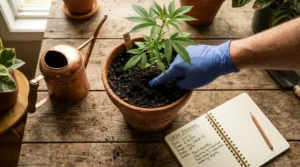
Rather than guessing, use this simple process to narrow down what is causing your plant to droop:
Step 1: Check the soil moisture. Push your finger two inches into the soil. Is it wet, moist, or dry? Wet and heavy suggests overwatering. Dry and pulling away from the pot edges suggests underwatering.
Step 2: Lift the pot. A heavy pot usually indicates too much water. A very light pot usually indicates it needs water.
Step 3: Examine the leaves closely. Are they firm and heavy (overwatering) or limp and papery (underwatering)? Are there spots, yellowing, or pest damage? Are the edges curling upward (heat)?
Step 4: Check the temperature and airflow. Is the environment hot, stuffy, or humid? Is the grow light too close to the canopy?
Step 5: Think about recent changes. Did you just transplant, feed heavily, change the light schedule, or experience a heat wave? Timing often provides a strong clue.
Step 6: Inspect the roots if needed. If soil moisture and environment seem fine, gently remove the plant from its container and look at the roots. White and firm is healthy. Brown, mushy, or dark indicates rot.
Working through these steps methodically removes the guesswork and saves you from applying the wrong fix.
Quick Reference: Drooping Causes at a Glance
- Overwatering: leaves droop but feel firm, soil is wet, pot is heavy
- Underwatering: leaves droop and feel limp, soil is dry, pot is light
- Heat stress: leaves curl upward and droop, upper canopy most affected
- Root bound: gradual drooping, slow growth, roots visible at drainage holes
- Root rot: drooping worsens despite watering, musty smell, dark roots
- Transplant shock: drooping shortly after repotting, otherwise stable conditions
- Pests or disease: drooping alongside visible damage, spots, or surface larvae
Common Beginner Mistakes That Lead to Drooping
Watering on a fixed schedule instead of reading the plant. Many beginners water every two days no matter what. Every plant, pot size, and environment is different. Water based on soil dryness, not the calendar.
Using pots without drainage holes. Water collects at the bottom with nowhere to go, creating a permanently wet root zone. Always use containers with drainage.
Overfeeding in an attempt to help a struggling plant. When a plant looks stressed, the instinct is to give it more more water, more nutrients. Often this makes things worse. A drooping plant that already has nutrient issues will be further harmed by additional fertilizer salts.
Not observing the plant regularly. Drooping usually develops gradually before it becomes severe. Growers who check their plants daily catch problems early. Those who check once a week often find a plant that has been struggling for days.
Ignoring the pot weight as a watering guide. Lifting the pot before and after watering teaches you what a well-watered versus a dry pot feels like. It is one of the simplest and most reliable tools available, and most beginners overlook it completely.
Pro Tips From Experience
Consistent observation is the single most valuable habit you can develop. Plants communicate constantly through their appearance color, texture, posture, and smell. The more time you spend around your plants, the faster you recognize when something is off.
When in doubt, do less. Many plant problems are caused by too much intervention rather than too little. If the cause is not obvious, wait 24 hours before making changes. Sometimes plants droop temporarily in the afternoon heat and recover by morning with no action needed at all.
Keep a simple grow journal. Note when you water, what you feed, temperature ranges, and any observations about the plant. Patterns become clear quickly, and you will develop a much better intuition for what your plants need. The University of Florida’s IFAS Extension has solid guidance on container plant care fundamentals (https://edis.ifas.ufl.edu/publication/EP282) that applies directly to managing soil moisture and root health in potted plants.
If you are just getting started and want to build this kind of intuition from the ground up, the Cannabis Plant: Complete Beginner to Advanced Guide provides a thorough foundation.
Important Considerations
Environment Affects Everything
Temperature, humidity, and airflow all influence how quickly your soil dries out and how efficiently your plant can use water. A plant in a hot, dry environment needs water more frequently than the same plant in a cool, humid one. Adjust your care based on actual conditions, not assumptions.
Drooping Is a Symptom, Not a Disease
It is easy to fixate on the drooping itself, but drooping is always a symptom of something else going on. Once you address the root cause, drooping resolves on its own in most cases. If a plant continues to droop after you have corrected an obvious issue, keep looking there may be a secondary cause at play.
Healthy Roots, Healthy Plant
Almost every case of chronic drooping traces back to root health in some way. Whether it is overwatering, root rot, root binding, or poor drainage, the roots are usually involved. Taking care of your root zone giving it proper drainage, the right moisture cycle, and enough space prevents the majority of drooping issues before they start. Understanding How to Care for a Cannabis Plant from the beginning makes this much easier to manage.
When Drooping Combines With Other Problems
If your plant is drooping and also showing signs of stunted growth, you may be dealing with multiple overlapping issues. The guide on [Why Is My Cannabis Plant Not Growing] can help you work through situations where both problems appear together.
Frequently Asked Questions
Why is my cannabis plant drooping in the morning but looking fine by evening? This can sometimes be normal if temperatures drop overnight and the plant rehydrates during cooler hours. However, if it is consistent, it often points to overwatering the roots are struggling to transport water efficiently. Check soil moisture carefully and consider watering less frequently.
Can a drooping cannabis plant recover fully? In most cases, yes. Plants are resilient, and drooping caused by watering issues, heat stress, or transplant shock usually resolves within hours to a few days once the cause is corrected. Root rot cases are more serious but can still recover if caught early and treated properly.
How often should I water to avoid drooping? There is no universal schedule. Water when the top one to two inches of soil are dry, or when the pot feels noticeably lighter than it did after the last watering. Frequency depends on pot size, plant size, soil type, temperature, and humidity.
Does drooping always mean something is wrong? Not always. Some drooping in the final hours before lights-off in an indoor setup is relatively common and often not a concern. Brief afternoon drooping during very hot days can also be temporary. Persistent drooping that does not recover on its own is the sign to investigate.
Can I fix root rot without repotting? It is difficult. Root rot typically requires removing the plant, trimming affected roots, and placing it into fresh, well-draining soil. Simply adjusting watering while the plant stays in the same damaged soil rarely resolves the infection. Acting quickly and repotting gives the plant the best chance of recovery.
Final Thoughts
A drooping cannabis plant is one of the clearest signals your plant can give you that something needs attention. The causes range from simple watering mistakes to more complex root problems, but with a methodical approach, most situations are diagnosable and fixable without much difficulty.
The most important things to remember are: check the soil before you water, lift the pot to gauge moisture, observe the whole plant rather than just the drooping leaves, and make one change at a time so you can see what is actually working.
Drooping caused by overwatering is fixed by giving the plant time to dry out. Drooping from underwatering is fixed with a thorough drink. Heat stress needs airflow and cooler conditions. Root problems need drainage, space, and sometimes repotting. Each cause has a specific, practical fix and none of them require guesswork once you know what to look for.
For broader guidance on keeping your plant healthy at every stage, the resources at Cannabis Plant Care offer practical, experience-based information that builds on everything covered here. With a little patience and consistent observation, most drooping issues resolve completely and your plant will be back to standing tall before long.
Legal disclaimer: Cannabis cultivation laws vary by country, state, and region. This article is written for educational and informational purposes only. Always verify what is permitted in your area before growing any plant.