Important Notice: This article is strictly educational and intended for adult readers in regions where cannabis cultivation is legal. Laws and regulations vary by location — always verify what is permitted in your specific area before growing or handling cannabis plants. This guide contains no legal or medical advice.
Most people assume plants only do their important work when the sun is out. You can see them reaching toward the light, their leaves soaking in all that energy — so naturally, it feels like night is just downtime. A rest period. Nothing much happening.
But that assumption is only half right. And for cannabis plants specifically, the night period is far more important than it looks from the outside.
If you have ever wondered what cannabis plants do at night, whether they keep growing in the dark, or what time of day plants grow the most — this guide answers all of it. We will walk through the plant biology clearly, explain why the dark period matters so much for cannabis in particular, and help you understand how light and darkness together drive the full growth cycle.
No complicated science jargon. Just a clear, honest explanation of what is actually going on inside the plant when the lights go out.
What Actually Happens to a Cannabis Plant at Night?
Here is the short answer: yes, cannabis plants do grow at night. But the way they grow at night is fundamentally different from what they do during the day.
To understand why, you need to know about two separate biological processes happening inside the plant — photosynthesis and respiration. These two processes essentially run in opposite directions, and they take turns depending on whether light is available.
Photosynthesis — The Daytime Engine
During daylight hours, cannabis plants are running on photosynthesis. This is the process where the plant uses light energy to convert carbon dioxide from the air and water from the roots into glucose — a simple sugar the plant uses as fuel for everything it does. It is essentially the plant making its own food using sunlight as the power source.
Photosynthesis is why light is so central to plant growth. Without it, the plant cannot produce the energy it needs to build new cells, develop roots, produce flowers, or do anything else. Think of it like charging a battery. The plant spends its daylight hours charging up by capturing as much light energy as it can.
Cellular Respiration — The Nighttime Worker
Once the lights go out, photosynthesis stops. But the plant does not shut down. Instead, it shifts over to cellular respiration — the process of converting the stored glucose from the day into usable energy at the cellular level.
This is where the actual growing happens. Cells divide. New tissue forms. Root systems extend. Stems and leaves expand. Much of this structural development relies on the energy the plant produced during the day but uses at night.
So to put it simply: the plant charges during the day, and builds during the night. Both halves of the cycle are essential. Remove either one and the plant suffers.
This is also why questions like “when do plants grow the most, day or night?” do not have a clean single answer. The plant is doing different but equally important work during each period. The most visible cellular growth — the actual division and elongation of cells — happens primarily during the dark period. But that growth is only possible because of what the plant captured in the light.
Why the Dark Period Is Especially Critical for Cannabis
For most garden plants, the division between light and dark is fairly straightforward. But for cannabis, the dark period carries an additional layer of importance that most beginners do not immediately realise.
Cannabis is what botanists call a photoperiod-sensitive plant. This means that the ratio of light hours to dark hours — not just the total amount of light — is what signals the plant to move from one stage of its lifecycle to another.
Specifically, it is the length of the uninterrupted dark period that triggers the transition from vegetative growth into flowering.
In nature, cannabis plants spend their spring and summer growing leaves, stems, and roots while the days are long. As autumn approaches and nights get longer, the plant detects that shift through a light-sensitive protein called phytochrome. When the dark period becomes long enough — typically around 12 hours or more — the plant interprets this as a signal that winter is coming. In response, it stops focusing on growth and starts putting everything into reproduction: producing flowers.
Indoor growers recreate this by manually switching from an 18/6 light schedule (18 hours of light, 6 hours of dark) during the vegetative stage, to a 12/12 schedule (equal light and dark periods) to trigger flowering. This is one of the most fundamental aspects of managing cannabis growth. If you want to understand more about how this connects to each stage of the plant’s life, our Cannabis Growth Stages and Harvest Guide walks through the full lifecycle in detail.
Light Leaks Are a Serious Problem
Because the dark period triggers flowering for photoperiod cannabis, any interruption to that darkness — even a brief burst of light from a phone screen, a gap in a tent, or a timer that is slightly off — can confuse the plant’s hormonal signalling. This can cause plants to revert back to vegetative growth, slow down flowering, or in some cases develop hermaphroditic traits (where a female plant produces male pollen sacs alongside female flowers).
This is not a casual concern. Growers who carefully manage every other aspect of their environment and then overlook light leaks often end up puzzled by erratic or disappointing results. Complete, uninterrupted darkness during the dark period is non-negotiable for photoperiod cannabis in flower.
What Time of Day Do Plants Grow the Most?
This is one of the most commonly searched questions about plant biology, and the answer is more nuanced than most sources let on.
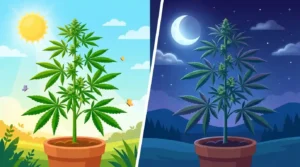
Research on various plant species — including cannabis — consistently shows that the peak of elongation growth (the kind that makes stems taller and leaves bigger) happens during the night or during the transition period just before and after dawn. This is partly driven by cellular activity during the dark period and partly because lower nighttime temperatures affect the hormonal balance in plants in ways that support certain growth patterns.
However, it is important not to over-simplify this. The plant does not choose one time to do all its growing and then rest the remainder. What is more accurate to say is that:
- Energy production (photosynthesis) peaks during the light period, roughly proportional to light intensity
- Cellular division and elongation tend to be highest during the dark period and early morning transition
- Root growth is largely continuous but tends to be more active at night when the plant is not directing energy to leaf processes
The takeaway for practical growing is that both periods genuinely matter, and disrupting either one — whether by giving insufficient light during the day or insufficient darkness at night — will cost the plant something it cannot easily make up for.
Understanding the relationship between light and dark is also closely connected to the broader question of what ideal conditions for cannabis growth actually look like at each stage. Temperature, humidity, and air circulation all behave differently during the dark period, and managing those variables correctly at night is just as important as managing them during the light period.
Does Music Help Cannabis Plants Grow?
It is a question that comes up more often than you might expect. Do plants grow better with music? Is there any truth to it?
The honest answer is: there is some genuinely interesting science here, though it is far from settled. A number of studies have explored the effects of sound waves on plant growth — particularly at specific frequencies — and some have found that certain sound exposures can stimulate germination rates, enzyme activity, or shoot growth in various plant species. The theory is that sound waves create physical vibrations that may influence cellular processes.
However, it is worth being clear about the limitations. Most of this research is still exploratory, the results are not consistent across species or conditions, and the practical application to home growing has not been reliably demonstrated. The idea that playing classical music in a grow room produces meaningfully better plants is not something the current science confirms with confidence.
What is clear is that acoustic stress — sustained loud noise or vibration — can have negative effects on plants. So while gentle music is unlikely to harm anything, the idea of it being a reliable growth accelerator sits more in the realm of interesting curiosity than practical advice.
If you are looking for reliable ways to improve plant development, focusing on the fundamentals — proper light cycles, temperature stability, good watering practices, and appropriate nutrition — will produce far more consistent results. Our guide on how to care for cannabis plants covers those fundamentals in detail.
How Light Schedules Actually Work in Practice
For anyone new to growing cannabis, the light schedule concept can feel abstract until you see how it connects to the plant’s actual behaviour. Let us walk through it practically.
Vegetative Stage: 18 Hours Light, 6 Hours Dark
During the vegetative phase, cannabis plants want as much light as they can get — up to a point. The standard indoor schedule is 18 hours of light followed by 6 hours of complete darkness. This long light period mimics summer days and keeps the plant in its growth phase, building stems, leaves, branches, and root mass. The plant is not yet focused on reproduction.
The 6-hour dark period still matters during this stage. Cellular processes that require darkness — including the recycling of certain proteins involved in photosynthesis — happen during this window. Growers who have experimented with running plants at 24 hours of light with no dark period have generally found that while plants can survive this, it does not necessarily produce better growth, and some plants show signs of stress.
Flowering Stage: 12 Hours Light, 12 Hours Dark
When the light schedule switches to 12/12, the cannabis plant detects that long dark period and begins its hormonal transition into flowering. This is a fundamental shift — the plant largely stops building new vegetative structure and redirects its energy into developing flowers.
The 12-hour dark period here is not just darkness. It is the trigger for one of the most significant biological transitions in the plant’s life. Getting it wrong — through light leaks, timer failures, or inconsistent schedules — can and does cause real problems.
Autoflowering Plants: A Different Story
Autoflowering cannabis varieties are a separate case. These plants flower based on age rather than light schedule. They carry genetics from Cannabis ruderalis, a subspecies that evolved in northern latitudes where the growing season is short and unpredictable. Because of this, autoflowering plants do not depend on a 12/12 light schedule to trigger flowering — they transition automatically, typically around 3–5 weeks from germination.
This makes autoflowering plants significantly more beginner-friendly from a light management standpoint. Many growers run them at 18–20 hours of light for their entire life cycle, which the plant handles well. Even with this flexibility, the plants still rest and perform cellular processes during the dark hours and benefit from a consistent cycle.
If you are still deciding which type of cannabis plant to start with, our Cannabis Seeds Guide has a full breakdown of seed types, including the differences between photoperiod and autoflowering genetics.
Night Temperature and Humidity: What Most Beginners Overlook
One of the most practical things to understand about the dark period is that environmental conditions at night are just as important as those during the day — and they are often managed less carefully.
Temperature Drop at Night
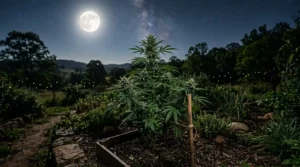
Cannabis plants can handle a moderate temperature drop during the dark period. A drop of around 5–10°C (about 9–18°F) compared to the light period is generally considered acceptable and can even benefit certain processes, particularly during late flowering. However, a swing of more than 10°C is where problems begin. Too large a temperature differential can stress the plant, slow down nighttime metabolic processes, and — particularly in flowering — contribute to condensation on leaves and buds, which raises mould risk.
This is one of the reasons growers measure temperature at canopy level during both the light and dark periods rather than just checking the room during the day. A grow space that is at a comfortable 24°C during the day might drop to 14°C overnight if there is no heating, and that gap will show up in plant performance over time.
Humidity at Night
Humidity management during the dark period deserves particular attention during the flowering stage. When the lights go off, transpiration slows and water vapour stays in the air longer without the warmth of the lights driving air movement. This means relative humidity tends to rise naturally at night.
During vegetative growth this is less of a concern. During flowering — especially in the final weeks when buds are dense — this nighttime humidity rise is one of the primary conditions under which botrytis (bud rot) establishes and spreads. Keeping relative humidity below 50% during flowering and using a fan or dehumidifier during the dark period can prevent a significant amount of heartache. For more on recognising and managing plant health problems, our Cannabis Plant Problems and Solutions guide covers the most common issues growers encounter, including mould.
Quick Summary: What Cannabis Plants Do at Night
- Plants cannot photosynthesize in darkness — energy production stops when the lights go out
- Cellular respiration continues, converting stored glucose into energy for growth
- Cell division and elongation — the processes that make plants taller and larger — happen primarily during the dark period
- Root development continues through the night and is often most active during darkness
- For photoperiod cannabis, the length of the uninterrupted dark period controls whether the plant is in vegetative or flowering mode
- Light leaks during the dark period can disrupt hormonal signalling and cause real problems in flowering plants
- Night temperature and humidity still need to be managed — the dark period is not a break from environmental responsibility
Pro Tips From Experience
A few things that beginners consistently get wrong around the light and dark cycle — and how to avoid them.
Do not check on flowering plants during the dark period. It is tempting to peek in and see how things are going. A brief flash of light at 2am might feel harmless, but repeated interruptions to the dark period accumulate. Use a timer, trust it, and wait until the lights come on.
Invest in a quality timer before anything else. Mechanical timers are cheap and unreliable. A digital timer with a battery backup is worth the small extra cost. An inconsistent light schedule causes far more problems than most beginners realise.
Measure temperature and humidity at night as well as during the day. Many beginner growers only check conditions when the lights are on. Set up a min/max thermometer and hygrometer that records overnight readings, or use a basic data logger. You will often find that your nighttime environment is quite different from what you assumed.
Give autoflowering plants a dark period even if it is not strictly required. Running autoflowering plants at 24 hours of light is possible but not particularly advisable. A consistent 20/4 or 18/6 schedule still gives the plant a genuine rest period, which many growers believe supports healthier long-term development.
Do not confuse nighttime leaf drooping with overwatering. Cannabis leaves often droop slightly at night as the plant reduces water uptake and relaxes transpiration. This is entirely normal and reverses once the lights come on. Overwatering has a different signature — the leaves droop during the light period and do not recover even with lights on. Knowing the difference saves a lot of unnecessary adjustment.
If you want to build a strong foundation in managing your plant’s environment across every growth stage, our dedicated guide on ideal conditions for cannabis growth is the logical next step.
Common Beginner Mistakes Related to Light and Dark
Assuming the dark period is unimportant. Some beginners manage the light period carefully and then ignore the dark period entirely — running lights on uneven schedules, letting light leaks go unfixed, or skipping humidity checks at night. The dark period is half the cycle. It needs the same attention.
Switching to 12/12 too early or too late. There is no universal “right” time to flip the light schedule and trigger flowering. The decision should be based on the plant’s current size, the available space, and the grower’s goals. Flipping too early produces small plants with limited yields; flipping too late in a limited space leads to plants that outgrow their environment during the flowering stretch. Understanding the relationship between vegetative development and flowering timing is covered in detail in our Cannabis Growth Stages and Harvest Guide.
Not accounting for the flowering stretch. Many photoperiod cannabis plants will continue growing significantly in height for the first 2–3 weeks after the light switch. This is called the stretch. Growers who flip the light at the last possible moment often end up with plants that hit the ceiling before flowering is complete.
Leaving the grow space unventilated during the dark period. Turning fans off at night to reduce noise is a common beginner choice that often causes regret. Mould thrives in warm, stagnant air. Keep air moving at night, even at a reduced rate.
Important Considerations
Everything described in this article applies to growers in jurisdictions where cannabis cultivation is legal for adults. Cannabis laws differ significantly between countries, states, and even municipalities. In some areas, cultivation is permitted for personal use with specific plant limits; in others, any cultivation is prohibited regardless of intent.
This guide does not encourage illegal activity of any kind. If you are curious about the legal landscape in your region, our Cannabis Basics and Legal Awareness section is a helpful starting point for understanding the general framework — though you should always verify current local rules from an up-to-date, jurisdiction-specific source.
Frequently Asked Questions
Do cannabis plants actually grow at night?
Yes, cannabis plants continue to grow during the dark period. While photosynthesis — which requires light — stops when the lights go out, cellular respiration continues and the plant uses stored energy to divide cells, extend roots, and develop new tissue. Much of the visible physical growth, including stem elongation, happens primarily during the dark period.
What do cannabis plants do at night during the flowering stage?
During flowering, the dark period serves a particularly important role. It is the length of the uninterrupted dark period that tells photoperiod cannabis to continue flowering rather than reverting to vegetative growth. The plant’s flower development continues during darkness as it uses the energy stored from the light period. This is also when humidity management becomes most critical, as dense buds in a dark, potentially humid environment are vulnerable to mould.
What time of day do plants grow the most?
Most of the structural growth in plants — cell division and elongation — happens during the dark period and the early morning transition back into the light. Daytime is primarily about energy production through photosynthesis. So both periods are essential, but if you are asking when the physical building blocks of growth are being assembled, that work happens predominantly at night.
Can I leave my cannabis plants in complete darkness for longer than 12 hours?
For autoflowering plants, longer dark periods are generally not beneficial and simply reduce the total light available for energy production. For photoperiod cannabis, a dark period longer than 12 hours will still maintain or deepen the flowering response, but it also reduces daily photosynthesis. In practice, most growers stick with a 12/12 schedule for flowering photoperiod plants as it balances flowering induction with adequate light for continued bud development.
Do plants grow better with music?
Some research has explored whether sound waves at specific frequencies can influence plant growth, and a few studies have found modest effects on germination or shoot activity in certain plant species. However, the science is not settled and the results are not consistent enough to rely on for practical growing decisions.
There is no reliable evidence that playing music in a grow room produces meaningfully better cannabis plants. Your time is better spent optimising light cycles, temperature, humidity, and watering practices, all of which have clear and well-documented effects on plant development.
Final Thoughts
The idea that plants only work when the lights are on is a reasonable assumption, but it is not how plant biology actually works. Cannabis plants are running two complementary processes — one that requires light, one that requires darkness — and both are genuinely necessary for healthy development.
Understanding what cannabis plants do at night helps you make better decisions about your entire growing environment. It explains why light leaks matter so much, why nighttime temperature and humidity still need monitoring, why autoflowering plants differ from photoperiod varieties, and why the dark period is not wasted time but an essential phase in the plant’s growth cycle.
The most successful growers treat the 24-hour period as a complete unit. Day and night together form one cycle — and every cycle builds on the last.
If you want to keep building on this foundation, explore our step-by-step guide on how to grow cannabis for a full walkthrough of the growing process, or check out our plant care guide for detailed advice on watering, feeding, and environmental management across every stage.
Educational content only. This article does not constitute legal or medical advice. Laws and regulations related to cannabis vary by location — always check your local rules before growing or handling cannabis plants.