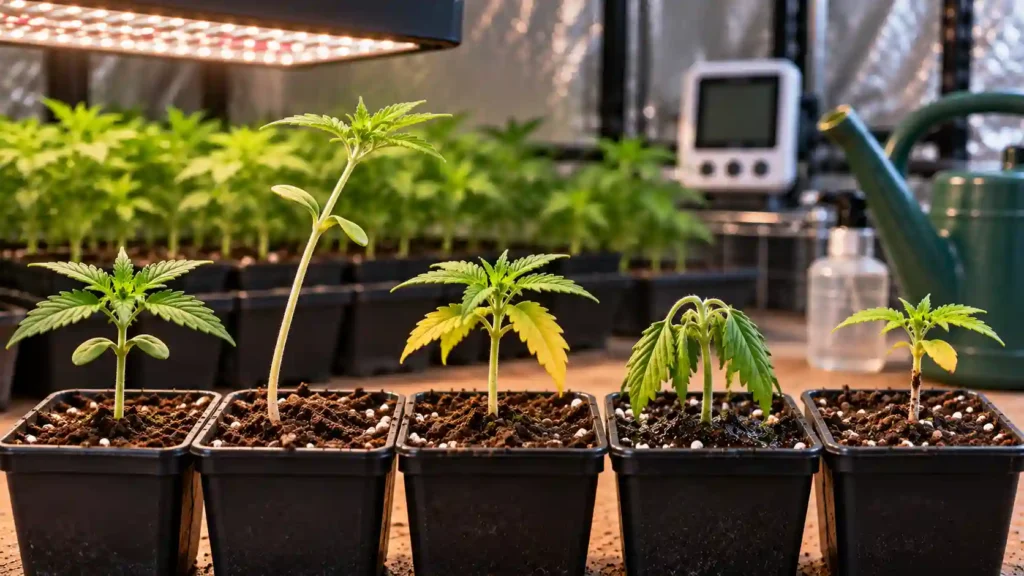
Cannabis seedlings can change quickly. One day they look healthy and upright; a few days later, they may be tall and weak, yellowing, drooping, or barely growing. The difficult part is that several different problems can produce similar symptoms.
The best approach is to diagnose before you treat. Instead of immediately adding nutrients, increasing light, or changing the watering routine, look at the whole picture: the leaves, stem, growing medium, roots, light, moisture, temperature, and recent changes.
This guide covers the most common cannabis seedling problems, including stretching, damping-off, yellow leaves, slow growth, and moisture-related stress. The goal is not to give you a one-size-fits-all recipe. It is to help you identify what the plant is actually telling you.
What a Healthy Cannabis Seedling Should Look Like
Before diagnosing a problem, establish a baseline.
A healthy young cannabis seedling should generally have:
- An upright, firm stem
- Green cotyledons and emerging true leaves
- New leaves that gradually increase in size
- A stem that supports the plant without obvious collapse
- Growing media that is moist but not continuously saturated
- Roots developing without persistent waterlogging
- Steady new growth rather than repeated wilting or decline
The first true leaves may look different from later leaves as the plant develops. A cotyledon can also yellow and decline naturally as the seedling moves beyond its earliest stage. A single older leaf changing color does not automatically mean the plant has a nutrient deficiency.
The key question is whether new growth looks healthy and whether the symptom is progressing.
Plant health problems rarely have only one possible cause. Penn State Extension’s seedling diagnostic guidance, for example, lists inadequate light, insufficient nutrition, cool conditions, excessive moisture, compact media, root problems, and disease among possible causes of poor seedling growth.
Cannabis Seedling Problems at a Glance
| Symptom | What to check first | Common possibilities |
| Tall, thin, leaning stem | Light reaching the seedling | Insufficient or poorly positioned light |
| Stem collapsing near soil line | Stem tissue and moisture | Damping-off or severe root-zone problems |
| Yellow cotyledons | Age and new growth | Normal aging or developing stress |
| Yellow true leaves | Pattern and root-zone conditions | Nutrient, moisture, light, temperature, or root problems |
| Very slow growth | Roots, light, temperature, moisture | Several possible causes |
| Drooping with wet media | Root-zone moisture | Overwatering, poor drainage, root stress |
| Drooping with very dry media | Moisture availability | Underwatering |
| Dark, soft, unhealthy-looking seedling | Stem and roots | Moisture/root disease or other stress |
Use this as a starting point, not a diagnosis. A symptom by itself rarely identifies the cause.
1. Cannabis Seedlings Stretching
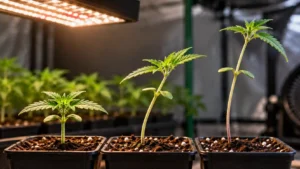
Stretching is one of the easiest seedling problems to recognize.
The seedling develops a long, thin stem and may lean toward the available light. The distance between the cotyledons and newer leaves can become noticeably larger than expected, and the plant may look weak compared with a compact seedling.
Why do cannabis seedlings stretch?
Insufficient light is a common cause.
Young seedlings respond to inadequate light by directing more growth toward the available light source. University of Maryland Extension notes that seedlings grown with insufficient light can stretch and lean toward the light, producing weaker growth.
The important point is that “more light” does not automatically mean “maximum light.” Light intensity, duration, spectrum, distance, and the plant’s ability to tolerate the environment all interact.
What to check
Before changing anything, ask:
- Is the seedling clearly leaning toward the light?
- Is the stem becoming longer while new leaves remain relatively small?
- Is the light source positioned far from the plant?
- Is another environmental factor slowing development while stem elongation continues?
- Did the stretching begin after a change in lighting?
If the pattern strongly points toward insufficient light, make a gradual, controlled adjustment rather than making several environmental changes at once.
A stretched seedling is also more vulnerable to physical damage because its stem may not provide enough support. Avoid repeatedly moving, bending, or handling it.
For broader context on diagnosing cannabis plant drooping and environmental stress, see Why Is My Cannabis Plant Drooping?.
2. Cannabis Seedling Damping-Off
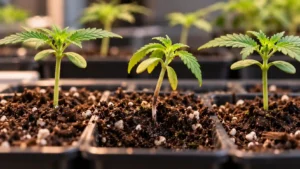
Damping-off is different from ordinary overwatering.
It is a group of seedling diseases associated with several soilborne pathogens, including Pythium, Rhizoctonia, Fusarium, and Phytophthora. Depending on the pathogen and timing, seeds may rot before emergence or young seedlings may develop stem and root damage and collapse.
What does damping-off look like?
Look closely at the area where the stem meets the growing medium.
Warning signs can include:
- A soft or water-soaked stem
- Discoloration near or below the soil line
- A narrowed or constricted stem
- Sudden wilting
- Seedling collapse
- Brown or damaged roots
- Multiple nearby seedlings developing similar symptoms
Penn State describes post-emergence damping-off as stem rot at or just below the soil line, with affected seedlings potentially discoloring, wilting, collapsing, and dying.
Is damping-off caused by overwatering?
Not exactly.
Overly wet conditions can increase damping-off risk, but damping-off itself is a disease problem involving pathogens. Excess moisture, poor drainage, overcrowding, and other unfavorable conditions can create an environment where these pathogens become more damaging.
That distinction matters because simply reducing watering does not necessarily solve an established disease problem.
If one seedling collapses while others remain healthy, inspect the stem and root zone rather than assuming the entire problem is a normal watering mistake.
3. Yellow Leaves on Cannabis Seedlings
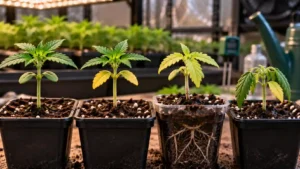
Yellow leaves are among the most misleading cannabis seedling symptoms.
Many growers immediately think nitrogen deficiency, but yellowing can result from several different problems.
Possible causes include:
- Natural aging of cotyledons
- Excess moisture and root stress
- Poor or inadequate nutrition
- Unsuitable root-zone conditions
- Insufficient light
- Temperature stress
- Root disease
- Other environmental problems
Penn State’s plant-health diagnostic guide lists multiple possible causes for yellowing, including fertility problems, light conditions, overwatering, root rot, and natural aging.
Start with the location of the yellowing
Ask:
Are the cotyledons yellowing while the true leaves remain healthy?
That can be a normal part of early development.
Are newly developing leaves yellow?
That deserves closer inspection of light, roots, nutrition, and the growing environment.
Are several leaves yellowing at the same time?
Look for a common environmental cause before assuming a single nutrient deficiency.
Is yellowing accompanied by wilting or a constantly wet medium?
Investigate the roots and moisture conditions first.
The pattern is more useful than the color alone.
For a broader nutrient reference, see the Cannabis Nutrient Deficiency Chart. For root-zone chemistry, see Cannabis pH Problems & Nutrient Deficiency.
4. Cannabis Seedlings Growing Slowly
Slow growth is another symptom with many possible explanations.
A seedling may remain green but produce very little new growth. Another may look slightly pale, remain small, and appear stuck at the same stage.
Instead of asking, “What nutrient is missing?” ask:
What factor is limiting the seedling right now?
Possible limiting factors include:
- Insufficient light
- Cool conditions
- Excessive moisture
- Insufficient moisture
- Poor drainage
- Compacted growing media
- Root damage
- Nutritional problems
- Unsuitable pH
- Disease
Penn State’s diagnostic framework specifically identifies inadequate light, insufficient fertilizer, cool conditions, excessive or insufficient moisture, compact soil, and damping-off among possible causes of poor seedling development.
Look at the roots before adding more nutrients
A seedling with unhealthy roots may struggle to use available water and nutrients properly.
If the medium stays saturated for long periods, the root zone can become unfavorable for root development. University of Maryland Extension recommends keeping seedling media moist rather than continuously wet and notes that saturated media can stop root growth and favor damping-off pathogens.
Adding more fertilizer to a plant whose real problem is root stress can make diagnosis harder rather than easier.
Overwatered vs. Underwatered Cannabis Seedlings
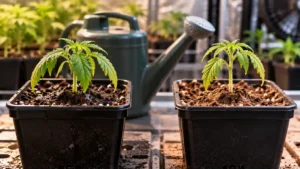
These problems can look surprisingly similar.
Both can cause:
- Drooping
- Slow growth
- Poor leaf posture
- Reduced vigor
The growing medium provides an important clue.
| Sign | Possible overwatering/root stress | Possible underwatering |
| Growing medium | Remains wet for too long | Becomes very dry |
| Drooping | Can occur despite wet media | Often occurs with dry media |
| Root-zone concern | Poor aeration, root damage | Insufficient water availability |
| Growth | Often slows | Can slow |
| Next step | Inspect drainage and watering pattern | Correct moisture availability |
Do not diagnose from leaf posture alone.
If the plant is drooping and the medium is still very wet, adding more water is unlikely to address the underlying problem.
If the medium is genuinely dry and the plant improves after appropriate watering, insufficient moisture becomes more plausible.
For a deeper comparison, see Overwatered vs. Underwatered Cannabis.
A Simple Cannabis Seedling Diagnostic Workflow
When a seedling suddenly looks unhealthy, use this sequence:
1. Observe
Do not change anything immediately.
Look at:
- Leaves
- Stem
- Soil line
- Growing medium
- Overall posture
- New growth
- Roots, if they can be inspected without damaging the plant
Take a photo if possible. Comparing today’s appearance with the plant 24–48 hours later can reveal whether a symptom is progressing.
2. Check the root zone
Ask:
- Is the medium staying saturated?
- Does the container drain properly?
- Is the surface crusted or compacted?
- Does the container remain wet unusually long?
- Are there signs of root discoloration or decay?
The root zone is easy to overlook because the problem is hidden below the surface.
3. Check light
Look for a relationship between the symptom and the light source.
A seedling stretching toward its light has a different diagnostic pattern from one showing yellowing and root-zone stress. Avoid changing light, water, nutrients, and temperature simultaneously. If everything changes at once, you lose the ability to determine what actually helped.
4. Check moisture history
Do not ask only, “Is the soil wet right now?”
Ask:
How long has it been wet?
The duration and pattern of moisture matter. A container that remains saturated repeatedly presents a different situation from one that was recently watered and is draining normally.
5. Check the stem at the soil line
This is especially important when a seedling is collapsing.
A healthy-looking upper portion with a damaged, constricted, or discolored stem near the medium can point toward damping-off rather than ordinary underwatering.
6. Review recent changes
Think back over the previous few days:
- Was the light moved?
- Was watering frequency changed?
- Was fertilizer introduced?
- Was the seedling transplanted?
- Did temperature change?
- Did the medium change?
- Did several seedlings develop the same symptom?
A symptom appearing shortly after a major change can provide useful diagnostic evidence.
7. Correct one major factor at a time
This is one of the most useful troubleshooting rules.
If you simultaneously change lighting, watering, nutrients, temperature, humidity, and growing medium, you may temporarily improve the plant without learning why it was struggling.
Make the smallest reasonable correction supported by your observations, then monitor new growth.
Symptoms That Can Look Like Something Else
Seedling problems frequently overlap.
Stretching vs. weak growth
A tall seedling is not necessarily unhealthy because it is “hungry.” If the plant is elongating toward the light, investigate lighting before adding fertilizer.
Yellow leaves vs. nutrient deficiency
Yellowing is a symptom, not a diagnosis. Root problems and environmental stress can interfere with normal growth and produce nutrient-like symptoms.
Drooping vs. underwatering
Drooping does not automatically mean the plant needs water. Check the medium first.
Damping-off vs. overwatering
Wet conditions can favor damping-off, but damping-off involves disease-causing organisms. Look for stem and root symptoms rather than diagnosing the problem from moisture alone.
Slow growth vs. nutrient deficiency
A small seedling may be limited by light, temperature, roots, moisture, nutrition, or disease. Fertilizer is only one possibility.
Common Mistakes When Troubleshooting Seedlings
Giving nutrients immediately
A yellow leaf often triggers an automatic fertilizer response. That can be premature. First determine whether the problem is nutritional, environmental, or root-related.
Watering because the plant is drooping
Always check the growing medium before adding water.
Changing everything at once
This makes the situation harder to diagnose and can introduce additional stress.
Ignoring the soil line
A damaged stem at the soil line can provide much more useful information than leaf color alone when damping-off is suspected.
Focusing only on the leaves
Roots, moisture, drainage, light, and temperature can all influence what appears above the soil.
Treating every seedling the same
One plant may be suffering from a localized root problem while another is responding to inadequate light. Compare individual plants as well as the growing environment.
How to Prevent Common Cannabis Seedling Problems
Prevention starts with a stable environment rather than aggressive intervention.
Keep the growing medium appropriately moist without maintaining constant saturation. Good drainage matters because roots need access to both water and oxygen.
Maintain clean containers and tools, particularly when starting seeds. Penn State notes that damping-off pathogens can spread through contaminated seed, soil, irrigation water, tools, pots, and other equipment.
Provide enough usable light to support compact growth. If seedlings consistently stretch toward the light, investigate the lighting setup rather than waiting for the stems to become increasingly weak.
Avoid overcrowding. Dense seedlings can create a more favorable environment for disease and make it harder to inspect individual plants. Excess moisture and overcrowding are recognized risk factors for damping-off.
Most importantly, monitor new growth. Old damaged tissue may not return to its previous appearance even after the underlying problem is corrected. New leaves and continued growth provide better evidence that the plant is moving in the right direction.
For a broader overview of environmental problems throughout the plant’s life cycle, see Cannabis Growth Stages: Week-by-Week.
Cannabis Seedling Problems: Quick FAQ
Why is my cannabis seedling stretching?
Insufficient or poorly positioned light is a common cause of seedling stretching. Check whether the stem is elongating and leaning toward the available light before changing nutrients or watering.
Why is my cannabis seedling falling over?
If the stem is soft, narrowed, discolored, or damaged near the soil line, damping-off should be considered. If the stem is simply long and weak, inadequate light may be contributing to the problem.
Why are my cannabis seedling leaves turning yellow?
Yellowing can have several causes, including natural cotyledon aging, moisture or root stress, inadequate nutrition, unsuitable light, temperature problems, and disease. Look at the location and pattern of yellowing rather than assuming a nutrient deficiency.
Can overwatering cause slow cannabis seedling growth?
Yes. Excessive moisture can create unfavorable root conditions and can increase the risk of damping-off and other root problems.
Can a stretched cannabis seedling recover?
A stretched seedling may continue growing after its environment is corrected, but previously elongated tissue does not necessarily become compact again. Focus on improving the conditions supporting new growth and protecting the weak stem from damage.
Is damping-off the same as overwatering?
No. Overly wet conditions can favor damping-off, but damping-off is associated with pathogenic fungi and water molds that attack seeds, roots, or young stems.
Should I fertilize a yellow cannabis seedling?
Not automatically. Yellowing is not enough evidence to diagnose a nutrient deficiency. Check the root zone, moisture pattern, light, temperature, and the location of the yellowing first.
Final Takeaway: Diagnose Before You Treat
Most cannabis seedling problems become easier to understand when you stop treating the symptom in isolation.
A stretched seedling points you toward the light. A collapsing stem near the soil line raises a different concern. Yellow leaves require you to consider age, roots, moisture, nutrition, light, and other environmental factors. Slow growth is even broader and should be approached as a diagnosis problem rather than an automatic fertilizer problem.
A simple framework can keep troubleshooting organized:
Observe → Check → Confirm → Correct → Monitor.
Start with what you can actually see. Check the root zone and growing conditions. Identify the most plausible cause before making a major change. Then watch the plant’s new growth and overall trajectory.
That approach is slower than randomly changing everything, but it gives you something more valuable: a clearer understanding of what your seedling actually needs.
Source:
-
University of Maryland Extension. (2023, February 19). Care of vegetable seedlings.
https://extension.umd.edu/resource/care-vegetable-seedlings/
Use for: keeping media moist rather than wet; saturated media displacing oxygen; roots stopping growth under saturation; and Pythium, Phytophthora, and Rhizoctonia becoming damaging in wet media.extension.umd -
University of Maryland Extension. (2026). Starting vegetable seeds indoors.
https://extension.umd.edu/resource/starting-vegetable-seeds-indoors/
Use for: seed-starting medium should be moist like a wrung-out sponge, not saturated; water management; drainage; and maintaining root access to both water and oxygen.extension.umd -
Penn State Extension. (2023, November 26). Damping-off.
https://extension.psu.edu/damping-off
Use for: damping-off as pre-emergence seed decay or post-emergence rot near the soil line; seedling collapse; and disease association with Pythium, Fusarium, and Rhizoctonia. It also supports excessive moisture and unsuitable temperature as risk factors.extension.psu -
Penn State Extension. (2026). Diagnosing poor plant health.
https://extension.psu.edu/diagnosing-poor-plant-health
Use for: yellowing and poor growth having multiple possible causes, including low fertility, too much or too little light, high temperature, and being pot-bound.extension.psu -
Penn State Extension. (2026). Safeguard your seedlings from damping-off.
https://extension.psu.edu/safeguard-your-seedlings-from-damping-off
Use for: sanitation of tools and containers, sterile growing media, avoiding overwatering and poor drainage, spacing seedlings, improving airflow, and removing symptomatic plants.extension.psu -
Utah State University Extension. (2021, January 25). Damping-off.
https://extension.usu.edu/planthealth/research/damping-off
Use for: the fuller pathogen list—Pythium, Rhizoctonia, Fusarium, and Phytophthora—and for the recommendation to dispose of infected seedlings and monitor nearby plants.extension.usu -
Cockson, P., Landis, H., Smith, T., Hicks, K., & Whipker, B. E. (2019). Characterization of nutrient disorders of Cannabis sativa. Applied Sciences, 9(20), Article 4432.
https://doi.org/10.3390/app9204432
Use for: cannabis-specific nutrient-disorder symptom context. Do not use it as the primary source for damping-off or general seedling pathology. -
Llewellyn, D., Golem, S., Jones, A. M. P., & Zheng, Y. (2023). Foliar symptomology, nutrient content, yield, and secondary metabolite variability of cannabis grown hydroponically with different single-element nutrient deficiencies. Plants, 12(3), Article 422.
https://doi.org/10.3390/plants12030422
Use for: cannabis-specific nutrient deficiency symptoms. It should not be cited for seedling stretching or damping-off.