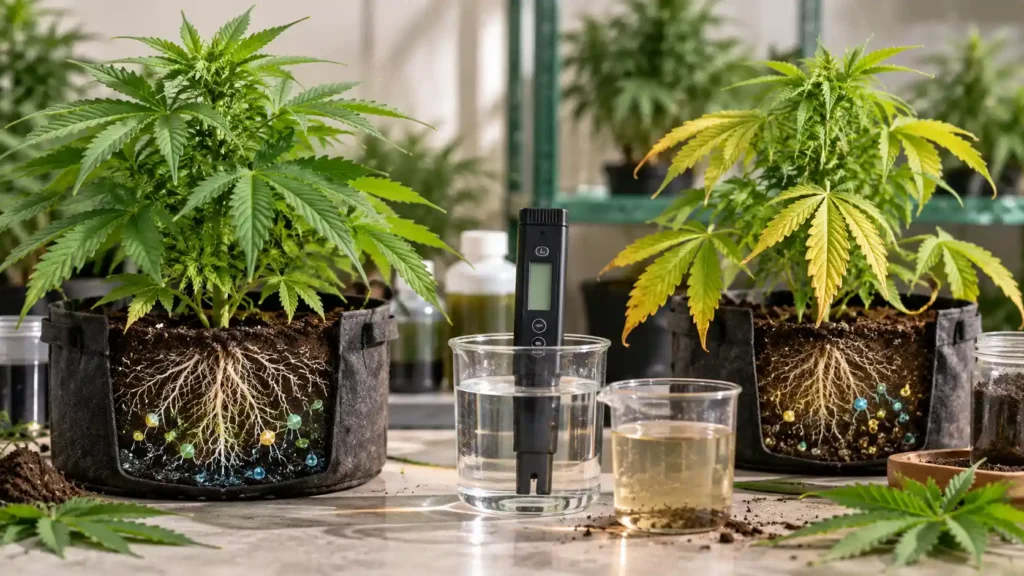
You fed your plant. You checked the schedule, mixed the nutrients correctly, and watered like you always do. A few days later, the leaves still look wrong yellowing, curling, maybe some odd spotting. So you feed again, a little heavier this time, because that’s the instinct. And somehow it looks worse.
This is one of the most common dead ends in cannabis troubleshooting, and it usually isn’t a feeding problem at all. It’s a pH problem wearing a deficiency’s clothes.
Quick answer: If more than one nutrient’s symptoms seem to be showing up at once say, some yellowing, some curling, maybe a purplish tint too suspect pH before you suspect your feeding schedule. Wrong pH doesn’t remove nutrients from the soil or reservoir. It just makes the roots unable to absorb them, so the plant starves in the middle of a full pantry.
This article walks through why that happens, what pH range your setup actually needs, how to test it correctly (most people test the wrong water), the one signal that separates a pH lockout from a true deficiency, and because this is where things usually go sideways why feeding more nutrients when pH is the real issue tends to make everything worse.
For the full symptom-by-symptom rundown once pH is ruled out, our Cannabis Nutrient Deficiency Chart covers that in detail; this piece picks up where that one intentionally left off.
Why pH Controls Whether Your Plant Can Actually Use Its Nutrients
A nutrient can be sitting right there in the soil or reservoir and still be completely unavailable to the plant. That’s the part beginners usually miss, and it’s the reason “just check your pH” sounds like vague advice instead of a real diagnostic step.
Here’s the mechanism in plain terms: nutrients exist in soil and water as charged particles called ions. For a root to absorb an ion, it has to be dissolved and in a chemical form the root can actually take up.
pH a measure of how acidic or alkaline the root zone is determines which form those ions take. Outside a certain range, some nutrients bind to soil particles or turn into compounds the roots can’t process. The nutrient hasn’t gone anywhere. It’s just chemically locked out of reach.
This is the literal basis of the term “nutrient lockout.” It’s not a nutrient shortage. It’s an access problem.
Different nutrients lock out at different points on the pH scale, which is why a single pH swing can produce a mix of symptoms rather than one clean, textbook deficiency. A plant grown in soil at pH 5.0, for example, can be fed a complete, well-balanced nutrient mix and still develop classic deficiency symptoms not because the feed was wrong, but because the roots couldn’t pull much of it in.
Cannabis-specific research on this isn’t as deep as it is for major food crops, but substrate pH trials on hemp and cannabis conducted at institutions including North Carolina State University have shown measurable growth reductions when pH drifts outside the plant’s usable range, consistent with the broader plant-nutrition science this idea comes from. This isn’t a cannabis-specific quirk it’s basic root chemistry applied to cannabis growing conditions.
Ideal pH Ranges for Cannabis Soil, Coco, and Hydro
Quick answer: Soil generally wants roughly 6.0–7.0. Coco coir and hydroponic systems run lower, roughly 5.5–6.5. Using a soil grower’s target number in a coco or hydro setup is a common and avoidable mistake.
| Medium | Ideal pH Range | How Fast It Drifts |
| Soil | 6.0–7.0 | Slow soil has natural buffering, so swings happen gradually |
| Coco coir | 5.5–6.5 | Moderate some buffering, but less forgiving than soil |
| Hydroponics (reservoir) | 5.5–6.5 | Fast no buffering at all, pH can shift within a day |
The reason soil is more forgiving comes down to something called cation exchange capacity, or CEC essentially, soil’s ability to hold onto and slowly release nutrient ions, which smooths out sudden pH changes.
Coco and hydro systems don’t have that cushion, which is why hydro growers often test daily while soil growers might check weekly. Our Deficiency Chart article goes deeper into how each medium buffers (or fails to buffer) pH swings, so we won’t repeat the full explanation here.
One honest caveat worth naming: these ranges reflect consensus across grower education sources, not a single controlled study pinning down one “correct” number. Treat them as a reliable target zone, not a number you need to hit exactly.
Nutrient Lockout vs. True Deficiency The One Difference That Actually Matters
Both look similar on a leaf. Yellowing, curling, discoloration visually, lockout and a genuine nutrient shortage can be hard to tell apart at a glance. But they come from different problems, and that distinction changes what you should do next.
- Lockout is an uptake problem. The nutrient is present in the soil or reservoir, but the roots can’t absorb it because of pH.
- True deficiency is a supply problem. The nutrient genuinely isn’t available in sufficient amounts in the feed itself.
The clearest behavioral tell: lockout tends to affect several nutrients at once, because a pH swing changes the availability of multiple ions simultaneously calcium, magnesium, iron, and zinc can all become less available in the same pH range. A true deficiency from an imbalanced feeding program, by contrast, usually shows up as one nutrient’s signature symptom at a time, since only that specific element is running short.
This is a strong pattern, not an ironclad rule a genuinely deficient feeding program can occasionally cause overlapping symptoms too. But if you’re staring at a plant that seems to be showing three different problems at once, pH is the more likely explanation.
| Nutrient Lockout | True Deficiency | |
| Root cause | Wrong pH blocks absorption | Feed genuinely lacks the nutrient |
| Nutrient in the medium? | Present, just unavailable | Actually insufficient |
| Typical symptom pattern | Multiple nutrients affected at once | Usually one nutrient’s symptoms at a time |
| Fix | Correct pH | Adjust the feeding program |
If you’ve confirmed pH is in range and the plant is still showing a single, consistent symptom pattern, that’s your cue to move to the Nutrient Deficiency Chart and identify the specific element involved.
How to Test pH the Right Way
Quick answer: Test runoff (soil/coco) or reservoir water (hydro), not the water you’re pouring in. Input water tells you almost nothing about what’s actually happening at the roots.
This is where most beginner troubleshooting quietly goes wrong. A grower checks their tap water, sees a reasonable pH reading, and assumes everything downstream is fine.
But soil chemistry changes the water’s pH as it passes through a tap water reading of 6.5 can easily produce runoff at 7.8 in an older pot, especially if salts have built up over a few feedings. The input number tells you what you started with. The runoff or reservoir number tells you what your roots are actually sitting in.
To test runoff pH in soil or coco:
- Water the plant slowly with a known volume until liquid drains from the bottom of the pot.
- Collect the runoff in a clean container avoid letting it sit on soil or touch anything that could contaminate the reading.
- Test it with a calibrated pH meter within a few minutes, before the sample changes.
- Log the number and date so you can track drift over time, not just react to a single reading.
To test reservoir pH in hydro or deep water culture:
- Stir or circulate the reservoir first so you’re not testing a stagnant pocket.
- Test directly from the reservoir, not from runoff at the plant.
- Check again after feeding or topping off, since adding water resets the pH balance.
A detail that trips up a lot of new growers: pH meters drift out of calibration over time, sometimes within weeks of regular use. A meter that’s off by even half a point will send you chasing a problem that doesn’t exist, or missing one that does. Calibrate with buffer solution on a regular basis, not just when a reading looks obviously wrong.
It’s also worth checking EC or PPM alongside pH. That reading tells you the total concentration of dissolved salts in the water, and it becomes important later when we get to why overfeeding makes lockout worse.
Reading the Symptoms When It’s Worth Checking (and When It’s Not)
Not every pH fluctuation is an emergency. Soil especially because of that buffering capacity mentioned earlier will naturally drift a little over a grow cycle. A runoff reading of 6.3 one day and 6.6 the next isn’t a lockout developing. It’s normal chemistry doing what soil chemistry does.
The point to actually intervene is when runoff or reservoir pH sits consistently outside the ideal range across multiple checks, not from a single reading that happens to land slightly off. Testing once, seeing 6.9 in soil, and immediately reaching for pH down is usually an overreaction. Testing three times over a week and consistently landing at 7.4 is a real signal.
Where a symptom shows up on the plant also helps narrow things down, though it’s a secondary clue rather than a primary one here. Older, lower leaves and new growth respond differently depending on whether a nutrient is mobile or immobile within the plant that mobile/immobile framework is covered in full in our Deficiency Chart guide, so we’ll just flag it as a useful next layer of diagnosis rather than re-explain it here.
In practice, the goal is calibration: check pH regularly enough to catch real drift, but don’t treat every minor swing as a crisis that needs immediate correction.
Why Feeding More Makes It Worse (The Mistake Loop)
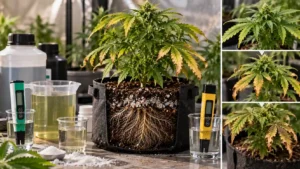
This is the part that trips up more growers than almost anything else, and it’s rarely explained clearly.
Here’s the sequence: a symptom appears that looks like a deficiency. The natural assumption is underfeeding, so the grower adds more nutrients maybe a bit extra, maybe an unscheduled feeding. That raises the concentration of dissolved salts in the root zone (the EC/PPM number climbing).
If the underlying issue was actually pH-driven lockout, those extra nutrients don’t get absorbed either they were never the problem. Instead, the buildup of unavailable salts around the roots can push pH further out of range and add a second problem on top of the first: nutrient burn, which shows up as crispy leaf tips or clawing.
So the plant that started with mild yellowing from lockout can end up with yellowing and burn, and the grower is now troubleshooting two overlapping problems instead of one a situation that’s much harder to read correctly.
A grower who feeds twice in a week after spotting yellowing may see new clawing and tip burn stack on top of the original symptom, which looks like things are spiraling when really it’s the same root cause compounding itself.
This is reasoned from the established relationship between EC buildup and lockout rather than a single cited statistic, but the pattern is well recognized among experienced growers: when in doubt, don’t feed more. Check pH and EC first.
[Visual suggestion: a simple 4–5 step flow diagram showing symptom appears → assume underfeeding → feed more → EC rises → lockout deepens → symptom worsens]
How to Fix a pH Problem (and What Recovery Actually Looks Like)
Quick answer: Correct the pH of your feed water going forward, give the medium time to stabilize, and expect gradual improvement in new growth not an overnight fix.
- Confirm the problem first. Test runoff or reservoir pH more than once before assuming lockout. One low reading isn’t enough to act on.
- Decide whether a flush is warranted. A full flush (using pH-corrected plain water to rinse the medium) makes sense when EC is also high or salt buildup is suspected. If EC looks normal and it’s purely a pH miss, correcting future feed water may be enough without a full flush.
- Correct the pH of everything going forward. Every watering and feeding from this point should be pH-adjusted to your medium’s target range.
- Give it time. Already-damaged leaf tissue typically won’t reverse, but healthy new growth emerging in the following one to two weeks is the real sign of recovery. This is a range, not a guarantee severity and medium both affect the timeline.
- Ease back into full-strength feeding rather than resuming a full nutrient dose immediately after correcting pH.
Note that CalMag, a common go-to for yellowing symptoms, addresses a supply problem it doesn’t fix an availability problem. Adding CalMag to a plant with a pH-driven lockout won’t help much if the roots still can’t absorb it, which is a big part of why “I added CalMag but it’s still deficient” is such a common complaint.
For the full flushing procedure, see our guide on how to flush cannabis plants.
Other Look-Alikes Worth Ruling Out
pH explains a lot of “mystery” deficiencies, but not all of them. If you’ve corrected pH and confirmed it’s staying in range, and the plant still isn’t improving, a few other possibilities are worth ruling out:
- Light or heat stress — clawing leaves can result from intense light or high temperatures, not just pH. See our guide on light burn vs. heat stress.
- Overwatering or underwatering — inconsistent watering can mimic nutrient symptoms and also affects oxygen at the root zone. Our overwatered vs. underwatered guide breaks down the difference.
- Root disease — persistent problems despite a corrected pH and consistent feeding can point toward root issues like Pythium or Fusarium, which damage the roots’ ability to absorb nutrients regardless of pH.
Not every yellow leaf is a pH problem, and treating everything as a pH issue can send you down the wrong path just as easily as ignoring pH entirely.
Frequently Asked Questions
Can my plant have a pH problem even if I’ve never adjusted my pH before?
Yes, especially in soil. Buffering capacity changes as the medium ages over a grow cycle, so pH can drift even without any intentional adjustment.
Does a pH meter expire or go out of calibration?
Most pH pens drift over time and need periodic calibration with buffer solution. A meter that hasn’t been calibrated in a while is one of the most common sources of a false reading.
Is it possible to have a pH problem in one part of the pot but not another?
Yes. Uneven watering can create pockets where pH differs from the rest of the medium, which is part of why a slow, even watering pass matters when testing runoff.
If I correct my pH, do I still need to feed on my normal schedule?
Generally yes, but ease back into full-strength feeding rather than resuming at full rate immediately after a correction.
Can pH problems affect bud quality, not just leaves?
Nutrient stress during flowering has been linked to effects beyond leaf appearance in cannabis research, so it’s not purely a cosmetic issue see our Deficiency Chart FAQ for more on that connection.
Is distilled or RO water immune to pH problems?
No. Reverse osmosis and distilled water often have unstable, naturally low pH and typically need to be buffered before use, not assumed to be pH-neutral.
Can I use household vinegar or baking soda to adjust pH?
It’s generally discouraged. Purpose-made pH up/down products give more consistent, predictable results than household substitutes.
How often should I actually test pH?
More often in coco or hydro closer to every feeding since those media have little buffering. Soil can usually be checked weekly, tied to how slowly it drifts.
Does pH matter the same way during seedling stage as during flower?
The target ranges stay similar, but young roots are more sensitive to swings, so tighter tolerance is safer early in a plant’s life.
If my pH is perfect, can I rule out lockout completely?
Mostly, but not entirely. EC buildup from accumulated salts can create a lockout-like effect even at correct pH, which is a separate issue worth investigating if symptoms persist.
Does topping off water without re-checking pH cause problems?
Yes. This is a common habit that lets pH drift unnoticed, since the new water’s pH isn’t confirmed against what’s already in the reservoir or medium.
Is a pH problem ever a sign of something more serious, like root disease?
Rarely the pH itself, but persistent lockout symptoms despite a confirmed correction are a reasonable signal to check for root disease.
Can two plants in the same room have different pH problems?
Yes. Individual pot and medium variation means each plant should be tested on its own rather than assuming uniform conditions across a room.
The Bottom Line
Most symptoms that look like a mystery deficiency trace back to pH, not a missing nutrient. Test the right water runoff or reservoir, not what you’re pouring in before changing anything else. If more than one nutrient’s symptoms show up together, treat pH as the leading suspect. And when in doubt, resist the instinct to feed more; that’s usually the move that turns a small pH miss into a bigger problem.
If your pH checks out and the plant is still struggling, the Nutrient Deficiency Chart is the next stop for identifying the specific nutrient involved. If pH is off, start with a correction and give it a week before judging the results recovery takes time, and the first 48 hours rarely tell the full story.
Note: Laws and regulations around cannabis cultivation vary by location. Readers should check applicable local laws and official government sources. This article is intended for educational plant-care purposes only.
Sources:
- University of Minnesota Extension. “Managing Soil Fertility.” University of Minnesota Extension. https://extension.umn.edu/managing-soil-and-nutrients/managing-soil-fertility
- Prenger, J. J., & Ling, P. P. (2001). “Greenhouse Condensation Control: Understanding and Using Vapor Pressure Deficit (VPD).” Ohio State University Extension, Fact Sheet AEX-804-01. https://kb.osu.edu/items/8b9ec2cd-99bd-5d84-bf5b-8f6a0ef8f12c
- Marschner, P. (Ed.). (2012). Marschner’s Mineral Nutrition of Higher Plants (3rd ed.). Academic Press. https://doi.org/10.1016/C2009-0-63043-9
- University of Florida IFAS Extension. “Iron Deficiency in Plants.” UF/IFAS Extension. https://gardeningsolutions.ifas.ufl.edu/care/fertilizer/iron-deficiency.html
- Pennsylvania State University Extension. “Hydroponics Systems and Principles of Plant Nutrition: Essential Nutrients, Function, Deficiency, and Excess.” https://extension.psu.edu/hydroponics-systems-and-principles-of-plant-nutrition-essential-nutrients-function-deficiency-and-excess/
- Pennsylvania State University Extension. “Saline Soils and Plant Growth.”
https://extension.psu.edu/saline-soils-and-plant-growth/ - University of Maryland Extension. “Soil Testing and Soil Testing Labs.” https://extension.umd.edu/resource/soil-testing-and-soil-testing-labs/