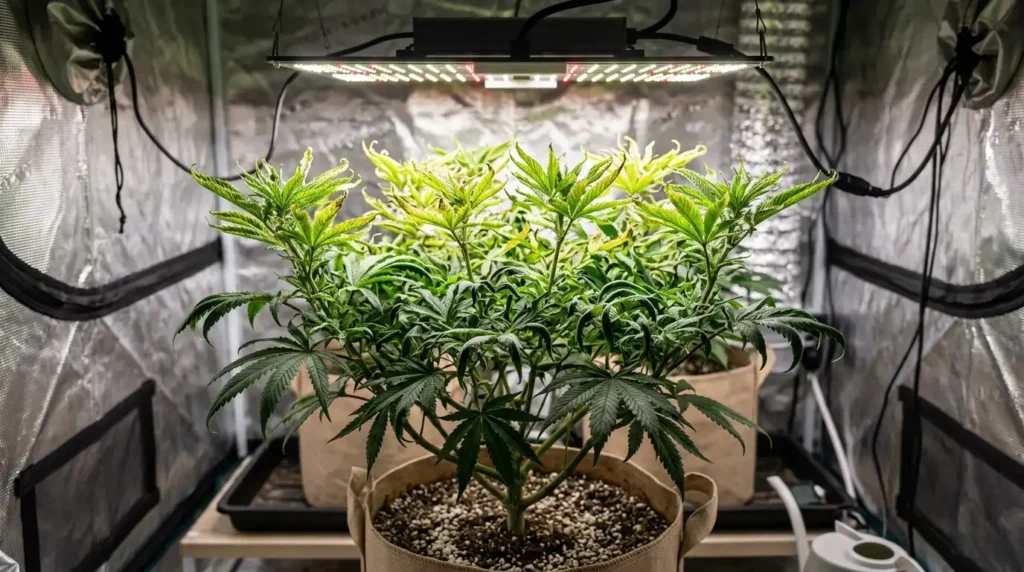
You raised the light, checked the runoff, and even added a fan, but the top leaves are still curling under like little claws. Or maybe they’re cupping upward instead, like tiny canoes. Either way, you’re left wondering whether the problem is your light, your temperature, or something in your feed schedule and picking the wrong fix just wastes time while the real cause keeps damaging new growth.
Here’s the short version: if the damage is concentrated at the top of the plant and the leaves are stiff and firmly attached, you’re probably looking at light burn or heat stress two problems that often show up together because grow lights produce both light and heat.
If the leaves fall off easily and the damage starts lower on the plant, nitrogen excess is more likely the culprit. The rest of this guide walks through how to tell all three apart and what to actually do about each one.
What Leaf Clawing Actually Means
“Clawing,” “curling,” “cupping,” and “tacoing” get used interchangeably online, which doesn’t help when you’re trying to figure out what’s wrong with your own plant. It helps to separate them by direction.
The classic claw is a downward curl the leaf tips bend under, toward the stem, so the leaf looks like a hand curling into a fist. Tacoing (also called canoeing) is the opposite: the leaf edges cup upward, so the leaf folds along its center line like a taco shell.
Both are stress responses, not diseases. The plant is reacting to something in its environment or its feed, and the leaf shape is simply how that reaction shows up. Neither pattern tells you the cause on its own that’s why position on the plant and leaf texture matter more than the curl direction alone.
Light Burn: Symptoms, Causes, and Fixes
Quick answer: Light burn shows up as damage concentrated on the leaves closest to the fixture usually the top few inches of canopy and those leaves stay firmly attached even when damaged, unlike leaves affected by a nutrient deficiency.
The pattern is the first clue. Light burn hits the top of the canopy hardest because that’s the part of the plant physically closest to the light source. Leaves further down or on the sides usually look fine. If you gently try to remove a light-burned leaf, it resists it’s still alive and attached, just stressed, which is different from a deficiency-related leaf that tends to fall off with almost no resistance.
Here’s where it gets more interesting than most grow guides let on. It’s tempting to assume light burn simply means “too many photons,” and that the fix is just dimming the light. But a controlled study published in Frontiers in Plant Science found that cannabis canopy yield kept increasing even as researchers pushed light intensity up to 1,800 µmol·m⁻²·s⁻¹ a PPFD level far higher than most home grows ever reach. Leaf-level photosynthesis saturates at a lower point than that, but the plant as a whole tolerated very high light levels without the kind of damage the term “light burn” implies.
What that research points to is that most of what growers call light burn is really a proximity problem, not a pure light-intensity problem. Fixtures generate heat along with light, and the closer a plant sits to the fixture, the more radiant heat it absorbs on top of the light itself. So when a light is hung too close, you’re rarely dealing with “too many photons” in isolation you’re dealing with a hot spot that happens to also be bright.
That reframing matters because it changes what you check first. Instead of assuming you need a dimmer or a weaker light, check the distance and the heat load before you touch the light’s intensity settings our guide to ideal grow room conditions has broader temperature and light targets if you want the full picture beyond just this symptom.
Rough starting points for hanging distance (always check your specific fixture’s manufacturer guidance first, since wattage and design vary a lot):
| Growth Stage | General Starting Distance (LED) |
| Seedling/clone | 24–36 inches |
| Vegetative | 18–24 inches |
| Early flower | 14–18 inches |
| Late flower | 12–16 inches |
These are starting points, not guarantees a low-wattage LED and a high-output LED at the same distance can produce very different canopy conditions. If you see clawing after moving a light closer or upgrading fixtures, that’s a strong signal to move back up a few inches and reassess.
Heat Stress: Symptoms, Causes, and Fixes
Quick answer: Heat stress typically produces tacoing leaves cupping upward often across a wider area of the canopy than just the spot directly under the light, especially if the whole tent or room has warmed up.
The mechanism behind tacoing comes down to water loss. When leaf temperature climbs, the plant transpires more water through its stomata (the small pores on the leaf surface) than it can pull up through the roots. Curling upward reduces the leaf’s surface area exposed to light and heat, which is the plant’s way of cutting its water losses.
This is where a term called VPD vapor pressure deficit becomes useful. VPD measures the difference between the moisture the air could hold and what it’s actually holding, factoring in both temperature and humidity. A high VPD means the air is pulling more moisture out of the leaves than the roots can replace, which is exactly the condition that drives tacoing.
According to horticultural LED manufacturer Fluence, commonly used VPD targets run roughly 0.8–1.0 kPa during vegetative growth, 0.9–1.1 kPa in early flower, and 1.1–1.3 kPa in late flower. Treat these as industry guidance rather than a hard scientific threshold they’re widely used in commercial cultivation, but no single peer-reviewed cannabis study has pinned down an exact cannabis-specific number.
Fluence’s guidance also points out something that connects back to the light burn section: high-PPFD LED setups genuinely run hotter than older, lower-intensity lighting, because higher light levels increase both the room’s air temperature and the plant’s own transpiration rate. In other words, if you’ve recently upgraded to a stronger light, your ventilation and dehumidification needs went up too, even if you didn’t change the hanging height.
Common signs of heat stress:
- Upward cupping or tacoing, often spread across more of the canopy than just the closest point to the light
- Leaves feel warm to the touch, especially near the top
- Wilting that doesn’t improve after watering
- Symptoms that get worse during the hottest part of the light cycle and ease up later
The fix here is airflow and heat management rather than light distance. Improving exhaust ventilation, adding an oscillating fan to keep air moving across the canopy, and checking whether your room’s cooling can keep up with a heat wave are the first things to look at. If your AC or exhaust setup was fine last month and problems started suddenly, an equipment issue or an external heat wave is worth ruling out before you assume anything about the plant itself.
Light Burn vs. Heat Stress: Side-by-Side Comparison
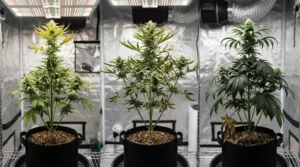
Because grow lights are both a light source and a heat source, these two problems frequently overlap which is exactly why they’re so easy to confuse. The table below, along with nitrogen toxicity as a third look-alike, gives you a fast way to narrow things down.
| Light Burn | Heat Stress | Nitrogen Toxicity (“The Claw”) | |
| Canopy position | Top leaves closest to the fixture | Often broader across the top canopy, sometimes tent-wide | Starts at the bottom, works upward |
| Curl direction | Downward claw | Upward cupping/tacoing | Downward claw |
| Leaf attachment | Stays firmly attached | Stays firmly attached | Detaches easily |
| Trigger pattern | Recent light height change or fixture upgrade | Heat wave, AC lapse, or reduced airflow | Recent feed strength increase |
| Primary fix | Adjust hanging distance | Improve airflow/exhaust, correct VPD | Flush and adjust feed schedule |
If your plant shows a mix say, tacoing near the light and a milder downward curl further out that’s consistent with light burn and heat stress happening at the same time, which is common rather than unusual. If your symptoms don’t match any row cleanly, our overwatered vs. underwatered diagnostic guide walks through a similar side-by-side approach for water-related look-alikes.
Could It Be Nutrient Burn (Nitrogen Toxicity) Instead?
If the clawing started at the bottom of the plant and is working its way up, or if damaged leaves come off with barely any resistance, you may be looking at nitrogen toxicity rather than a light or heat issue. This is sometimes just called “the claw” in grower forums, which adds to the confusion since it produces the same downward curl as light burn.
The key differences are position and attachment: nitrogen toxicity begins low on the plant and detached leaves come away easily, while light-burned or heat-stressed leaves near the top stay put. If you recently increased feed strength and the timing lines up with when the clawing appeared, that’s a reasonable signal to check your nutrient schedule before touching your lighting setup.
Research out of North Carolina State University, which grew cannabis under controlled nutrient treatments and photographed the resulting deficiency and toxicity symptoms, backs up this bottom-up progression pattern as a general feature of nutrient-related leaf problems in cannabis, distinct from the top-down pattern seen with light and heat.
A separate hydroponic trial from the University of Guelph, which withheld individual nutrients one at a time, found that nutrient problems also came with measurable drops in vegetative growth and floral yield, not just a change in leaf appearance a reminder that a nutrient-based cause is worth ruling out carefully rather than assumed from leaf shape alone.
It’s also worth noting that this kind of “yellowing equals nitrogen” shortcut isn’t reliable even outside cannabis. General crop research from Michigan State University Extension points out that several other nutrient deficiencies can produce similar yellowing patterns in row crops, which is a useful caution against jumping straight to a nitrogen diagnosis without checking the fuller picture.
This article focuses on the light- and heat-related causes, so it won’t go deep into nutrient diagnosis that’s a large enough topic to deserve its own dedicated guide. In the meantime, our guide to why cannabis leaves turn yellow covers the related nitrogen-deficiency side of the same nutrient picture, and the full cannabis leaf problems guide is a useful hub if you’re not sure clawing is even the right symptom to be troubleshooting.
How to Measure Canopy Temperature and Light Distance at Home
Guessing at “a bit too close” or “kind of warm” doesn’t give you anything to act on. A cheap infrared (IR) thermometer solves most of this.
- Point the IR thermometer at the leaf surface, not the air. Air temperature and leaf surface temperature aren’t the same thing, and growers commonly report leaf temperatures running several degrees warmer than ambient air under LED lighting. Treat that gap as a rough, grower-reported pattern rather than a fixed number it varies by fixture and airflow.
- Take readings in at least three spots: the point of canopy closest to the light, the center of the canopy, and an edge further from the fixture. A big gap between the closest point and the rest of the canopy points toward a localized hot spot rather than a room-wide heat problem.
- Measure hanging distance with a tape measure, not by eye, and compare it against your fixture’s manufacturer guidance for your current growth stage.
- Decide if you need a PPFD meter. For most hobby setups, distance guidelines from the manufacturer are enough. A PPFD meter is worth the cost mainly if you’re running a high-output fixture close to canopy, growing multiple strains with different light tolerances, or troubleshooting a problem that distance checks alone haven’t explained.
A common mistake: changing the light height, the fan speed, and the feed strength all in the same day. If the clawing improves, you won’t know which change actually fixed it and if it doesn’t improve, you’ve made your next round of troubleshooting harder. Change one variable, give it a few days, and check new growth before adjusting anything else.
Will Clawed Leaves Recover?
Leaf tissue that’s already damaged generally doesn’t uncurl or reverse itself. That’s normal and doesn’t mean lasting harm to the plant. What matters more is what the next set of leaves looks like after you make a correction flat, healthy new growth is the real sign that you fixed the right thing.
There’s no reliably verified timeline for exactly how long that takes, since it depends on the severity of the stress and how quickly you addressed it, so be cautious of any source that gives you an exact day count. In practice, growers generally watch the next couple of growth nodes rather than expecting the existing damaged leaves to fix themselves.
Preventing Both Going Forward
Once you’ve corrected the immediate issue, treat hanging distance and canopy temperature as things to check periodically, not just once. A light that was fine at seedling stage may be too close by the time the plant reaches late flower and grows taller. Likewise, a ventilation setup that handled spring temperatures might not keep up during a summer heat wave.
- Recheck hanging distance whenever the plant grows noticeably or you change growth stages
- Take a canopy temperature reading during the hottest part of your light cycle, not just when you happen to walk by
- Keep an eye on VPD trends rather than a single reading, especially across a heat wave or a change in room humidity
- If you upgrade to a stronger light, expect your airflow and cooling needs to go up as well
For a broader look at the temperature, humidity, and light ranges cannabis plants generally do best in, our guide to ideal growing conditions is a useful next stop.
Frequently Asked Questions
Is leaf clawing always a bad sign?
Not necessarily. It usually points to a fixable environmental or feeding issue rather than disease, and plants often recover well once the cause is corrected.
Can light burn and heat stress happen at the same time?
Yes, and it’s common rather than rare. Since a grow light is both a light source and a heat source, a fixture hung too close can trigger both problems together.
Does a more expensive grow light prevent light burn?
Not by itself. Distance from the canopy and how well you manage heat matter more than the price of the fixture.
Can a fan alone fix heat stress?
A fan improves airflow, which helps, but it doesn’t address the underlying heat or humidity source. Pair it with checking your room temperature and exhaust setup.
Is a PPFD meter worth buying for a small hobby grow?
For most beginner setups, manufacturer distance guidelines are enough. A meter becomes more useful if you’re running a high-output fixture close to canopy or troubleshooting a stubborn problem.
Why do only the top leaves show clawing?
Because light burn and heat stress are both concentrated near the fixture, the top of the canopy takes the brunt of it while lower leaves are less affected.
Can overwatering cause something that looks similar?
Yes, overwatering and root problems can cause their own kind of leaf curling and drooping, but that’s a different root-level issue with its own diagnosis and fix see our cannabis leaf problems guide for watering and drooping symptoms specifically.
Does clawing affect yield?
It can, depending on how severe the damage is and how quickly it’s corrected, but there’s no reliable general percentage to point to. Catching and fixing the cause early limits the impact.
What temperature is officially “too hot” for cannabis?
There’s no single verified scientific threshold. Growers commonly aim to keep canopy conditions comfortable relative to VPD targets rather than chasing one specific number.
How is tacoing different from clawing?
Tacoing curls upward and is associated with heat and moisture stress; the classic claw curls downward and is more associated with light burn or nitrogen excess.
Should I cut off clawed leaves?
Usually not necessary. The plant typically grows past the damage with healthy new leaves, and removing leaves unnecessarily can reduce the plant’s overall photosynthetic capacity.
Can wind or a fan blowing directly on leaves cause a similar curl?
Direct, constant wind exposure can cause its own mild leaf curling, but it’s a distinct and less common cause worth ruling out only if light and heat don’t explain what you’re seeing.
Is light burn permanent?
The specific damaged leaf tissue won’t reverse, but the plant itself isn’t permanently harmed new growth after the fix is the real indicator of recovery.
Is this nitrogen toxicity or light burn?
Check where the damage started and how easily the leaves detach. Bottom-up progression with easy leaf drop points to nitrogen; top-down damage with firmly attached leaves points to light or heat.
How long does it take for heat-stressed leaves to recover?
There’s no verified fixed timeline. Watch the next couple of growth cycles for flat, healthy new leaves rather than expecting the already-damaged ones to reverse.
Disclaimer: Laws and regulations around cannabis cultivation vary by location check your local rules and official sources before growing. This article is for educational plant-care purposes only.
Sources
- Rodriguez-Morrison, V., Llewellyn, D., & Zheng, Y. (2021). Cannabis yield, potency, and leaf photosynthesis respond differently to increasing light levels in an indoor environment. Frontiers in Plant Science, 12, 646020. https://doi.org/10.3389/fpls.2021.646020
- Fluence. (n.d.). Expert insights on cannabis cultivation. Fluence LED. https://fluence-led.com/resources/cannabis-cultivation-insights/
- Cockson, P., Landis, H., Smith, T., Hicks, K., & Whipker, B. E. (2019). Characterization of nutrient disorders of Cannabis sativa. Applied Sciences, 9(20), 4432. https://doi.org/10.3390/app9204432
- Llewellyn, D., Golem, S., Jones, A. M. P., & Zheng, Y. (2023). Foliar symptomology, nutrient content, yield, and secondary metabolite variability of Cannabis grown hydroponically with different single-element nutrient deficiencies. Plants, 12(3), 422. https://doi.org/10.3390/plants12030422
- Sneller, E. (n.d.). Are you sure that yellowing means nitrogen deficiency? Michigan State University Extension. https://www.canr.msu.edu/news/are_you_sure_that_yellowing_means_nitrogen_deficiency