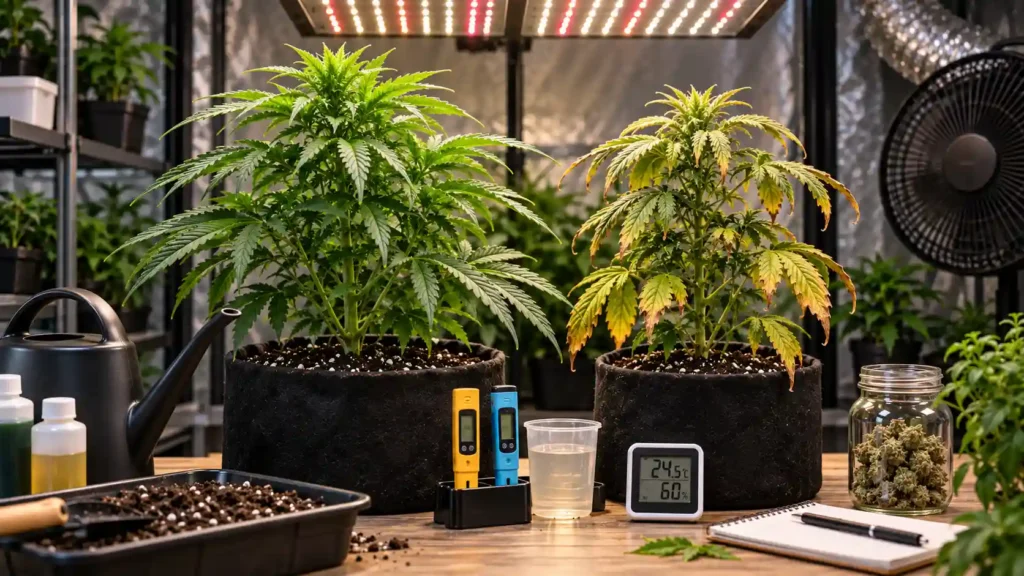
Most first grows don’t fail from neglect. They fail from care watering too often, feeding too early, moving the light every day, and changing four things at once the moment a leaf looks wrong.
That last habit causes more damage than any single mistake on this page. When you adjust watering, pH and light distance in the same afternoon, you lose the ability to tell which change helped. The plant gets a new set of conditions to react to before it has finished reacting to the old ones.
The harder problem is that most beginner symptoms look alike. Drooping, yellowing, curling tips and crispy edges can each come from five different causes, and the internet will give you five confident answers. So this guide does two things: it walks through the mistakes that actually sink first grows, and it gives you a way to work out which one you’re looking at before you change anything.
If something already looks wrong, skip ahead to the diagnosis table. If you haven’t started yet, read it in order.
A note on where the numbers come from: where published research exists on light intensity, nitrogen, root-zone pH and irrigation it’s cited. Where only grower practice exists, it’s labelled as practice. Cannabis horticulture has a real scientific literature now, and almost none of it makes it into beginner articles.
Start here: change one thing at a time
Before you touch the plant, spend ten minutes looking at it. Which leaves are affected lower, upper, or all of them? Did it happen overnight or over a week? Are all your plants doing it, or just one?
Then change one variable. Write down what you changed and the date.
Here’s the part almost nobody explains: damaged leaf tissue does not heal. A yellowed leaf will not turn green again, and a burnt tip will not un-burn. So if you keep staring at the damaged leaf to judge whether your fix worked, you’ll conclude it failed and change something else. Judge by new growth over the following several days instead.
That single habit one change, then wait and watch the new growth prevents most of the compounding damage that turns a recoverable problem into a dead plant.
[Visual suggestion: simple checklist box the grow log fields below]
Keep a short log. Experienced growers ask for exactly this information before they’ll diagnose anything, which tells you it’s the information that matters:
- Strain, and whether it’s an autoflower or photoperiod
- Growing medium and pot size
- Light type, wattage and distance from the canopy
- Nutrient product and schedule
- Watering frequency and roughly how much
- Feed pH and EC, if you measure them
- Room temperature and humidity
- What you changed today
Quick diagnosis: what your plant is telling you
One symptom rarely points to one cause. Use this to narrow the field, then confirm before you act.
[Visual suggestion: this table, with each row linking to the relevant detailed article]
| What you see | Most likely causes | Other signs to check | How to confirm | What NOT to do |
| Droopy seedling | Overwatering; oversized pot | Soil still damp days later; fungus gnats | Lift the pot if it’s heavy, it’s wet | Don’t water it again |
| Droopy mature plant | Underwatering; overwatering; heat | Pot weight; leaf texture (limp vs. firm) | Water it if it perks up in a few hours, it was thirsty | Don’t assume droop always means dry |
| Yellowing lower leaves | Nitrogen shortage; pH lockout; normal late-flower senescence | Growth stage; whether new growth is healthy | Check runoff pH before adding anything | Don’t feed more into a lockout |
| Yellowing new growth | pH lockout; micronutrient availability | Interveinal pattern (yellow between green veins) | Runoff pH; feed pH | Don’t add cal-mag reflexively |
| Burnt or brown leaf tips | Feed too strong (high EC); salt buildup | Tips first, working inward; dark green leaves | Check runoff EC if you can | Don’t increase feed strength |
| Clawing or taco-ing leaves | Too much nitrogen; heat stress; overwatering | Leaf temperature; canopy distance | Back of hand at canopy height for 30 seconds | Don’t guess between heat and nutrients check both |
| Bleached or pale tops | Light too close | Only the tallest tips affected | Raise the light and watch new growth | Don’t cut the affected leaves off |
| Crispy edges | Heat; low humidity; salt buildup | Room temp and RH readings | Compare canopy temp to room temp | Don’t flush before checking heat |
| Stunted growth | Root problems; pH; transplant shock; light too far | Recent changes in the last 10 days | Review your log | Don’t stack another change on top |
| Leggy, stretched seedling | Light too far away or too weak | Long gaps between leaf sets | Move the light closer, gradually | Don’t add more hours of light instead |
| Spots on leaves | Several causes, including pests and deficiencies | Underside of leaves; pattern and spread | Inspect with magnification | Don’t treat before identifying |
| White powder on leaves | Powdery mildew | Humidity, airflow, crowding | Visual it wipes off, unlike trichomes | Don’t ignore it and hope |
What to check first, in this order
Work from free to invasive. Most people do this backwards, changing the feed before they’ve checked the pot.
- Look. Which leaves, what pattern, how fast.
- Lift. Pot weight against what you know the pot weighs dry.
- Measure. Runoff pH and EC, canopy temperature, humidity, light distance.
- Then, and only then, change something.
If you don’t own any meters, you can still do most of this. Learn the weight of your pot bone-dry and freshly watered; the difference is your whole watering guide. Hold the back of your hand at canopy height for thirty seconds if it’s uncomfortably warm for you, it’s warm for the plant. And note how many days a full dryback takes: if your soil needs more than about three days to dry out, your pot is likely too large or your mix holds too much water.
One warning about the finger test. In a large pot, the surface and the edges dry first while the centre stays saturated. So “the top inch feels dry” is not the same as “the pot needs water” which is precisely why so many beginners overwater while believing they’re doing it right.
Before you start: planning mistakes
1. Choosing genetics you can’t manage
Poor seed quality costs you before you’ve made a single mistake. Buy from a reputable source. Be sceptical of “beginner-friendly strain” claims, though that’s grower opinion, not tested fact, and it varies hugely between individual plants of the same variety.
2. Treating an autoflower like a photoperiod plant
This trips up more beginners than any other planning error. Photoperiod plants stay in vegetative growth until you change the light schedule, so they have time to recover from stress. Autoflowers run on a fixed internal clock. Every week lost to transplant shock or aggressive training is a week you don’t get back, and it comes straight out of the final yield.
3. Overcrowding the space
Packed plants restrict airflow and compete for light. The airflow problem doesn’t show up in veg it shows up as mould in flower, when it’s expensive.
4. Getting the outdoor timing wrong
Starting too early exposes seedlings to cold; starting too late means flowering runs into autumn damp. Both cost yield in temperate climates.
5. Buying the wrong things first
| Actually need | Worth having soon | Skip for now |
| A light appropriate to your space | pH meter (or pH test drops) | Bloom boosters |
| Decent soil or a proper soilless mix | Cheap thermometer/hygrometer | Most additives and “enhancers” |
| Pots with real drainage | Jeweller’s loupe for harvest | Moisture meters as your main tool |
| A fan for air movement | EC/PPM meter | CO₂ equipment |
A pH meter does more for a beginner than any bottle of additive. A moisture meter, on the other hand, gives readings that vary wildly by placement pot weight is more reliable and costs nothing.
Germination and seedling mistakes
6. Over-handling seeds
Peeling shells, poking at taproots, planting too deep. Seeds germinate reliably when left alone in warm, damp conditions.
7. Putting a seedling in a huge pot
[Visual suggestion: side-by-side diagram of a seedling in a 1-gallon vs 5-gallon pot, shading the saturated zone]
A seedling’s root system is tiny. It cannot drink down five gallons of wet soil, so the centre of that pot stays saturated for days and stagnant, airless soil is where root problems begin. This is the upstream cause of a great deal of what gets called “overwatering.” Start small and pot up as roots fill the container.
8. Overwatering seedlings
The most common way beginners kill a plant in week one. Water in a small circle near the base rather than soaking the whole container, and wait for a real dryback between waterings.
9. Feeding too early
Most pre-amended soils carry a seedling for weeks, and the cotyledons the first round leaves feed it for the first few days. Adding nutrients on top of an already-fertile mix is how beginners get burnt tips before the plant has four leaves.
Watering mistakes
10. Misunderstanding what overwatering actually is
Here’s the idea that makes everything else in this section make sense: overwatering is an oxygen problem, not a water problem.
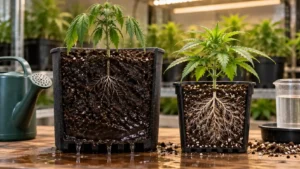
Roots need oxygen. In soil, that oxygen sits in the air pockets between particles. When you water, those pockets fill; as the medium dries, air moves back in. Water too frequently and the pockets never refill, the roots use up what dissolved oxygen remains, and the plant starts to fail drooping, yellowing, stalling.
The proof is hydroponics. Plants grow with their roots permanently submerged, as long as that water is oxygenated. Water itself was never the enemy.
Once you see it this way, several other rules stop being arbitrary. Fabric pots help because they let air in from the sides. Perlite helps because it holds air. Pot size matters because a small root system can’t dry out a big volume. Root rot follows overwatering because low-oxygen conditions favour the pathogens.
It’s frequency, not volume. Small daily sips are worse than a thorough watering followed by a proper dryback.
11. Watering on a fixed schedule
“Every three days” is not a rule, it’s a coincidence that worked once for someone with a different pot, mix, plant size and room. Dryback speed depends on all of those. Lift the pot instead.
Underwatering exists too, and it looks similar droopy, limp leaves. The difference is what happens next: a thirsty plant perks up within hours of watering, while an overwatered one either doesn’t change or gets worse.
12. Deliberately stressing plants for potency
You’ll see this advice a lot, and there is one real study behind it. Researchers at the University of Guelph found that a single controlled drought applied late in flowering raised THCA by about 12% and CBDA by about 13%, alongside an increase in dry flower weight (Caplan, Dixon & Zheng, 2019, HortScience).
That result has not held up as a general rule. Later work found severe drought cut flower biomass in high-CBD plants with no cannabinoid gain, while moderate deficit irrigation saved water without meaningfully affecting yield or chemistry (Frontiers in Plant Science, 2026).
The effect appears to depend on genetics, timing and severity, and nobody has pinned down which combination works.
For a first or second grow: don’t. Deliberate stress is a technique for someone who has already learned to water consistently. Get the baseline right first.
Feeding and pH mistakes
13. The lockout trap
When root-zone pH drifts outside the workable range, nutrients can be sitting right there and the plant still can’t take them up. The leaves show what looks exactly like a deficiency. The instinctive response is to feed more which adds salts, pushes pH further off, and deepens the problem.
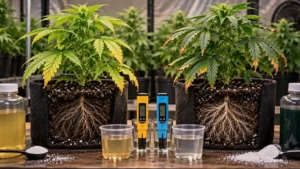
Check and fix pH before you add anything. This is the highest-value correction in this entire guide. Cannabis pH Problems: When Wrong pH Looks Like a Nutrient Deficiency
14. Feeding too strong, and not knowing what EC measures
EC (or PPM) measures dissolved salts in your water not “food.” Higher isn’t stronger nutrition past a point; it’s osmotic stress, and it shows up as burnt leaf tips working inward. Start at half the bottle’s recommended strength. Bottle schedules are written for large, fast-growing plants in ideal conditions, not your seedling. Nutrient Burn vs. Nutrient Deficiency: How to Tell the Difference.
pH by growing medium
| Medium | Working range | Notes |
| Soil (potting mix with nutrients) | ~6.0–7.0 | More forgiving; natural buffering helps |
| Coco coir / soilless | ~5.5–6.5 | Little buffering; check more often |
| Hydroponics | ~5.5–6.5 | Drifts fastest; check regularly |
| Amended living soil | Rarely needs adjusting | Biology handles availability; heavy intervention can do harm |
“Keep it at 6.5” is the advice you’ll see everywhere, and it’s medium-dependent. In soilless production, dropping below roughly 5.5 raises the risk of manganese toxicity, while going above about 6.5 restricts the availability of phosphorus, iron and manganese (Frontiers in Plant Science, 2024). Research at NC State also found that extremely low substrate pH around 3.8 reduced both shoot and root growth directly, rather than only through micronutrient problems (Veazie et al., 2025).
15. Underfeeding, and the “plain water is fine” myth
Underfeeding is a genuine failure mode, and it’s more severe than most beginners realise. In controlled trials at the Volcani Center, plants grown at 30 mg/L nitrogen showed visible deficiency along with roughly 75% less biomass and 25% lower photosynthetic rate compared with the optimum of around 160 mg/L (Saloner & Bernstein, 2020).
But more nitrogen is not better. The same research group found that pushing nitrogen above the point that maximises yield actually suppresses cannabinoid and terpene concentration. There’s a window, and both edges cost you something.
In practice: a good pre-amended soil feeds a plant for several weeks on its own. After that, feed conservatively and watch the plant.
On flushing
Two different things share the name. Running plain water through the medium to clear accumulated salts is a legitimate correction when EC has climbed. Flushing for the final weeks to improve smoke smoothness is widespread practice with little published evidence behind it not proven false, just unproven. Treat it as optional, not as a rule you’re breaking.
Light and environment mistakes
Light too close and why “more light burns” is mostly wrong
Cannabis is an unusually light-hungry plant. In controlled trials, flower yield rose in a straight line as canopy light intensity increased all the way to 1,800 µmol·m⁻²·s⁻¹ far past the point where individual leaves stopped photosynthesising faster (Rodriguez-Morrison, Llewellyn & Zheng, 2021). A separate trial found the same proportional relationship (Llewellyn et al., 2022).
So when a plant is damaged under a light held too close, the usual culprit is heat and proximity, not photon count. That distinction matters because the fix is different: improving airflow or raising the fixture slightly, rather than dimming everything in a panic.
This is not a reason to buy a bigger light. Those figures come from research conditions with cooling and CO₂ management that a home tent doesn’t have, and your real constraints are heat, distance and your electricity bill. Follow your fixture’s recommended hanging height and adjust from what the plant shows you.
Light burn and heat stress look similar and need different responses. Cannabis Light Burn vs. Heat Stress: Why Your Leaves Are Clawing
Chasing fixed temperature and humidity numbers
You’ll see 40–60% humidity and 21–22 °C (70–75 °F) repeated everywhere. It’s reasonable general practice, but it treats temperature and humidity as separate dials when the plant experiences them together. The same humidity reading means something quite different at 20 °C than at 28 °C. VPD for Cannabis: A Beginner’s Temperature & Humidity Chart
Weak airflow
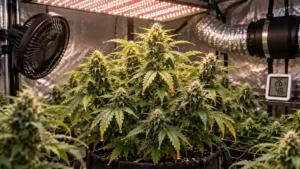
Air movement doesn’t announce itself as a problem in veg. It announces itself in flower, as bud rot. Run an extraction fan plus an oscillating fan moving air through the canopy, and don’t let plants grow into each other.
Light leaks
Photoperiod plants read darkness to stay in flower. A timer glitch or a gap in the tent zipper can stress them into producing pollen sacs. Worth knowing: hermaphroditism isn’t always “bad genetics” light leaks and stress are common triggers.
Training, transplanting and timing mistakes
Top based on node count, not the calendar and go gently with autoflowers, which have no spare time to recover.
Don’t stack techniques. Topping, repotting and correcting your watering in the same week means you’ll never know which one caused what followed.
And plan for the stretch. Photoperiod plants can roughly double in height after the switch to flowering. Headroom has to exist before you flip, not after.
Heavy defoliation is an advanced technique that looks simple on video. Removing large amounts of leaf from a plant that’s already struggling makes things worse.
Flowering and late-stage mistakes
Yellowing in late flower is usually normal. As a plant finishes, it pulls nutrients out of its older leaves. That’s senescence, not failure, and the correct response is to leave it alone rather than feed it.
Which connects to the second mistake here: pushing growth nutrients late in flower. Beyond the point that maximises yield, extra nitrogen suppresses the compounds you’re actually growing for.
Keep humidity controlled as buds fill out. There’s an uncomfortable irony in bud rot it prefers dense, well-formed buds, so it disproportionately punishes grows that were going well.
Deal with pests early. Once buds have formed, your options narrow sharply, and anything you apply has to respect label directions and pre-harvest intervals.
Harvest, drying and curing mistakes
More quality is lost in the last two weeks than most beginners expect.
Harvesting too early is near-universal on a first grow. Pistil colour is unreliable. Use a 30–60× loupe and check several buds, not one: clear trichomes mean immature, cloudy means peak, and amber indicates conversion toward a heavier, more sedative effect. Where you harvest in that window is a preference, but harvesting while everything is still clear is simply early.
Drying too fast produces a green, hay-like smell that a long cure will not remove. Slow it down with lower temperature and controlled humidity rather than more airflow across the buds.
Drying in the wrong space an open room, a cupboard, a cardboard box gives you no control over temperature, humidity or air exchange, and undoes months of work.
Rushing the cure costs aroma and smoothness. Jar, burp, be patient.
Mouldy material should be discarded. Don’t smoke it, and don’t turn it into hash or extract concentrating contaminated material concentrates the contamination too. This is a safety call, not a quality one. How to Dry and Cure Cannabis Buds After Harvest.
Can this plant be saved?
Usually, yes with two honest caveats.
Damaged tissue is permanent. Judge recovery by whether new growth comes in healthy, typically over the following several days to a week after a correct fix. If new leaves emerge normal-coloured and normal-shaped, you fixed it.
| Mistake | Typically | Watch for |
| Light burn on tops | Cosmetic, recoverable | New growth unaffected after raising the light |
| Nutrient burn (mild) | Recoverable | No new burnt tips after reducing feed |
| Overwatering (caught early) | Recoverable | Drooping resolves after a full dryback |
| Overwatering (advanced root rot) | Often terminal | Smell at the root zone; slimy roots |
| pH lockout | Recoverable, slowly | Weeks, not days, to fully correct |
| Early photoperiod light leak | Yield-limiting | Pollen sacs; check every plant |
| Harvested too early | Not reversible | — |
| Badly dried buds | Not reversible | — |
Starting over is sometimes the right call: advanced root rot, or a seedling severely damaged early in an autoflower’s fixed cycle. That isn’t a verdict on you. Watering is a calibration skill, and plenty of growers several years in will admit it still catches them out.
Myths that cause more problems than they prevent
| Claim | Status | What’s actually true |
| “More light burns plants” | Oversimplified | Yield rises with intensity well past most home setups; heat and proximity do the damage |
| “Water every three days” | Context-dependent | Dryback depends on pot, medium, plant size and climate |
| “Overwatering means too much at once” | Wrong | It’s frequency and root-zone oxygen |
| “pH should be 6.5” | Oversimplified | Depends on your medium |
| “Plain water is enough” | Wrong for most setups | Severe nitrogen shortage causes large growth losses |
| “Drought stress boosts potency” | Conflicting evidence | One supportive study; later work disagrees |
| “Flush for smoother smoke” | Unproven | Common practice, little published support |
| “Molasses improves buds” | Unsupported | No credible cannabis-specific evidence |
| “Yellow leaves always mean deficiency” | Wrong | Late-flower yellowing is normal |
| “Bigger pot, bigger plant” | Context-dependent | Oversized pots stay wet in the centre |
| “Hermies are always bad genetics” | Oversimplified | Light leaks and stress are common triggers |
| “Autoflowers are just faster photoperiods” | Wrong | No recovery time from stress |
FAQ
How long should my soil take to dry out?
Roughly two to three days for most container grows. Much longer suggests the pot is too big for the plant or the mix holds too much water.
Should I cut off yellow or damaged leaves?
Generally no, especially on young plants. A damaged leaf still photosynthesises, and removing leaves is another stressor. Remove them only if they’re fully dead or you’re managing airflow in flower.
How long before I see improvement after fixing something?
Watch new growth over several days to a week. Existing damage won’t change.
Do I need to pH my water in living soil?
Usually not. Amended soils with active biology buffer themselves, and aggressive pH adjustment can disrupt that. In coco, hydro and standard potting mixes with bottled nutrients, checking pH matters a lot more.
How much runoff should I see?
Enough that water reaches the bottom of the container roughly 10–20% of what you poured in. Less and the lower root zone may be staying dry.
Is a moisture meter worth buying?
Not as your main tool. Readings shift depending on where you push the probe. Pot weight is more reliable and free.
Can I fix a leggy seedling?
Yes. Move the light closer in stages and support the stem, or bury the stretched section when you pot up. The cause is usually light intensity, not light hours.
What’s the difference between nutrient burn and light burn?
Nutrient burn starts at leaf tips anywhere on the plant. Light burn affects the leaves closest to the fixture, usually at the top, often as pale or bleached patches.
Why did my plant produce pollen sacs?
Stress or light leaks during the dark period are common causes in photoperiod plants not only genetics.
Why were my buds airy?
Usually insufficient light reaching those sites, crowding, or genetics. Larf on lower branches is normal; larf everywhere points to light.
Is it too late to fix this if I’m already flowering?
Depends on the problem. Environmental issues heat, humidity, airflow are worth correcting at any stage. Structural problems like insufficient light in a crowded canopy mostly can’t be solved mid-flower.
Do beginner-friendly strains really exist?
Some varieties are more forgiving, but the claim is grower opinion rather than tested fact, and individual plants vary. A decent seed from a reputable source matters more than the name on the pack.
Is it normal to still get watering wrong after a few grows?
Yes. It’s the most commonly reported ongoing difficulty among experienced growers, because it depends on conditions that change every cycle.
Key takeaways
- Lift the pot before you water it.
- Check pH before you add anything.
- Change one thing, then wait and watch the new growth.
- Treat frequency, not volume, as the watering variable that matters.
- Give autoflowers less intervention than you think they need.
- Expect yellowing at the end of flower that one’s supposed to happen.
- Protect the last two weeks as carefully as the first twelve.
If you’re mid-problem right now, go back to the table, pick the single most likely cause, confirm it, make one change, and write down the date.
A note on legality and safety
Cannabis cultivation laws vary widely by country, state and municipality, and often by plant count, location and licence status. Check the rules where you live before growing anything. This article is educational plant-care information, not legal advice.
A few practical safety points: be careful with electrical equipment around water and humidity; pH up and down solutions are corrosive concentrates and deserve care; follow label directions and pre-harvest intervals on anything you apply for pests; and discard mouldy plant material rather than trying to salvage it.
Sources:
-
Caplan, D., Dixon, M., & Zheng, Y. (2019). Increasing inflorescence dry weight and cannabinoid content in medical cannabis using controlled drought stress. HortScience, 54(5), 964–969. https://doi.org/10.21273/HORTSCI13510-18journals.ashs
-
Saloner, A., & Bernstein, N. (2020). Response of medical cannabis (Cannabis sativa L.) to nitrogen supply under long photoperiod. Frontiers in Plant Science, 11, Article 572293. https://doi.org/10.3389/fpls.2020.572293frontiersin
-
Rodriguez-Morrison, V., Llewellyn, D., & Zheng, Y. (2021). Cannabis yield, potency, and leaf photosynthesis respond differently to increasing light levels in an indoor environment. Frontiers in Plant Science, 12, Article 646020. https://doi.org/10.3389/fpls.2021.646020pubmed.ncbi.nlm.nih+1
-
Llewellyn, D., Jones, A. M. P., & Zheng, Y. (2022). Indoor grown cannabis yield increased proportionally with light intensity, but ultraviolet radiation did not affect yield or cannabinoid content. Frontiers in Plant Science, 13, Article 974018. https://doi.org/10.3389/fpls.2022.974018frontiersin
-
Balliu, A., Takač, A., & others. (2024). Effect of augmented nutrient composition and fertigation on medical cannabis growth, yield, and cannabinoid production. Frontiers in Plant Science, 14, Article 1322824. https://doi.org/10.3389/fpls.2024.1322824frontiersin+1
-
Veazie, P. P., Cockson, P., & Whipker, B. E. (2025). Impact of substrate pH and micronutrient fertility rates on Cannabis sativa. Agronomy Journal. https://doi.org/10.1002/agg2.70044acsess.onlinelibrary.wiley
-
Cockson, P., Landis, H., Smith, T., Hicks, K., & Whipker, B. E. (2019). Characterization of nutrient disorders of Cannabis sativa. Applied Sciences, 9(20), Article 4432. https://doi.org/10.3390/app9204432
-
Llewellyn, D., Golem, S., Jones, A. M. P., & Zheng, Y. (2023). Foliar symptomology, nutrient content, yield, and secondary metabolite variability of cannabis grown hydroponically with different single-element nutrient deficiencies. Plants, 12(3), Article 422. https://doi.org/10.3390/plants12030422
-
Caplan, D., Dixon, M., & Zheng, Y. (2017). Optimal rate of organic fertilizer during the vegetative-stage for cannabis grown in two coir-based substrates. HortScience, 52(9), 1307–1312. https://doi.org/10.21273/HORTSCI12201-17
-
Desaulniers Brousseau, M., & others. (2024). Mineral nutrition for Cannabis sativa in the vegetative stage: Nutrient requirements and interactions. Plants, 13(23), Article 3340. https://pmc.ncbi.nlm.nih.gov/articles/PMC11650207/pmc.ncbi.nlm.nih
-
Lesilolo, M. K., Nkomo, M., & Moyo, M. (2024). Temperature effects on seed germination and seedling biochemical profile of cannabis landraces. Plants, 13(20), Article 2873. https://doi.org/10.3390/plants13202873
-
O’Brien, M. J., Reed, K., & Ferguson, R. (2022). Temperature limits for seed germination in industrial hemp (Cannabis sativa L.). Crops, 2(4), Article 29. https://doi.org/10.3390/crops2040029
-
Dowling, C. A., Shi, J., Toth, J., Quade, M., Smart, L. B., McCabe, P., et al. (2024). A FLOWERING LOCUS T ortholog is associated with photoperiod-insensitive flowering in hemp (Cannabis sativa L.). The Plant Journal, 118(5), 1203–1219. https://doi.org/10.1111/tpj.16691
-
Danziger, N., Bernstein, N., & others. (2023). Is twelve hours really the optimum photoperiod for promoting flowering in Cannabis sativa? Plants, 12(14), Article 2632. https://doi.org/10.3390/plants12142632
-
Jannat, A., & others. (2025). Transcriptomic analysis of CDL-gated photoperiodic flowering mechanisms in cannabis and their responsiveness to red:far-red ratios in controlled-environment agriculture. Frontiers in Plant Science, 16, Article 1586400. https://doi.org/10.3389/fpls.2025.1586400pmc.ncbi.nlm.nih
-
Cockson, P., Veazie, P., Logan, D., & Whipker, B. E. (2024, April 18). How to troubleshoot cannabis nutrient disorders. Cannabis Business Times. https://www.cannabisbusinesstimes.com/columns/cultivation-matters/news/15686755/how-to-troubleshoot-cannabis-nutrient-disorders
-
Cockson, P., Veazie, P., Logan, D., & Whipker, B. E. (2024, November 6). 3 tips to avoid nutrient lockout. Cannabis Business Times. https://www.cannabisbusinesstimes.com/nutrition-plant-health/cannabis-plant-nutrition/article/15690403/3-tips-to-avoid-nutrient-lockout
-
AROYA. (n.d.). Cannabis nutrient burn: Signs, causes, and solutions. https://aroya.io/education-guides/nutrient-burn
-
Grow Weed Easy. (2016, September 15). How to flush a sick cannabis plant. https://www.growweedeasy.com/flushing-sick-cannabis