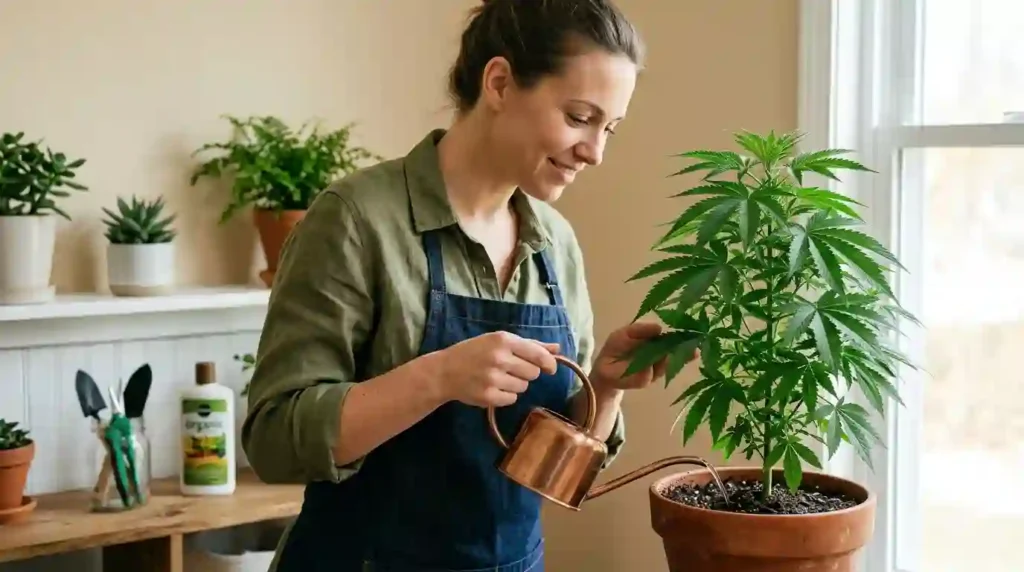
Growing a healthy cannabis plant starts with a few basic habits. Among the most important are watering correctly and providing appropriate nutrition.
Beginners often make the same mistakes: watering too frequently, adding nutrients too early, using too much fertilizer, or changing several things at once when the plant shows a problem.
The goal is not to give the plant more of everything. The goal is to provide what it needs and then observe how it responds.
This guide focuses specifically on watering, feeding, pH, and common beginner mistakes. For a broader look at lighting, temperature, humidity, growth stages, training, and other aspects of plant care, see our Complete Cannabis Plant Care Guide.
Educational Notice: This article is for educational purposes and applies only where cannabis cultivation is legal. Always check and follow the laws in your location.
Understanding the Basics of Cannabis Plant Care
Cannabis plants need several things to grow, including light, water, nutrients, air, and an appropriate growing environment.
However, watering and feeding are two areas where beginners can easily overdo things.
Roots need both water and oxygen. Keeping the growing medium constantly wet can reduce the air available around the roots and contribute to root problems.
Likewise, more fertilizer does not automatically mean faster or healthier growth. Excess nutrients can cause nutrient burn and make existing problems harder to diagnose.
A good approach is simple:
- Check the growing medium before watering.
- Give the plant enough water without keeping the medium constantly saturated.
- Understand when additional nutrients are actually needed.
- Start conservatively with feeding.
- Observe the plant before making another change.
For the complete six-pillar approach to plant care, see the Complete Cannabis Plant Care Guide.
How Often Should You Water a Cannabis Plant?
There is no single watering schedule that works for every cannabis plant.
Watering frequency depends on factors such as:
- Pot size
- Growing medium
- Plant size
- Growth stage
- Temperature
- Humidity
- Drainage
- Indoor or outdoor conditions
Instead of watering simply because a certain number of days has passed, check the condition of the growing medium.
The Lift Test
The lift test is a simple way to judge moisture.
After watering, notice how heavy the container feels. As the growing medium dries, the container becomes noticeably lighter.
With experience, the difference between a freshly watered pot and a drier pot becomes easier to recognize.
The Finger Test
You can also check the upper layer of the growing medium with your finger.
If the medium still feels noticeably moist, you may not need to water yet. If the upper layer has dried and the container feels significantly lighter, it may be time to water.
The important thing is to avoid following a rigid calendar.
How to Water a Cannabis Plant Correctly
When watering a container-grown plant, apply water gradually and evenly rather than pouring everything into one small area.
Good watering practices include:
- Water evenly across the growing medium.
- Allow excess water to drain from the container.
- Avoid leaving the pot sitting in standing water.
- Check the medium before watering again.
- Adjust watering frequency according to the environment.
The goal is to provide adequate moisture while allowing the root zone to receive oxygen between watering events.
If you’re specifically trying to understand the difference between too much and too little water, see:
Overwatered vs Underwatered Cannabis Plants
Overwatering vs Underwatering
One of the confusing things about cannabis plants is that both overwatering and underwatering can cause drooping.
Signs associated with underwatering
A plant that is too dry may show:
- Drooping leaves
- A very light container
- Dry growing medium
- Limp or thin-looking foliage
Signs associated with overwatering
A plant receiving too much water may show:
- Persistent drooping
- Constantly wet growing medium
- A heavy container
- Leaves that appear swollen or overly firm
Don’t automatically add more water just because the plant is drooping.
Check the growing medium first.
For a broader troubleshooting resource, visit the Cannabis Plant Problems & Solutions Guide.
What Nutrients Does a Cannabis Plant Need?
Cannabis plants require several nutrients for healthy development.
The three primary macronutrients are commonly represented as NPK:
Nitrogen (N)
Nitrogen is particularly important for leafy and vegetative growth.
A lack of nitrogen can contribute to yellowing of older leaves, although yellowing can have several other causes as well.
Phosphorus (P)
Phosphorus contributes to root development and plays an important role in reproductive growth.
Potassium (K)
Potassium supports several plant processes, including water regulation and general plant health.
Cannabis also requires secondary nutrients and micronutrients, including calcium, magnesium, iron, zinc, and manganese.
However, nutrient problems aren’t always caused by a lack of fertilizer.
pH problems can interfere with nutrient availability even when nutrients are present in the growing medium.
When Should You Start Feeding a Cannabis Plant?
The answer depends on the growing medium and what nutrients are already available.
Quality growing mixes may contain enough nutrition to support early plant development without immediately adding additional fertilizer.
Young seedlings are also more sensitive to concentrated nutrients than established plants.
Rather than automatically feeding from the beginning:
- Consider what is already present in the growing medium.
- Check the plant’s growth and appearance.
- Follow the instructions for the specific nutrient product.
- Start conservatively.
- Observe the plant before increasing the amount.
The biggest beginner mistake is often assuming that more nutrients will produce faster growth.
What Is the Best Plant Food for Cannabis?
There is no universal “best” plant food for every cannabis plant.
The appropriate choice depends on:
- Growing medium
- Plant growth stage
- Existing nutrients
- Water quality
- Feeding approach
Some growers use organic nutrient sources, while others use formulated mineral fertilizers.
The important thing is not simply which product you choose. It is understanding what the plant already has available and avoiding unnecessary overfeeding.
For more detailed information about plant nutrition, you can also explore our Cannabis Plant Care Guide.
Avoid Overfeeding Your Cannabis Plant
Too much fertilizer can cause nutrient burn.
Common signs can include:
- Brown or crispy leaf tips
- Darkened foliage
- Leaf-edge damage
- Declining plant appearance after feeding
If you notice a problem after increasing fertilizer, don’t immediately add another nutrient product to compensate.
Instead, review:
- What you fed
- How much you used
- How recently you fed
- The condition of the growing medium
- Water pH
- Whether another environmental issue could explain the symptoms
Observe the pattern before making another major change.
Why pH Matters When Watering and Feeding
pH affects nutrient availability.
For soil-based growing, the original article used a general range of approximately 6.0–7.0, while hydroponic systems use a lower range.
When pH moves outside an appropriate range, certain nutrients can become less available to the plant. This can create symptoms that look like nutrient deficiencies even when fertilizer is present.
This is commonly referred to as nutrient lockout.
A reliable pH meter or testing method can therefore be useful when diagnosing recurring nutrient problems.
For the broader relationship between environment, growing medium, pH, and plant health, see: Ideal Conditions for Cannabis Growth
Common Watering and Feeding Mistakes
1. Watering on a Fixed Schedule
Plants don’t necessarily need water every two or three days.
Environmental conditions change how quickly the growing medium dries.
Check the medium instead of relying only on the calendar.
2. Feeding Too Early
Young plants may need little or no additional fertilizer when growing in a nutrient-containing medium.
Adding fertilizer before it’s needed can create unnecessary stress.
3. Using Too Much Fertilizer
More nutrients do not automatically mean more growth.
Excess fertilizer can cause nutrient burn and complicate troubleshooting.
4. Ignoring pH
If a plant repeatedly shows nutrient-related symptoms, don’t assume it simply needs more fertilizer.
Check whether pH could be affecting nutrient availability.
5. Changing Too Many Things at Once
If a plant develops a problem, changing watering, nutrients, lighting, and environment simultaneously makes it difficult to identify the actual cause.
Make one reasonable adjustment at a time whenever possible.
A Simple Watering and Feeding Routine
For beginners, a simple observation-based routine can be easier to manage than a complicated schedule.
Before watering
Check:
- Is the growing medium still wet?
- Does the container still feel heavy?
- Has the plant recently been watered?
- Are there signs that the plant is under stress?
Before feeding
Check:
- Does the plant actually need additional nutrients?
- What nutrients are already present?
- What growth stage is the plant in?
- What does the product label recommend?
- Is pH appropriate?
After feeding
Observe the plant rather than immediately increasing the dose.
Look for changes in:
- Leaf color
- Leaf tips
- Growth rate
- Plant posture
- Overall appearance
Keeping a simple grow journal can also make patterns easier to identify.
When Should You Worry About Yellow Leaves?
Yellow leaves don’t always mean the plant needs more nitrogen.
Possible causes include:
- Natural aging
- Overwatering
- Nutrient deficiency
- pH-related nutrient lockout
- Other environmental stress
Before adding fertilizer, look at the pattern and location of the yellowing and review your recent watering and feeding practices.
For a dedicated explanation, see: Why Are Cannabis Leaves Turning Yellow?
How Watering and Feeding Change Through Growth
Water and nutrient requirements are not identical throughout the plant’s lifecycle.
Young plants generally require more careful watering and are sensitive to concentrated fertilizer.
As plants become established, their water and nutrient requirements can increase.
During flowering, nutrient requirements change again.
For the complete lifecycle from germination through harvest, see: Cannabis Growth Stages & Harvest Guide And for the complete plant-care framework: How to Care for Cannabis Plants
Frequently Asked Questions
How often should I water a cannabis plant?
There is no universal schedule. Check the growing medium and container weight, and consider the plant’s size and environment before watering.
How do I know if my cannabis plant is overwatered?
Persistent drooping combined with a consistently wet growing medium can indicate overwatering. Check the moisture level before adding more water.
What nutrients does cannabis need?
The primary macronutrients are nitrogen, phosphorus, and potassium. Plants also require secondary nutrients and micronutrients.
What is the best plant food for cannabis?
There isn’t one universal product. The appropriate nutrient choice depends on the growing medium, plant stage, existing nutrition, and feeding approach.
Should I feed a young cannabis plant?
Not necessarily. Some growing media already contain enough nutrients for early growth. Young plants can also be sensitive to concentrated fertilizer.
Why are my cannabis leaves turning yellow?
Yellowing can have multiple causes, including natural aging, overwatering, nutrient deficiency, and pH-related nutrient lockout. Check the overall pattern before changing your feeding routine.
Does pH affect cannabis nutrient uptake?
Yes. When pH moves outside an appropriate range, certain nutrients may become less available to the plant even when they are present in the growing medium.
Final Thoughts
Good cannabis plant care doesn’t require constantly adding water, fertilizer, or supplements.
The better approach is to observe first and respond appropriately.
Check the growing medium before watering. Understand what nutrients are already available before feeding. Avoid excessive fertilizer, and pay attention to pH when nutrient problems persist.
Most importantly, don’t try to solve every plant problem with more nutrients or more water.
For the complete picture of cannabis plant care—including light, temperature, humidity, soil, growth stages, training, troubleshooting, and indoor vs outdoor care—continue to the main: Complete Cannabis Plant Care Guide
Legal Disclaimer:
Cannabis cultivation laws vary significantly by country, state, and region. This article is provided for educational and informational purposes only. It does not encourage, endorse, or advise illegal activity. Always check and comply with the laws applicable in your location.
Sources & References:
- Langa, S., Magwaza, L. S., Mditshwa, A., & Tesfay, S. Z. (2024). Characterization of cannabis varieties and the intrinsic and extrinsic factors affecting cannabis germination and seedling establishment: A descriptive review. Industrial Crops and Products, 208, 117861.
https://www.sciencedirect.com/science/article/pii/S0926669023016266 - Pennsylvania State University Extension. (2025). Seed and Seedling Biology.
https://extension.psu.edu/seed-and-seedling-biology - University of Missouri Extension. (2020). Germination 101.
https://extension.missouri.edu/news/germination-101