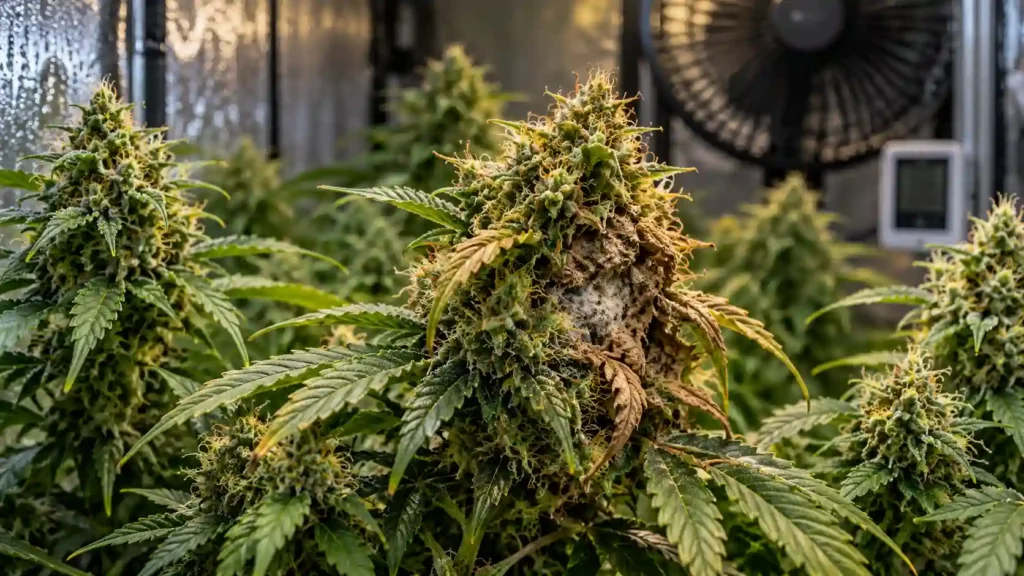
A cannabis flower that suddenly develops brown tissue, a dying sugar leaf, or an unusual fuzzy growth deserves a closer look. Cannabis bud rot can begin inside a dense flower before obvious mold is visible on the outside, so waiting for a large gray patch to appear can mean missing an earlier warning sign.
The term bud rot is commonly associated with Botrytis cinerea, the fungus responsible for gray mold. However, not every case of flower decay is caused by Botrytis. Research on cannabis inflorescences has identified several pathogens that can produce bud-rot symptoms.
The safest approach is therefore simple: diagnose first, then act. Look at the pattern of damage, inspect the suspicious flower, compare it with possible look-alikes, check the plant’s moisture history, and then contain the affected tissue while correcting conditions that favor disease.
What Is Cannabis Bud Rot?
Cannabis bud rot is decay of cannabis flower tissue, usually within the inflorescence or cola. One of the most important pathogens associated with it is Botrytis cinerea, commonly called gray mold.
Botrytis cinerea is a fungal pathogen that can colonize weak, damaged, aging, or otherwise susceptible plant tissue. On cannabis flowers, infection may progress through tightly packed internal tissue before gray fungal growth becomes obvious. University and plant-pathology resources identify Botrytis as an important disease of cannabis and hemp flowers.
Is bud rot always caused by Botrytis?
No.
Botrytis is a major cause, but “bud rot” describes the disease symptom rather than proving the identity of the pathogen. In a 2021 study of diseased cannabis and hemp tissue, researchers recovered 178 fungal isolates. Of those, 162 were identified as B. cinerea, while other organisms including B. pseudocinerea, B. porri, Sclerotinia sclerotiorum, Diaporthe eres, and Fusarium graminearum were also identified.
That distinction matters when symptoms are unusual, widespread, or repeatedly return. A visual inspection can identify possible bud rot, but it cannot always establish the exact pathogen.
What Does Early Cannabis Bud Rot Look Like?
The earliest signs can be subtle. Instead of an obviously moldy cola, you may first notice a small area that looks different from the surrounding flower.
Common warning signs include:
- A localized brown or gray area within a flower
- Sudden yellowing or browning of a bract or flower-associated leaf
- Tissue that appears to be dying while nearby tissue remains healthy
- Unusual softening or decay
- White, gray, or brown fungal growth
- A flower that deteriorates much faster than neighboring flowers
- Brown or necrotic tissue developing inside a dense cola
- A suspicious flower following a period of prolonged moisture, rain, condensation, or poor airflow
A 2021 cannabis disease study documented early infection associated with yellowing and necrosis of bract tissue. A newer greenhouse study found that infection could begin in internal cavities of cannabis inflorescences and remain difficult to see from the outside.
Early vs. developing vs. advanced symptoms
| Stage | What you may notice |
| Early | Localized discoloration, necrosis, or an unusually dying bract |
| Developing | Internal decay, brown tissue, or fungal growth within the flower |
| Advanced | Extensive brown/gray decay and visible fungal sporulation |
[Visual suggestion: Create an original three-stage illustration showing early, developing, and advanced bud rot. Avoid copying competitor photography.]
What does advanced bud rot look like?
As disease develops, the affected flower can become extensively brown, gray, or decayed. Gray-white or gray-brown fungal growth may become visible, particularly when conditions favor sporulation.
UF/IFAS describes gray or gray-white mycelium and conidia on affected buds, petioles, and stems. Oregon State’s Pacific Northwest handbook similarly describes brown flower tissue with fuzzy brownish-gray fungal sporulation.
Why Bud Rot Can Be Hard to See
The tricky part is that the outside of a flower can look relatively normal while decay is developing deeper inside.
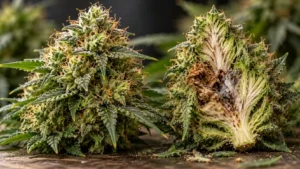
Cannabis flowers contain tightly packed clusters and small cavities where moisture and fungal growth can develop. In a 2025 greenhouse study, researchers observed B. cinerea developing within internal portions of cannabis inflorescences. In some cases, the internal decay was not visible until the inflorescence was opened for inspection.
The researchers also observed two early signs: browning or necrosis of bract-leaf petioles and visible fungal growth on stigmatic tissue. Under favorable conditions, disease progression inside the inflorescence could occur within several days in the study environment. That timing should not be treated as a universal timeline for every cultivar or growing environment.
This is why a suddenly dying leaf attached to an otherwise healthy-looking flower should not automatically be dismissed as normal aging.
Important: A yellow or brown sugar leaf by itself does not prove bud rot. The pattern, location, tissue condition, environmental history, and presence of fungal growth all matter.
How to Check a Cannabis Bud for Possible Rot
Instead of immediately changing nutrients, spraying something, or assuming the whole plant is infected, work through a simple diagnostic sequence.
1. Look for an abnormal localized area
Start with the flower that looks different.
Ask:
- Is the discoloration sharply localized?
- Did it appear suddenly?
- Is nearby tissue still healthy?
- Is a bract or attached leaf dying unusually fast?
A localized abnormality is a reason to inspect not proof of a fungal disease.
2. Inspect the suspicious flower closely
Look for:
- Brown or gray decaying tissue
- Unusual texture
- Visible fungal growth
- Tissue that appears wet or water-soaked
- A clear difference between healthy and deteriorating tissue
3. Inspect the interior when appropriate
Dense flowers deserve particular attention because external inspection may miss internal decay.
If an affected flower can be examined safely, look for tissue that is brown, necrotic, decayed, or visibly colonized by fungal growth.
4. Check nearby flowers
Inspect surrounding flowers for similar symptoms.
Finding one affected cola does not automatically establish that the entire plant is infected. Instead, use the first affected flower as a reason to examine the surrounding canopy carefully.
5. Review the moisture history
Think about what happened during the days before the symptoms appeared.
- Was there rain?
- Did flowers remain wet?
- Was there condensation?
- Did nighttime humidity rise substantially?
- Were there stagnant areas with little air movement?
- Is the canopy unusually dense?
6. Compare other possible explanations
Before calling it Botrytis, consider pest injury, physical damage, normal senescence, environmental stress, or another fungal disease.
If the symptoms remain unclear, laboratory diagnosis may be appropriate.
Diagnostic shortcut:
SEE → LOCATE → INSPECT → COMPARE → CONFIRM
[Visual suggestion: Create an original diagnostic decision tree using this sequence.]
Cannabis Bud Rot vs. Look-Alike Problems
Discoloration alone is not enough to diagnose bud rot.
| Sign | Possible bud rot | Normal aging | Pest or physical damage |
| Localized discoloration | Can occur | Can occur | Can occur |
| Sudden tissue death | Concerning | Less typical | Possible |
| Internal decay | Important clue | Not expected | Depends on damage |
| Fungal growth | Supports fungal involvement | No | May occur secondarily |
| Moisture history | Often relevant | Not diagnostic | Not required |
| Nearby flowers affected | Possible | Usually not the same pattern | Depends on cause |
Bud rot vs. normal flower aging
Flowers naturally change as they mature, and individual leaves can yellow or dry as the plant develops.
The concern is a localized, abnormal deterioration pattern, especially when tissue is rapidly becoming necrotic or decayed.
Bud rot vs. pest damage
Insects can damage flower tissue and create wounds. Those wounds can also provide opportunities for fungal infection.
So pest damage and fungal disease are not always completely separate possibilities. Physical injury can sometimes become part of the disease process.
Bud rot vs. other fungal diseases
Several plant pathogens can produce similar-looking symptoms. NC State Extension, for example, notes that Fusarium flower mold can resemble gray mold, while the two can differ in the type of fungal growth produced.
When the diagnosis matters and the symptoms are ambiguous, don’t treat a visual guess as laboratory confirmation.
What Causes Cannabis Bud Rot?
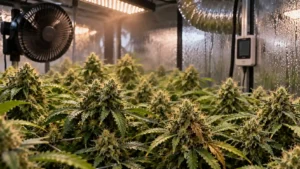
Bud rot becomes more likely when the flower environment remains favorable for fungal infection. The major factors are moisture, humidity, poor air movement, dense flower tissue, damaged tissue, and prolonged wetness.
Humidity and moisture
High humidity can create conditions favorable to Botrytis, particularly when it occurs alongside moisture on plant surfaces.
A 2021 cannabis study found that high humidity or free moisture favored spore germination and fungal growth. Extension resources similarly connect gray mold with humid or wet conditions.
Free water and prolonged wetness
Humidity is only part of the picture. Condensation, rain, dew, and persistent wetness can create an even more favorable environment.
This is particularly important outdoors after extended rainy periods.
Poor airflow
Still air allows moisture to linger around dense flowers.
A 2025 greenhouse study found that enhanced air circulation around cannabis inflorescences substantially reduced bud-rot incidence under its specific experimental conditions. The reported reduction was 66–92%, but that result should not be interpreted as a universal percentage for every grow room, cultivar, or outdoor crop.
Dense flowers and canopy microclimates
Dense flowers can contain small internal spaces where moisture and humidity differ from the surrounding room or outdoor air.
That helps explain why a plant can appear to have acceptable overall environmental conditions while a dense cola develops a problem internally.
Plant wounds and damaged tissue
Botrytis is an opportunistic pathogen and can invade damaged or weakened tissue. Wounds caused by insects or physical activity can provide opportunities for infection.
Dead plant material
Dead or decaying plant tissue can contribute to disease pressure. Removing dead material and maintaining good sanitation are therefore part of broader disease management.
Why there isn’t one “magic” humidity number
There is no single relative-humidity setting that guarantees a cannabis plant will never develop bud rot.
Disease development depends on several interacting factors, including temperature, moisture duration, tissue condition, flower density, airflow, pathogen presence, and the specific growing environment. The goal is to reduce conditions that favor disease, not rely on one number as a guarantee.
For broader environmental guidance, see Ideal Growing Conditions for Cannabis.
What to Do When You Find Possible Bud Rot
If you find a suspicious flower, focus on containment and environmental correction, not on trying to “cure” visibly infected flower.
1. Inspect before assuming the whole plant is affected
Check the suspicious flower and nearby flowers systematically.
One affected cola is a reason to inspect the plant not automatic proof that every flower is infected.
2. Remove confirmed infected material carefully
Extension guidance for Botrytis emphasizes removing infected tissue, sanitation, airflow, and avoiding prolonged wetness as management principles.
Handle affected material carefully to avoid unnecessarily disturbing the surrounding canopy.
3. Clean tools and contaminated surfaces
Sanitation matters because fungal material and plant debris can contribute to disease pressure.
After dealing with affected tissue, clean tools and avoid leaving visibly infected debris around the growing area.
4. Inspect surrounding flowers again
Look for similar discoloration, dying tissue, or fungal growth.
The goal is not to panic and remove everything. It is to identify whether the problem appears localized or whether multiple flowers show related symptoms.
5. Correct the environmental conditions
Review:
- Humidity
- Condensation
- Air movement
- Canopy density
- Flower wetness
- Recent rain or dew
- Dead plant material
- Potential wounds or pest damage
Simply removing a visibly affected flower without addressing the conditions that favored disease can leave the same risk in place.
6. Keep monitoring
Continue checking suspicious and nearby flowers, especially during periods of high moisture or dense flowering.
Do not assume that one inspection ends the problem.
What about drying or curing moldy flower?
Do not assume that drying, curing, heating, or trimming visible mold away makes visibly moldy flower safe.
This article focuses on plant disease management, not on making contaminated material suitable for consumption.
For post-harvest moisture management, see How to Dry and Cure Cannabis Buds.
How to Prevent Cannabis Bud Rot
Prevention is mainly about reducing the environmental conditions that allow fungal disease to establish and spread.
Practical prevention checklist
- Avoid allowing flowers to remain wet for extended periods.
- Monitor humidity rather than relying on guesswork.
- Maintain consistent air movement around the canopy.
- Reduce stagnant-air pockets.
- Manage excessive canopy and flower density where appropriate.
- Remove dead or decaying plant material.
- Minimize unnecessary plant injury.
- Inspect dense flowers regularly during late flowering.
- Pay closer attention after rain, dew, or condensation.
- Watch for humidity increases during the dark period.
- Investigate unusual localized flower discoloration early.
Nighttime conditions deserve particular attention because environmental moisture can change after the lights go out. CannabisPlantCare’s guide on whether cannabis plants grow at night also discusses nighttime humidity and its relationship to mold risk.
The goal is not to create a supposedly “perfect” environment. It is to prevent the combination of moisture + susceptible flower tissue + poor drying conditions + pathogen pressure from persisting.
Indoor vs. Outdoor Cannabis Bud Rot
The disease itself is not fundamentally different, but the environmental risks can be.
| Indoor | Outdoor |
| High humidity | Rain |
| Poor ventilation | Dew |
| Stagnant canopy zones | Prolonged wet weather |
| Condensation | Seasonal humidity |
| Dense flowers | Dense flowers |
| Limited air exchange | Weather-dependent drying |
Outdoor growers have less control over rain and dew, while indoor growers have greater control over ventilation and humidity.
Oregon State notes that rainy periods during bud maturation can favor significant gray-mold outbreaks in hemp.
Can Cannabis Bud Rot Spread to Other Flowers?
Yes, conditions can allow the disease to move from infected tissue to susceptible tissue. Botrytis produces spores, and extension resources describe spores being dispersed by wind and water movement.
That does not mean one affected flower automatically infects every flower on the plant.
Spread depends on factors such as:
- Presence of infectious fungal material
- Spore production
- Moisture
- Air movement
- Flower susceptibility
- Wounds or damaged tissue
- Environmental conditions around neighboring flowers
This is why removing infected material is only part of the response. Nearby flowers should be inspected, and the environment should be corrected at the same time.
[Visual suggestion: Original disease-cycle diagram showing infected tissue → spore production → wind/water movement → susceptible flower → favorable moisture → new infection.]
When Should You Seek Professional Plant-Disease Diagnosis?
Consider professional diagnosis when:
- The symptoms are ambiguous.
- Several pathogens could explain the appearance.
- The disease repeatedly returns.
- Multiple plants are developing unusual flower symptoms.
- You need confirmation for commercial production.
- The suspected disease does not respond to basic environmental management.
UF/IFAS provides plant-disease guidance and diagnostic resources for hemp and notes the value of diagnostic confirmation when pathogen identification is needed.
This is especially useful because bud rot is a symptom description, not a guaranteed pathogen identification.
Frequently Asked Questions
What are the first signs of cannabis bud rot?
Early signs can include localized discoloration or necrosis, a suddenly dying bract or flower-associated leaf, unusual deterioration, or early fungal growth. Because infection can develop internally, the outside of a dense flower may not reveal the full problem.
Does bud rot start inside the bud?
It can. Cannabis-specific research has documented B. cinerea developing in internal cavities and inner portions of inflorescences before obvious external decay appeared.
Is cannabis bud rot always Botrytis?
No. Botrytis cinerea is a major and well-documented cause, but other pathogens can produce similar flower-rot symptoms.
Does high humidity cause bud rot?
High humidity can create favorable conditions for Botrytis, especially when combined with free moisture or prolonged wetness. It is better to think of humidity as part of a disease-risk environment rather than a single guaranteed cause.
Can rain cause cannabis bud rot?
Rain can increase risk by keeping flowers wet and increasing moisture around dense inflorescences. Outdoor risk can be especially important during prolonged wet weather and flower maturation.
Should I remove a flower with suspected bud rot?
First inspect the flower and compare the symptoms with possible look-alikes. When infection is confirmed or strongly suspected, removing affected plant material and improving sanitation and environmental conditions are established disease-management principles.
Can pest damage lead to bud rot?
Pest injury can create damaged tissue that provides an opportunity for fungal infection. However, pest damage itself is not proof that bud rot is present.
Can one affected cola mean the entire plant is infected?
Not necessarily. One affected flower should trigger a careful inspection of surrounding flowers and the growing environment rather than an assumption that the entire plant is infected.
Can bud rot spread quickly?
It can progress rapidly under favorable conditions. A 2025 greenhouse study observed internal disease development over a period of several days under favorable experimental conditions, but that should not be treated as a universal timeline for every cannabis plant.
Can drying or curing make moldy cannabis safe?
Do not assume that drying, curing, heating, or removing visible mold makes visibly moldy flower safe. Post-harvest processing should not be presented as a guaranteed way to eliminate contamination.
How can I prevent bud rot during flowering?
Focus on keeping flowers from remaining wet, maintaining air movement, reducing stagnant canopy zones, managing excessive density, removing dead material, avoiding unnecessary wounds, and inspecting flowers regularly especially during humid, rainy, or condensation-prone periods.
The Bottom Line
The most useful way to think about cannabis bud rot is not simply “brown bud = mold.” The better approach is to diagnose before you act.
Look for unusual localized deterioration, inspect suspicious flowers carefully, remember that infection can be hidden inside dense inflorescences, and compare the symptoms with normal aging, pest injury, physical damage, and other diseases.
If bud rot is confirmed or strongly suspected, contain the affected tissue, maintain good sanitation, inspect nearby flowers, and correct the moisture and airflow conditions that can favor disease. And when the symptoms do not clearly fit, professional plant-disease diagnosis is more reliable than trying to identify the pathogen from appearance alone.
Sources:
-
Punja, Z. K., & Ni, L. (2021). The bud rot pathogens infecting Cannabis sativa inflorescences: Symptomology, species identification, pathogenicity and biological control. Canadian Journal of Plant Pathology, 43(4), 521–538. https://doi.org/10.1080/07060661.2021.1936650
-
Buirs, L., Lung, S., & Punja, Z. K. (2025). The epidemiology and management of Botrytis cinerea causing bud rot on greenhouse cultivated cannabis. Canadian Journal of Plant Pathology. https://doi.org/10.1080/07060661.2025.2478250
-
Oregon State University. (n.d.). Hemp (Cannabis sativa) Gray mold (Botrytis bud blight and stem canker). Pacific Northwest Plant Disease Management Handbooks. https://pnwhandbooks.org/plantdisease/host-disease/hemp-cannabis-sativa-gray-mold-botrytis-bud-blight-stem-canker
-
University of Florida Institute of Food and Agricultural Sciences. (n.d.). Field guide to hemp (Cannabis sativa) diseases (Publication PP379). https://ask.ifas.ufl.edu/publication/PP379
-
North Carolina State Extension. (n.d.). Gray mold of industrial hemp. https://content.ces.ncsu.edu/gray-mold-of-industrial-hemp
⚠️ Safety Disclaimer
This article is provided for general educational and plant-care information only. It is not a substitute for professional plant-disease diagnosis, agricultural advice, or local regulatory guidance. Do not assume that visibly moldy or diseased cannabis flower can be made safe for consumption by drying, curing, heating, trimming, or removing visible mold.
When disease identification is uncertain, widespread, recurring, or important to a commercial crop, consult a qualified plant-disease diagnostic service or agricultural professional. If using any pesticide or fungicide, follow the product label and applicable local laws; never assume a product is approved or safe for use on cannabis flowers in your jurisdiction.