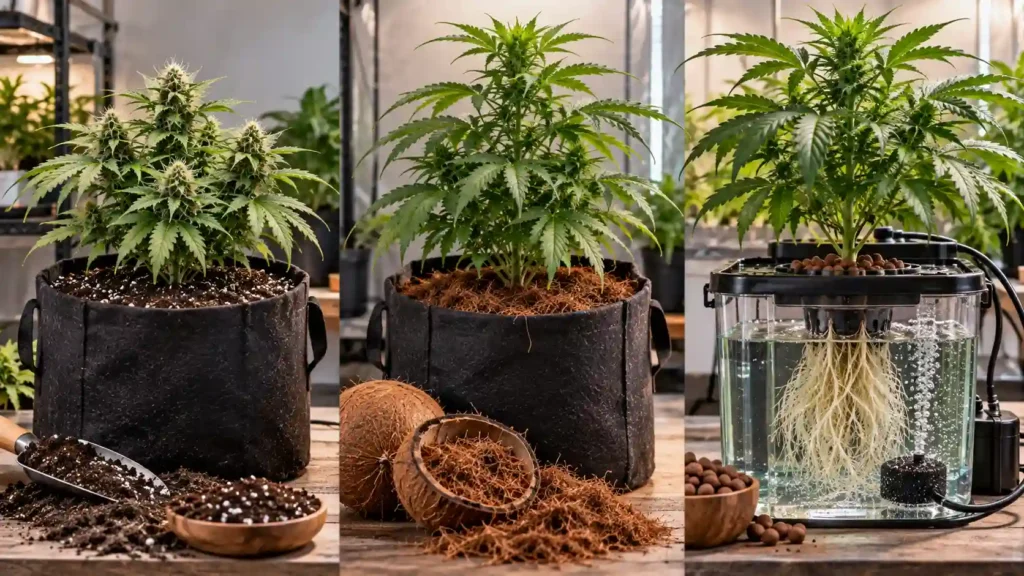
Choosing a growing medium is one of the first major decisions in an indoor cannabis setup. Soil, coco coir, and hydroponics can all support healthy plants, but they do not give beginners the same margin for error.
For most first-time growers, soil is the simplest starting point. Coco is a useful middle ground for growers who want more control and are comfortable with more frequent feeding. Hydroponics can offer precise root-zone control and rapid growth, but it also demands closer monitoring and gives mistakes less time to go unnoticed.
The important point is that there is no scientifically established rule that one medium automatically produces better cannabis. Research shows that growing media can affect growth, rooting, nutrient uptake, and flower yield, while cannabinoid concentration is much more strongly associated with genetics under stable growing conditions.
What Are the Differences Between Soil, Coco, and Hydroponics?
The simplest way to understand the three is to ask how much of the plant’s nutrition and root environment is controlled by the growing medium versus the grower.
Soil
Soil or a quality potting mix provides a physical root environment while also holding water, nutrients, organic matter, and microorganisms. Its chemical and biological buffering gives the grower some protection from small mistakes.
That does not mean soil makes every problem harmless. Overwatering, poor drainage, unsuitable fertility, and compacted roots can still cause serious problems. The difference is that soil generally gives beginners more room to correct an error before the plant responds severely.
Coco Coir
Coco coir is made from processed coconut material and is widely used as a soilless growing substrate.
Here’s the distinction that often confuses new growers:
Coco is not the same thing as soil. Technically, coco is a soilless hydroponic medium.
It can feel like soil because it is placed in containers and has a familiar texture, but its nutrient behavior is different. Coco has some cation exchange capacity (CEC), so it provides more buffering than highly inert media such as rockwool, but substantially less than many soil-based mixes. Research comparing cannabis growing media also places coconut coir between peat-based substrates and rockwool in several physical and chemical characteristics.
That is why coco generally requires a more controlled feeding approach than ordinary soil.
Hydroponics
Hydroponics is an umbrella term rather than one particular setup.
It includes systems such as:
- Deep Water Culture (DWC)
- Recirculating Deep Water Culture (RDWC)
- Nutrient Film Technique (NFT)
- Drip and other fertigation systems
- Systems using rockwool or clay pebbles/LECA
In hydroponics, roots receive water and dissolved nutrients with little or no organic soil-like buffer. That allows the grower to control the root-zone environment more precisely but it also means mistakes can become problems quickly.
Soil vs. Coco vs. Hydroponics: Comparison at a Glance
| Factor | Soil | Coco Coir | Hydroponics |
| Beginner friendliness | High | Moderate | Lower |
| Forgiveness of mistakes | High | Moderate | Low |
| Feeding control | Moderate | High | Very high |
| Watering/feeding frequency | Lower | Higher | System-dependent |
| pH buffering | Relatively high | Moderate | Low |
| Monitoring requirement | Lower | Moderate high | High |
| Equipment needs | Low | Low moderate | Moderate high |
| Growth potential | Strong | Strong | Strong |
| Failure response | Usually slower | Moderate | Can be rapid |
| Best suited to | First-time growers | Growers wanting more control | Experienced/technical growers |
These are practical comparisons rather than guarantees. Actual performance depends on the substrate’s physical properties, irrigation management, plant genetics, and environmental conditions.
A University of Hohenheim study found that differences among rockwool, coco, and peat-perlite media were strongly related to water availability and management, rather than the medium acting as an independent “magic” yield factor.
Why Is Soil More Forgiving Than Hydroponics?
The answer comes down partly to buffering.
One useful term here is cation exchange capacity (CEC). In simple language, CEC describes how strongly a growing medium can hold certain positively charged nutrients and exchange them with the root environment.
A medium with more buffering can help reduce the consequences of small changes in nutrient availability or chemistry.
A simplified way to think about the spectrum is:
Soil → more buffering → Coco → less buffering → Inert hydro media → very little buffering
Coco is therefore not simply “soil without dirt.” Its physical structure and chemical behavior are different, which is one reason feeding and irrigation need to be managed differently.
Research on cannabis substrates supports this broader principle: substrate properties such as water-holding capacity, aeration, and nutrient buffering can influence plant development and yield.
Why this matters to beginners
Imagine two new growers make a small feeding or watering mistake.
With a buffered soil mix, the mistake may not immediately create a major change in the root environment.
With a highly inert hydroponic system, the plant has less substrate-level buffering. The root environment therefore depends much more directly on the grower’s management.
That is the real reason hydroponics can feel less forgiving not because hydroponic plants are inherently fragile, but because the grower becomes responsible for more of the root-zone conditions.
If you’re learning about pH-related nutrient problems, it’s useful to understand this buffering difference before changing nutrients or blaming a deficiency.
The Real Hydroponic Risk: Root-Zone Problems
Hydroponics has another consideration that beginners sometimes underestimate: the root environment can change quickly.
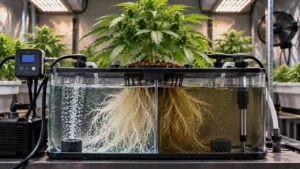
Pythium and other root pathogens are important examples. Cornell University researchers studying hydroponic crops have identified conditions such as waterlogged environments, low dissolved oxygen, and unfavorable temperatures as factors associated with Pythium problems.
Their guidance includes maintaining a root-zone temperature around 68–75°F (20–24°C) and adequate dissolved oxygen, with more than 6 ppm recommended and approximately 8–9 ppm representing saturated conditions in the cited hydroponic context.
This research is from hydroponic vegetable production rather than cannabis specifically, so it should be understood as general plant-pathology evidence rather than cannabis-specific disease thresholds.
This matters because hydroponic systems can connect multiple plants through the same water supply. A root-zone problem therefore isn’t always isolated to one container.
There is also a practical equipment consideration: some hydroponic systems depend on pumps, aeration, circulation, or other active components. A failure can therefore affect the root environment much faster than it would in a conventional container of soil.
Soil and coco are not immune to root problems. Excessively wet soil or coco can also create oxygen-poor conditions. The difference is that hydroponic systems can make the relationship between water, oxygen, temperature, and root health much more immediate.
Does Hydroponics Really Yield More Than Soil?
You may have seen the claim that hydroponics produces 30–50% more yield than soil.
That number should not be treated as a universal scientific rule.
The research dossier for this article could not trace that percentage to a sufficiently strong primary cannabis study, and the University of Hohenheim research does not support reducing the entire comparison to a single universal percentage.
In its greenhouse experiments, researchers compared rockwool, coco coir, and peat-perlite media and found differences in growth, biomass accumulation, and nitrogen uptake. They also concluded that differences could largely be explained by differences in water availability and irrigation management.
A 2025 peer-reviewed review similarly concluded that substrate selection can influence vegetative growth, rooting, and flower yield, but that cannabinoid concentrations remain primarily genotype-driven under stable environmental and nutritional conditions.
So the more useful question isn’t:
“Which medium guarantees the biggest harvest?”
It’s:
“Which medium can I manage consistently enough to let the plant reach its potential?”
A highly optimized hydroponic system can be extremely productive. But a complicated system that a beginner cannot monitor consistently may perform worse than a well-managed soil grow.
More control does not automatically mean better results. It means more responsibility for using that control correctly.
Soil vs. Coco for Beginners: What Changes?
Coco sits in an interesting middle position.
It provides a relatively structured root environment and can retain substantial water while maintaining useful air space. At the same time, it is designed to work with controlled nutrient delivery rather than relying entirely on the nutritional reserves of a soil mix.
That makes coco attractive to growers who want more control without immediately building a conventional DWC or RDWC system.
But there is a common beginner mistake:
Treating coco exactly like soil.
A grower may assume that because coco looks and feels like a container substrate, it should be watered and fed like ordinary potting soil. That assumption can create problems because coco’s physical and chemical behavior is different.
Another practical difference is dry-down. Coco can require more frequent attention than soil, particularly when used in systems designed around frequent fertigation.
If your question is “Why is my coco drying out so fast?”, the answer is not automatically that something is wrong. Coco’s water-holding and air-space characteristics are different from those of a particular soil mix, and irrigation management needs to account for the substrate’s physical properties.
A Special Case: Autoflowers
Autoflowers deserve a separate mention because their fixed life cycle changes the decision.
A photoperiod plant can remain in vegetative growth for a grower’s chosen period. An autoflower follows its own developmental timetable, so delays early in the plant’s life can have a larger practical impact on the overall cycle.
That makes rapid, predictable nutrient availability attractive to some experienced autoflower growers, which is one reason coco can be appealing.
But that doesn’t automatically make coco the better beginner medium for autoflowers.
If you’re growing an autoflower for the first time, the value of simplicity can still outweigh the additional control offered by coco. If you’ve already developed good irrigation and feeding habits, the calculation changes.
For a deeper comparison of lifecycle differences, Autoflower vs. Photoperiod Cannabis
So, Which Growing Medium Should Beginners Choose?
For a true first-time grower, soil is the most straightforward starting point.
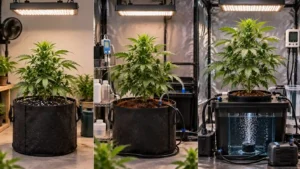
That recommendation is based on management complexity rather than a claim that soil produces inherently superior cannabis.
Choose soil if:
- This is your first grow.
- You want fewer variables to monitor.
- You prefer a more forgiving root environment.
- You don’t want to depend heavily on pumps or other hydro equipment.
- Your priority is learning basic plant care before adding more technical systems.
Consider coco if:
- You’ve already grown successfully in soil.
- You want more control over feeding and irrigation.
- You’re comfortable paying closer attention to the root environment.
- You specifically want to learn soilless growing.
- You’re prepared for more frequent management than a typical soil container.
Consider hydroponics if:
- You’re specifically interested in hydroponic cultivation as a skill.
- You understand that pH, nutrient concentration, oxygen, and root-zone conditions require active management.
- You are comfortable monitoring equipment and the root environment.
- You understand that greater control also means less room for unmanaged mistakes.
The easiest medium for a first cannabis grow is generally soil. Coco is a reasonable next step for growers who want more control, while hydroponics makes the most sense when the grower is deliberately choosing the technical complexity rather than simply chasing a promised yield advantage.
A Simple “Which Medium Fits Me?” Decision Guide
Ask yourself these five questions:
- Is this my first grow?
→ If yes, start by considering soil. - Do I want maximum simplicity?
→ Soil generally involves fewer root-zone variables. - Do I want more control over feeding?
→ Coco may be a better fit. - Am I specifically interested in learning hydroponics?
→ Hydro can make sense, provided you’re prepared for the monitoring involved. - Am I choosing hydro only because someone promised dramatically higher yields?
→ Stop and reconsider. The evidence does not support treating a universal percentage advantage as established fact.
That last question may save more beginners from a bad decision than any equipment checklist.
Frequently Asked Questions
Is coco coir the same as soil?
No. Coco is a soilless growing medium and is technically considered part of hydroponic cultivation. It can feel similar to soil when handled in a container, but its nutrient buffering and irrigation requirements are different.
What’s the easiest growing medium for a first cannabis grow?
For most true beginners, soil is the simplest choice because its buffering provides more room for small management mistakes.
Is hydroponics hard for beginners?
It can be. Hydroponics gives the grower greater control over the root environment but also requires closer attention to factors such as pH, nutrient concentration, water temperature, oxygen, and equipment.
Does hydroponics really yield more than soil?
Not by a guaranteed percentage. Well-managed hydroponic systems can support rapid growth and high productivity, but results depend on genetics, environment, irrigation, nutrition, and grower skill. Research does not justify treating the commonly repeated “30–50% more” figure as a universal cannabis rule.
Does the growing medium determine cannabis potency?
No. Current peer-reviewed evidence indicates that cannabinoid concentration is primarily associated with genotype under stable growing conditions, although substrate choice can affect growth and yield.
Does growing medium change flavor or terpene profile?
Growers commonly report differences in flavor and terpene expression between growing methods, but the research reviewed for this article does not establish a simple rule that soil always produces better flavor than coco or hydroponics. Treat that claim as anecdotal rather than settled science.
Should I use soil or coco for autoflowers?
Both can work. Soil prioritizes simplicity, while coco can provide more direct control over nutrient delivery. For a first grow, the simpler system may be easier to manage; experienced growers may value coco’s additional control.
Is DWC good for beginners?
DWC can be learned by beginners, but it is generally a more demanding first system because the root environment depends heavily on active management of water, oxygen, nutrient concentration, and temperature.
How often do you water coco compared with soil?
Coco commonly requires more frequent irrigation management than conventional soil because its physical properties and feeding approach are different. The exact frequency depends on the substrate, container, plant, environment, and irrigation system.
Can root rot happen in soil or coco?
Yes. Root disease is not exclusive to hydroponics. Excessive moisture can reduce oxygen around roots in soil or coco as well. Cornell’s hydroponic research highlights the connection between waterlogged conditions, low dissolved oxygen, temperature, and Pythium risk.
Is living soil the same as regular potting soil?
Not exactly. Living soil is a specific soil-growing approach that relies heavily on biological activity and its own management philosophy. It deserves separate treatment from a general soil-versus-coco-versus-hydro comparison.
The Bottom Line
The best growing medium isn’t necessarily the one with the most technology or the biggest theoretical yield.
For beginners, soil is usually the easiest place to start because it provides more buffering and demands less active root-zone management. Coco is a useful middle ground for growers who want greater control without moving directly into a complex hydroponic system. Hydroponics offers precision and strong production potential, but that advantage comes with greater responsibility.
The most useful way to think about soil vs. coco vs. hydroponics for cannabis is therefore not “Which medium wins?”
It’s:
How much control do you want, how much monitoring can you realistically handle, and how much room for error do you need?
Once you answer those questions, the choice becomes much clearer.
For more beginner guidance, continue with the site’s full beginner cannabis growing guide and related resources on cannabis plant problems, pH management, nutrient issues, and autoflower versus photoperiod growing.
Sources:
-
Malík, M., & Tlustoš, P. (2025). Soilless growing media for cannabis cultivation. Agriculture, 15(18), Article 1955. https://doi.org/10.3390/agriculture15181955
https://www.mdpi.com/2077-0472/15/18/1955
Use for: the physical and chemical properties of rockwool, coconut coir, peat-based substrates, perlite, clay media, aeration, water-holding capacity, nutrient buffering, biomass production, and resource-use efficiency.ideas.repec -
Schober, T., et al. (2024). Growth dynamics and yield formation of cannabis (Cannabis sativa) cultivated in differing growing media under semi-controlled greenhouse conditions. Industrial Crops and Products, 213, Article 118410. https://doi.org/10.1016/j.indcrop.2024.118410
https://www.sciencedirect.com/science/article/pii/S0926669023009378
Use for: comparisons of cannabis grown in rockwool, coconut coir, and peat-perlite media; the roles of water availability, irrigation management, biomass accumulation, nitrogen uptake, and yield formation.sciencedirect -
Malík, M., & Tlustoš, P. (2025). Soilless growing media for cannabis cultivation. Agriculture, 15(18), Article 1955. https://doi.org/10.3390/agriculture15181955
Use this review—not a general claim—to support the statement that substrate selection can affect rooting, vegetative growth, water availability, nutrient buffering, and flower yield, while cultivar/genotype strongly influences cannabinoid concentration.ideas.repec -
Mattson, N. S. (2018, January 30). Pythium root rot on hydroponically grown basil and spinach. HortiDaily.
https://www.hortidaily.com/article/6040777/pythium-root-rot-on-hydroponically-grown-basil-and-spinach/
Use for: hydroponic root-zone disease guidance derived from Cornell University research—Pythium risk, a 20–24 °C root-zone temperature target, dissolved oxygen above 6 ppm, and approximately 8–9 ppm as near-saturation. This is hydroponic basil and spinach guidance, not cannabis-specific evidence.hortidaily -
Mattson, N. S. (2017, May 29). Monitoring is critical for hydroponic production systems. HortiDaily.
https://www.hortidaily.com/article/6035178/monitoring-is-critical-for-hydroponic-production-systems/
Use for: the claim that hydroponic root-zone pH, electrical conductivity, and temperature can change quickly because the nutrient solution has limited buffering; NFT systems may need especially close monitoring.hortidaily+1 -
Cockson, P., Landis, H., Smith, T., Hicks, K., & Whipker, B. E. (2019). Characterization of nutrient disorders of Cannabis sativa. Applied Sciences, 9(20), Article 4432. https://doi.org/10.3390/app9204432
https://www.mdpi.com/2076-3417/9/20/4432
Use for: cannabis nutrient-disorder symptoms and the importance of root-zone nutrient availability. Do not use it as a direct soil-versus-coco-versus-hydroponics comparison. -
Llewellyn, D., Golem, S., Jones, A. M. P., & Zheng, Y. (2023). Foliar symptomology, nutrient content, yield, and secondary metabolite variability of cannabis grown hydroponically with different single-element nutrient deficiencies. Plants, 12(3), Article 422. https://doi.org/10.3390/plants12030422
https://www.mdpi.com/2223-7747/12/3/422
Use for: cannabis nutrient management and deficiency responses in a hydroponic system. Do not use it to claim that hydroponics necessarily outyields soil.