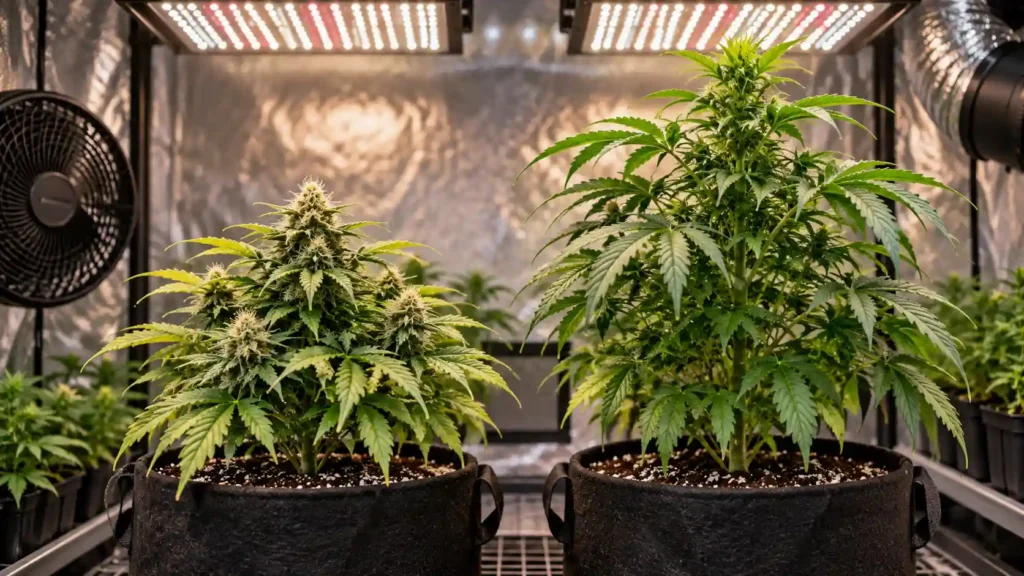
You open a seed listing and one word carries a lot of weight: autoflower or photoperiod. The listing doesn’t say what it means for the months ahead.
Here is what it means. The two types start flowering for different reasons, and that one difference shapes how long the grow takes, how big the plants get, and how much room you have to recover from mistakes.
The short answer is that autoflowers suit small spaces, short seasons, and growers who want a quicker, simpler first run. Photoperiod plants suit growers who want control over size and timing and don’t mind waiting. Experienced growers disagree about which is easier for a true first-timer, so the sections below help you decide by situation instead of giving one verdict.
Key takeaways
- Photoperiod plants flower when nights get long enough. Autoflowers flower with age.
- Autoflowers finish sooner and stay smaller. Photoperiod plants take longer but have a higher yield ceiling and can be cloned.
- Neither is better overall. The right pick depends on your space, timeline, and appetite for managing a light schedule.
- “Feminized” and “autoflower” describe different things.
What’s the Real Difference Between Autoflower and Photoperiod Cannabis?
A photoperiod plant decides when to flower by measuring darkness. An autoflower decides by age.
Cannabis is a short-day plant, meaning it flowers once nights are long enough. Cornell researchers describe the plant as flowering once night length reaches a critical threshold, and note that some plants ignore day length entirely and are colloquially called “autoflowering.” (Toth et al., 2022) nih
Under long days, such as 18 hours of light and 6 of dark (18/6), a photoperiod plant stays in the vegetative stage and keeps building leaves and stems. Indoors, growers switch to 12 hours of light and 12 of dark (12/12) to trigger flowering. Outdoors, the shorter days of late summer do the same job.
The 12-hour figure is a convention, not a hard line. In a controlled study of ten drug-type cultivars, every one started flowering under light periods up to 14 hours, with delays of anywhere from none to about four days compared with 12 hours. (Ahrens et al., 2023) The threshold varies by strain.
For a beginner, 12/12 is still the reliable, well-tested schedule. An autoflower ignores all of this. It begins flowering on its own, commonly around three to four weeks after sprouting, whatever the light schedule.
Picture two seedlings under the same 18/6 lights. The photoperiod plant keeps growing leaves for as long as you leave the lights on that schedule, even for months. The autoflower starts making buds by week three or four, and from then on its clock is running.
[Visual suggestion: two-column diagram, “Trigger = light schedule” vs. “Trigger = plant age”]
The vegetative and flowering stages are the same in both types. What differs is what flips the switch. Our guide to the stages of cannabis growth and harvest shows what each stage looks like.
Why Autoflowers Exist (The Genetics, Briefly)
Autoflowers descend from Cannabis ruderalis, a hardy form native to harsh climates in Russia, central Europe, and central Asia. Where summers are short, waiting for long nights is a risky plan, and flowering by age is safer. Genetic work supports this.

Loss-of-function versions of a clock gene called CsPRR37 are found in the highest-latitude regions, which suggests the gene may help cannabis adapt to different latitudes.
Researchers have now pinned down what likely changed. The Cornell team mapped the autoflower trait to one region of the genome, which they named Autoflower1 (Toth et al., 2022). A separate team found a splice-site mutation in CsPRR37 in autoflowering plants. That gene normally represses a flowering signal, so the mutation helps explain why the plants no longer wait for the right day length. (Leckie et al., 2024) wiley
The story isn’t fully settled. A second locus on a different chromosome has also been linked to photoperiod-insensitive flowering. “One gene causes autoflowering” is probably too tidy, and research is still filling in the picture. You don’t need the genetics to choose seeds, but it explains why autoflowers are so consistent about timing.
Autoflower vs. Photoperiod at a Glance
Most autoflowers go from seed to harvest in roughly 9 to 12 weeks. A photoperiod plant usually takes about 3.5 to 5 months or more indoors, depending on how long you let it grow before flowering.
The figures below are typical ranges reported by breeders and grower guides, not results from controlled trials. They shift a lot with strain and setup. Because reliable side-by-side yield data is scarce, yield is compared in relative terms rather than grams.
| Autoflower | Photoperiod | |
| What triggers flowering | Plant age | Long nights (about 12 hours of darkness indoors) |
| Seed to harvest | Roughly 9–12 weeks | Roughly 3.5–5+ months indoors |
| Typical height | Often under about 3 ft (90 cm), some taller | Highly variable; you control it through veg time |
| Light schedule | Flexible; long days such as 18/6 are common | Long days in veg, then a strict 12/12 |
| Yield per plant | Usually lower | Usually higher, with a higher ceiling |
| Cloning a favorite plant | Not practical | Easy |
| Room for mistakes | Less recovery time, more forgiving of timing | Can extend veg to recover, but light leaks matter |
| Harvests per year | More runs possible | Fewer runs |
Per plant, photoperiod usually wins on yield because you can let it grow larger first. Per square foot per year, the gap can narrow, since autoflowers are smaller and allow more harvests. That is grower reasoning rather than a tested result, so treat it as a starting point.
[Visual suggestion: the comparison table above, styled for mobile scrolling]
Pros and Cons of Autoflower
Pros
- Speed. A short seed-to-harvest window means less time for things to go wrong.
- Compact size. They suit tents and spaces with limited height. Smaller plants also work well with sea of green (SOG), which packs many small plants together.
- Simpler lighting. There is no 12/12 switch to time. Growers generally describe autoflowers as more forgiving here, but that is community experience, not lab-verified fact.
Cons
- Lower yield ceiling. Less time to grow means smaller plants.
- Little time to recover. The clock keeps running if a seedling gets stunted by overwatering, heat, or rough handling. The plant may flower while still small.
- No practical cloning. A cutting doesn’t hand you a fresh grow cycle (more on this below).
- Limited training. Gentle bending early on is generally fine. Heavy pruning is riskier because there is so little time to bounce back. Our cannabis training guide covers the techniques.
Pros and Cons of Photoperiod
Pros
- Higher yield ceiling. Extra veg time builds a bigger plant with more bud sites.
- Control over timing. You choose when flowering starts. If growth is slow or the plant is stressed, you can extend veg and let it recover.
- Cloning. You can keep a favorite plant going as a “mother” and take cuttings. The cannabis cloning guide explains how.
Cons
- Light management. Flowering needs uninterrupted darkness. Growers commonly report that light leaks during the dark period stress plants and can trigger hermaphroditism, where a plant grows both male and female flowers. A timer and a truly light-tight space handle most of this.
- Longer timeline. More weeks means more chances for pests, nutrient trouble, or a schedule slip.
- More space. Plants often double in height or more after the switch to 12/12, so plan for the flowering size, not the seedling size.
Is photoperiod harder? It asks for more management, not necessarily more skill. If you can run a timer and keep the space dark, the skill gap is small.
Which Should You Grow?
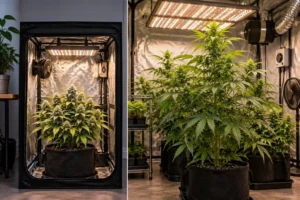
Choose by your situation. Here is how the common ones play out:
- Limited headroom, like a small tent or cupboard-sized space: autoflower. Compact size is the main draw.
- Short or cool outdoor season: autoflower, since it can finish before the weather turns. An early-flowering photoperiod strain is the other route, sometimes paired with light deprivation, which means covering plants to shorten their days. That takes more effort.
- First grow, and you want the most forgiving timeline: autoflower is the common pick. Some experienced growers argue photoperiod teaches more, because you can slow down and correct mistakes. Both views are credible.
- Biggest possible plants and you don’t mind waiting: photoperiod.
- Want to keep a favorite plant going through clones: photoperiod.
- Want more harvests per year: autoflower.
[Visual suggestion: simple decision tree, “Do you have strict control of light and room to grow tall?” → yes: photoperiod is viable; no: autoflower]
If you’re still torn, ask yourself whether you can keep a strict light schedule and give plants room to grow tall. If yes, photoperiod is realistic. If not, an autoflower removes two of the biggest variables. For a wider look at buying seeds, see our guide to choosing the right cannabis seed type.
Common Mix-Ups to Avoid
Feminized does not mean autoflower.
These are two separate questions about a seed. Feminized versus regular is about plant sex. Autoflower versus photoperiod is about what triggers flowering. Any combination exists: feminized autoflower, feminized photoperiod, regular autoflower, or regular photoperiod. Our guide to male vs. female cannabis plants covers the sex side.
Cloning an autoflower doesn’t restart its clock.
A cutting comes from a plant already on its age-based path. Growers commonly report that clones of autoflowers flower early and stay small, so cloning is not a way to keep a favorite going. Research on how a cutting’s age plays out is thin, so this rests on grower experience plus the logic of how the trait works.
Mixing both types in one tent needs planning.
Photoperiod plants can share an 18/6 schedule with autoflowers, but they won’t flower until you move to 12/12. The autoflowers will be finishing long before that, and the photoperiod plants’ extra height can shade them. Once you switch to 12/12, the autoflowers still flower but get fewer light hours. Most beginners find one type per tent simpler for a first run.
FAQ
How many hours of light do autoflowers need?
Because they flower by age, the schedule doesn’t control flowering. Many growers run 18 to 20 hours of light a day, and some go longer. More hours mean more light energy but also more heat and electricity, and there is little controlled data on a single best schedule.
Are autoflowers less potent than photoperiod strains?
Early autoflowers often were. The first ruderalis crosses had low THC and lacked the finer qualities of established strains. Breeders now report the gap has narrowed a lot, but independent comparisons are limited. Potency varies by breeder and strain more than by type.
Can you train or prune autoflower plants?
Yes, lightly. Gentle bending or tying early on is generally well tolerated. Heavy or late training is riskier because the plant has little time to recover.
What happens if I get my autoflower’s light schedule wrong?
Usually not much. It flowers by age regardless, though very short light periods may slow growth. A photoperiod plant is far less forgiving, because a lighting error can delay flowering or stress the plant.
Why isn’t my autoflower flowering on time?
Most autoflowers show early flower signs within a few weeks of sprouting. A late start can come from slower genetics, early stress that stunted growth, or a seed that was actually photoperiod. A single symptom can’t tell you which, so check the seed’s listing and the plant’s early growth history first.
Why would a photoperiod plant flower outdoors on its own?
As summer ends, days shorten and nights lengthen past the plant’s critical threshold, and that triggers flowering. The exact timing depends on latitude and strain.
Can a photoperiod plant go back to vegetative growth after flowering starts?
Growers call this revenge. Returning to long days can push a plant back toward vegetative growth, but results are unpredictable and the plant is under stress. It is not a beginner’s strategy.
What’s a good first strain if I’m not sure which type to pick?
Start from your space and schedule using the decision list above, then look for a strain that fits. Our seeds guide goes deeper on strain selection without pointing you to specific brands.
The Bottom Line
Everything comes back to one difference. Autoflowers flower by age, so they are fast, compact, and simple. Photoperiod plants flower by light, so they offer control and a higher yield ceiling in exchange for more time and space. The numbers here are typical ranges, and genetics vary by breeder and strain.
Cannabis growing laws differ by country, state, and even city, so check your local rules and official government sources before buying seeds or planting.
Once you’ve chosen, our step-by-step cannabis growing guide walks through what comes next.
References:
- Ahrens, A., Llewellyn, D., & Zheng, Y. (2023). Is twelve hours really the optimum photoperiod for promoting flowering in indoor-grown cultivars of Cannabis sativa? Plants, 12(14), Article 2605. https://doi.org/10.3390/plants12142605pubmed.ncbi.nlm.nih+1
- Toth, J. A., Stack, G. M., Carlson, C. H., & Smart, L. B. (2022). Identification and mapping of major-effect flowering time loci Autoflower1 and Early1 in Cannabis sativa L. Frontiers in Plant Science, 13, Article 991680. https://doi.org/10.3389/fpls.2022.991680pubmed.ncbi.nlm.nih+1
- Dowling, C. A., Shi, J., Toth, J. A., Quade, M. A., Smart, L. B., McCabe, P. F., Schilling, S., & Melzer, R. (2024). A FLOWERING LOCUS T ortholog is associated with photoperiod-insensitive flowering in hemp (Cannabis sativa L.). The Plant Journal, 119(1), 383–403. https://doi.org/10.1111/tpj.16769pubmed.ncbi.nlm.nih+1
- Leckie, K. M., Sawler, J., Kapos, P., MacKenzie, J. O., Giles, I., Baynes, K., Lo, J., Baute, G. J., & Celedon, J. M. (2024). Loss of daylength sensitivity by splice site mutation in Cannabis pseudo-response regulator. The Plant Journal, 118(6), 2020–2036. https://doi.org/10.1111/tpj.16726pubmed.ncbi.nlm.nih
- Danziger, N., Bernstein, N., & others. (2023). Is twelve hours really the optimum photoperiod for promoting flowering in Cannabis sativa? Plants, 12(14), Article 2632. https://doi.org/10.3390/plants12142632.
Do not use this citation for your article: it is a different paper/article number than the correct Ahrens, Llewellyn, and Zheng source above. Your correct photoperiod citation is item 1.pubmed.ncbi.nlm.nih+1 - Rodriguez-Morrison, V., Llewellyn, D., & Zheng, Y. (2021). Cannabis yield, potency, and leaf photosynthesis respond differently to increasing light levels in an indoor environment. Frontiers in Plant Science, 12, Article 646020. https://doi.org/10.3389/fpls.2021.646020
- Llewellyn, D., Jones, A. M. P., & Zheng, Y. (2022). Indoor grown cannabis yield increased proportionally with light intensity, but ultraviolet radiation did not affect yield or cannabinoid content. Frontiers in Plant Science, 13, Article 974018. https://doi.org/10.3389/fpls.2022.974018
Practical sources:
- Cockson, P., Veazie, P., Logan, D., & Whipker, B. E. (2024, April 18). How to troubleshoot cannabis nutrient disorders. Cannabis Business Times. https://www.cannabisbusinesstimes.com/columns/cultivation-matters/news/15686755/how-to-troubleshoot-cannabis-nutrient-disorders
- Grow Weed Easy. (n.d.). Autoflowering cannabis: Complete guide. https://www.growweedeasy.com/autoflowering-cannabis
- Royal Queen Seeds. (n.d.). Autoflowering vs. photoperiod cannabis plants. https://www.royalqueenseeds.com/blog-autoflowering-vs-photoperiod-cannabis-n65