If you have ever grown tomatoes, you probably know that a little pruning and support can make a huge difference in how many fruits you harvest. Cannabis plants work in a surprisingly similar way. With the right training techniques, you can shape how a plant grows, encourage it to produce more flowering sites, and make the most of the space and light you have available.
But if you are new to growing cannabis, the idea of bending, cutting, or tying your plants might feel a little intimidating. What if you hurt them? What if you do it wrong? These are completely normal concerns, and this guide is here to walk you through everything step by step.
In this article, you will learn what plant training actually is, why growers do it, which methods work best for beginners, and how to avoid the most common mistakes. By the end, you will have a solid understanding of how to train cannabis plants in a way that is practical, safe for the plant, and based on real horticultural principles.
What Does “Training” a Cannabis Plant Actually Mean?
Plant training is the practice of physically manipulating a plant’s structure to influence how it grows. In horticulture, this concept has been used for centuries. Fruit trees are pruned and shaped. Grapevines are tied to trellises. Roses are deadheaded to encourage new blooms.
With cannabis, training works on the same basic principle. Left alone, a cannabis plant tends to grow in a natural Christmas tree shape, with one dominant central stem reaching upward and smaller branches fanning out below it. This top-heavy structure means the upper parts of the plant receive most of the light, while the lower branches get very little.
Training changes that. By bending, tying, or selectively trimming parts of the plant, you can create a flatter, more even canopy where multiple branches receive roughly the same amount of light. The result is a plant that develops many productive growth points instead of just one or two.
Why Do Growers Train Cannabis Plants?
There are several good reasons why training has become a standard practice among experienced cannabis cultivators.
- Better light distribution: When you flatten the canopy, every branch gets closer to the light source. More light exposure generally means more vigorous growth across the whole plant.
- More flowering sites: Instead of concentrating energy in one main cola (the primary flowering cluster), a trained plant can develop multiple colas of similar size.
- Better use of space: In a small indoor grow room or tent, vertical space is often limited. Training helps you work with those constraints instead of fighting them.
- Improved airflow: Dense, untrained plants can trap moisture and restrict airflow, which increases the risk of mold and pests. A trained, open canopy breathes better.
Low-Stress Training Techniques (Best for Beginners)
Training methods are generally split into two categories: low-stress training (LST) and high-stress training (HST). As a beginner, starting with low-stress methods makes the most sense. These techniques work with the plant gently and give it time to recover and adapt as you go.
1. Basic Low-Stress Training (LST)
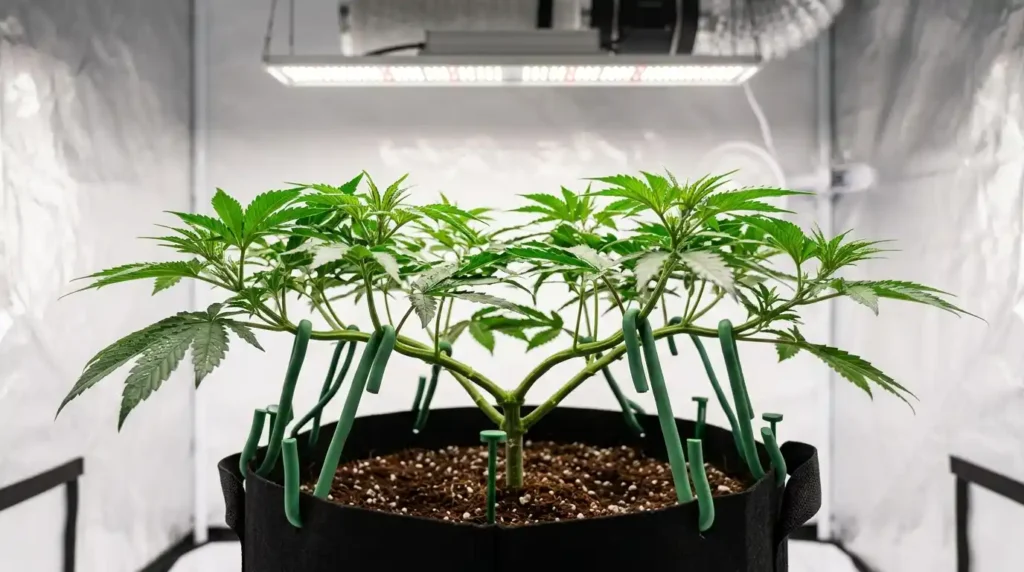
This is the foundation of most training approaches. The idea is simple: you gently bend the main stem sideways and tie it down so the plant grows outward rather than straight up. This causes the lower branches to receive more light and start growing upward, eventually creating a more level canopy.
What you need:
- Soft garden wire or pipe cleaners
- Small clips or hooks
- A pot with holes around the rim for anchoring
How to do it:
- Wait until your plant has at least three to four nodes (the points along the stem where branches grow out).
- Gently bend the main stem to one side, aiming for roughly a 90-degree angle if possible. Do this slowly and carefully. If you feel resistance, ease off slightly.
- Secure the stem in that bent position using a soft tie attached to the pot or a stake.
- Over the next few days, the plant will start growing its branches upward. Continue adjusting the ties as new growth appears, keeping the canopy as flat and even as possible.
2. Screen of Green (ScrOG)
ScrOG takes LST a step further by using a horizontal screen or trellis net placed above the plant. As the plant grows up into the screen, you tuck the branches underneath it so they spread outward instead of growing vertically. Over time, the plant fills the screen with an even layer of growth.
This method is particularly useful in indoor setups where you have a fixed light height and want to make sure every part of the canopy is at the same distance from the light source. It takes a bit more setup than basic LST, but the results are a very uniform, productive plant.
3. Sea of Green (SOG)
Sea of Green is less about training individual plants and more about growing many smaller plants close together so their canopies merge into one continuous layer. Each plant is kept small and encouraged to develop a single main cola. This method is popular where space is tight and fast turnaround is a priority.
High-Stress Training Techniques (For Intermediate Growers)
High-stress techniques involve intentionally damaging part of the plant to trigger a response. These methods can be highly effective, but they require more experience and a healthy plant to begin with. Recovery time is also needed after applying these techniques.
Topping
Topping means cutting off the very top of the main stem, specifically the newest growth tip. When you do this, the plant responds by growing two new main shoots from just below the cut. Those two shoots then develop into two new main colas instead of one. You can repeat this process on those new shoots to create four main colas, then eight, and so on.
Think of it like trimming a hedge. When you cut the tip, the plant pushes energy into the branches below, resulting in fuller, bushier growth. Topping is best done early in the vegetative stage when the plant is growing vigorously and has enough leaves to recover quickly.
Fimming
Fimming is similar to topping but involves removing only about 75 percent of the newest growth tip rather than cutting it off entirely. This creates a slightly different result, often producing three or four new shoots instead of two. The technique is less precise than topping and can produce inconsistent results, but some growers prefer it for creating a very bushy plant.
Lolli popping
Lolli popping refers to removing the lower branches and growth that receive very little light. Since these lower sites get shaded by the upper canopy, they rarely develop into productive growth. By removing them, the plant redirects its energy toward the well-lit upper portions, which can improve overall quality.
Step-by-Step: Starting Your First Training Session
Here is a simple, beginner-friendly training plan using basic LST to get you started.
- Wait for the right stage: Only train during the vegetative stage, not during flowering. The plant needs to be actively growing to recover from training.
- Assess the plant: Your plant should look healthy with green leaves, no signs of nutrient deficiency, and at least three to four nodes of growth.
- Prepare your materials: Have your ties, hooks, and a clean space ready before you begin.
- Make your first bend: Slowly and carefully bend the main stem to one side. Secure it with a soft tie.
- Check daily: Observe how the plant responds. Adjust ties as needed. New growth will emerge within a few days.
- Continue shaping: As new branches grow, gently guide them outward to fill the available space. The goal is a flat, even canopy.
Pro Tips from Experienced Growers
- Train during watering days: Stems are slightly more pliable right after watering, which makes bending a little easier and reduces the risk of snapping.
- Start slow: You do not have to achieve a 90-degree bend on day one. Ease the stem down gradually over several sessions.
- Use soft materials: Hard wire or string can cut into stems. Use soft ties, Velcro strips, or pipe cleaners instead.
- Always use clean tools: If you are using scissors or a blade for any cuts, sterilize them first. This prevents introducing pathogens to open plant tissue.
- Give the plant time to recover: After high-stress techniques like topping, wait a few days before making any additional changes.
Common Beginner Mistakes to Avoid
- Training too early: Young seedlings are fragile. Wait until the plant has developed properly before starting any training.
- Training during flowering: Once a plant switches to the flowering stage, its structure becomes less flexible and it is focused on producing flowers rather than vegetative growth. Heavy training at this point can stress the plant significantly.
- Bending too aggressively: Stems can snap if forced. If you hear a creak or crack, stop. A snapped stem can sometimes be splinted with tape and will heal, but prevention is far better.
- Ignoring the plant’s response: Training is not a one-time task. Check your plant every day after training and adjust accordingly.
- Training a stressed or sick plant: Only train healthy plants. If a plant is already struggling with nutrient issues, pests, or disease, adding training stress on top of that can be too much.
Important Considerations
Know Your Legal Status
This point is worth repeating clearly. Cannabis cultivation is legal in some places and strictly prohibited in others. Before you grow any cannabis plant, research the laws in your specific country, state, or territory. Laws can vary even at the city or county level. This article is purely educational, and nothing here should be taken as encouragement to grow cannabis where it is not legally permitted.
Environmental Factors Matter
Training is just one part of plant care. The environment in which your plant grows will have a major impact on how well it responds to training. Consistent temperature, adequate humidity, proper lighting, and good airflow all work together. A plant growing in poor conditions will not benefit as much from training as a healthy plant in a well-managed environment.
Genetics Play a Role
Different cannabis strains respond differently to training. Some varieties naturally grow short and bushy, while others are tall and stretchy. Some are more flexible and resilient, while others are more brittle. Understanding the general growth characteristics of the specific plant you are working with will help you choose the most appropriate training method.
Frequently Asked Questions
When should I start training cannabis plants?
The best time to begin training is during the vegetative stage, once the plant has developed at least three to four nodes. At this point, the stems are still flexible enough to bend without snapping easily, and the plant is actively growing, so it can recover quickly from any stress.
Can I train cannabis plants that are growing outdoors?
Yes, many training techniques work just as well outdoors as they do indoors. Low-stress training and topping are both commonly used on outdoor plants. Outdoors, plants often have more space to grow wider, which can work very well with LST methods that encourage horizontal spreading.
Will training hurt my plant?
Low-stress training methods are generally very gentle and should not cause lasting harm to a healthy plant. High-stress techniques like topping do involve cutting the plant, and recovery time is needed, but a healthy plant in a good environment will bounce back within a few days.
How do I know if I have trained my plant too aggressively?
Signs of over-training include wilting, yellowing leaves, slow or stunted growth, or stems that have snapped or split. If you notice these signs, stop training and give the plant time to recover. Remove any damaged material with clean scissors and make sure the growing conditions are optimal to support recovery.
Does training work with auto flowering cannabis varieties?
Auto flowering plants follow a fixed timeline and switch from vegetative to flowering based on age rather than light cycles. This means their vegetative window is shorter, leaving less time for training. Most experienced growers stick to gentle LST methods with autos and avoid high-stress techniques that require significant recovery time.
Quick Summary
- Training cannabis plants means physically manipulating their structure to improve light distribution and increase the number of productive growth sites.
- Low-stress training (LST) is the most beginner-friendly approach and involves gently bending and tying stems rather than cutting them.
- High-stress techniques like topping and fimming involve cutting the plant and are better suited to growers with some experience.
- Always train during the vegetative stage, not during flowering.
- Only train healthy, well-established plants in a good growing environment.
- Always check and follow the cannabis cultivation laws in your area.
Final Thoughts
Training cannabis plants is one of the most practical and rewarding skills a grower can develop. At its core, it is simply applied plant science. You are working with the natural growth tendencies of the plant, nudging it toward a structure that makes better use of available resources.
The key, especially for beginners, is to start gently and pay close attention to how the plant responds. No two plants are exactly alike, and part of learning to train cannabis plants well is developing an eye for what each individual plant needs.
Take your time, use clean and gentle tools, respect the plant’s recovery needs, and always make sure you are growing within the legal framework of your location. With patience and observation, training becomes an intuitive part of the growing process rather than something to fear.
Whether you are just starting out or looking to refine your technique, the foundational principles covered in this guide give you everything you need to begin training cannabis plants with confidence.
Disclaimer: Cannabis cultivation laws vary widely by country, state, and region. This article is intended purely for educational and informational purposes. Always check and comply with the laws in your local area before growing any plant.