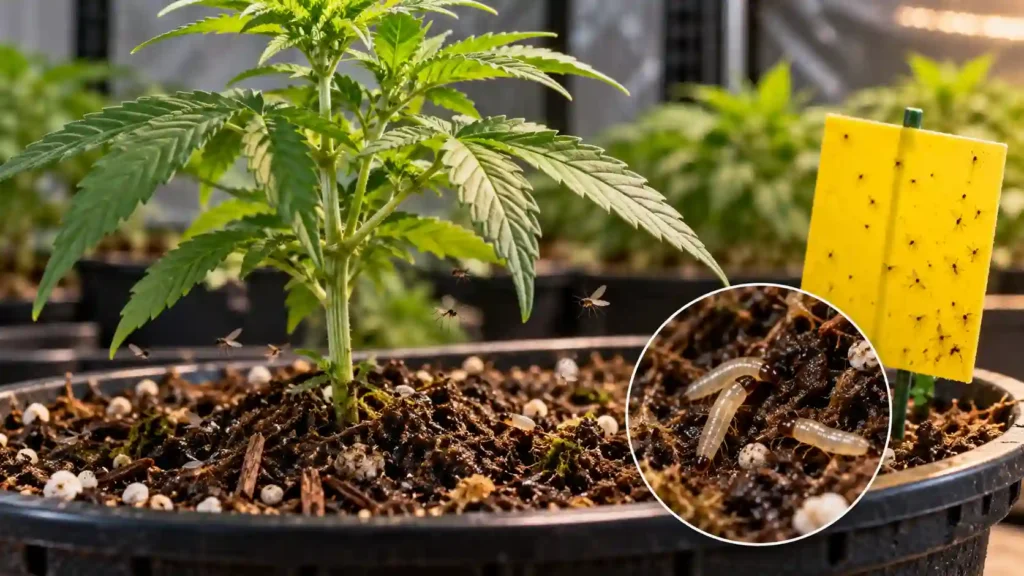
Tiny dark flies hovering around the surface of your cannabis growing medium can be easy to dismiss. But before reaching for a treatment, it helps to answer a more important question: are they actually fungus gnats, and is there a larval population developing in the growing medium?
Adult fungus gnats are the stage you notice first. Their larvae, however, live in the growing medium and are the stage to investigate when you are concerned about root stress. Larvae primarily feed on fungi, algae, and organic material, although they can also feed on roots under some conditions.
The practical approach is simple:
Identify → Confirm → Inspect → Control → Monitor → Prevent
That means diagnosing the pest and its life stage before assuming that every tiny fly represents serious plant damage.
Quick answer: Fungus gnats are tiny flies associated with soil and other growing media. Adults are easy to notice, but larvae live in the medium and are the life stage to investigate when assessing potential root damage.
Check This First
- Are the insects actually fungus gnats?
- Are they coming from the growing medium?
- Are larvae present?
- Is the medium staying wet for too long?
- Are seedlings or young plants showing stress?
- Are other containers showing the same problem?
Pro tip: Yellow sticky traps tell you about adult activity. They do not directly tell you how many larvae are present in the growing medium.
Warning: Don’t treat every tiny flying insect as a fungus gnat. Appearance, location, behavior, and when possible the immature stage should be considered together.
What Are Fungus Gnats on Cannabis?
Fungus gnats are small flies belonging to the family Sciaridae. Several genera and species occur in growing environments, including Bradysia. Adults are delicate, dark-colored, mosquito-like flies that are generally weak fliers. Their immature stages develop in soil, potting mix, and other growing media.
The life cycle has four main stages:
Egg → Larva → Pupa → Adult
The eggs and pupae occur in the growing medium, while larvae spend much of their development there. Larvae commonly feed on fungi and organic material. Depending on the species and conditions, they can also feed on root tissue and root hairs.
This distinction matters when dealing with fungus gnats on cannabis.
Seeing a few adults does not, by itself, prove that your cannabis plant has serious root damage. It tells you that further inspection is warranted.
The real question is whether a reproducing population is present and whether larvae are affecting the root zone.
What Do Fungus Gnats Look Like on Cannabis?
Correct identification should come before control. Fungus gnats can be confused with several other tiny insects that may appear around cannabis containers.
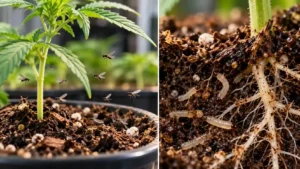
What adult fungus gnats look like
Adult fungus gnats are typically:
- Very small
- Grayish to black
- Slender and delicate
- Long-legged
- Long-antennaed
- Mosquito-like in appearance
- Weak fliers
- Commonly found around growing media
Virginia Tech describes adult fungus gnats as approximately 3 mm long, with transparent wings that may have smoky-gray shading.
If you disturb a container and several tiny dark flies rise from the growing-medium surface, fungus gnats become a reasonable possibility but that observation alone is not definitive.
What fungus gnat larvae look like
Fungus gnat larvae look very different from the adults.
They are generally:
- Pale or translucent
- Slender and worm-like
- Legless
- Found within moist growing media
- Equipped with a noticeably dark head capsule
Virginia Tech describes the larvae as pale, worm-like maggots with a dark head capsule.
Where should you look?
Pay particular attention to:
- The soil or medium surface
- The upper layer of the growing medium
- Persistently moist areas
- Organic debris around the container
- Pot edges
- Root-zone areas when inspection is appropriate
You don’t necessarily need to disturb the entire root system just to look for evidence. Start with the surface and upper medium, where larvae and the conditions supporting them are commonly found.
Are Fungus Gnats Actually Harmful to Cannabis Plants?
They can be, but the level of concern depends on what you find.
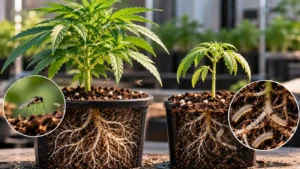
Adult fungus gnats are mainly the visible stage and a useful indicator that you should investigate the growing medium. The larvae are more important when assessing potential plant damage.
Larvae commonly feed on fungi and organic material, but some can also feed on root hairs and roots. Under heavier infestations, root feeding can contribute to plant stress, and young plants can be particularly vulnerable.
Adults vs. larvae
Think of the problem this way:
Adults → visible signal and monitoring target
Larvae → growing-medium and root-zone concern
A few adults flying around a healthy mature plant are not equivalent to a confirmed larval infestation.
Why seedlings deserve extra attention
Seedlings and young plants have relatively small root systems. Root injury therefore has the potential to represent a larger proportion of the available root system.
Extension guidance notes that fungus gnat larvae can cause stunting and that direct damage can be particularly important in seedlings and propagation environments.
A practical severity framework
| What you observe | What it suggests |
| One or a few adults | Investigate and monitor |
| Repeated adult catches | Reproduction may be occurring |
| Larvae found in the medium | Active reproduction is confirmed |
| Larvae + weak seedlings | Greater concern |
| Persistent population + plant stress | Control and environmental correction deserve attention |
If the plant is struggling but you cannot find larvae, don’t automatically blame fungus gnats. Watering problems, root problems, nutrient issues, other pests, and environmental stress can produce overlapping symptoms.
For watering-related differential diagnosis, see our guide to overwatered vs. underwatered cannabis.
Why Do Fungus Gnats Appear Around Cannabis Plants?
Fungus gnats are associated with moist growing media, particularly when moisture persists alongside suitable organic material and fungal growth.
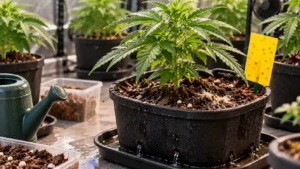
That does not mean that “overwatering causes fungus gnats” is a complete explanation.
A more accurate way to think about it is:
Persistent moisture + suitable growing conditions + access to the growing medium → opportunity for reproduction
Fungus gnats can also be introduced through plants, growing media, or nearby infested containers.
Moist growing media
Excessive or prolonged moisture can create favorable conditions for fungus gnats. UC IPM specifically recommends avoiding overwatering and maintaining good drainage because fungus gnats thrive in moist conditions.
Organic material and fungi
The name can be misleading if you assume the insects are simply eating the cannabis plant.
Larvae primarily feed on fungi and organic material in the growing medium. Decaying plant material and other organic debris can therefore contribute to favorable habitat.
Poor drainage
A container that remains wet for extended periods can maintain the conditions fungus gnats favor.
That is why correcting the environment is part of pest management not just an optional extra step.
For broader environmental guidance, see ideal growing conditions for cannabis.
They can arrive with plants or media
A fungus gnat problem does not necessarily begin because you watered incorrectly.
Potential sources include:
- New plants
- Cuttings
- Contaminated growing media
- Nearby potted plants
- Organic material already supporting fungus gnats
This is one reason checking the surrounding growing area matters.
How to Confirm You Actually Have Fungus Gnats
This is the most important diagnostic part of the process.
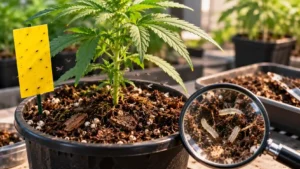
Use:
SEE → CHECK → CONFIRM → ASSESS
Step 1 — Observe the adults
Look for a combination of clues:
- Tiny dark flies
- Weak flight
- Mosquito-like shape
- Activity around the growing medium
- Adults rising when a container is disturbed
One characteristic alone is not enough.
Step 2 — Check the growing medium
Look for:
- Persistently wet areas
- Organic debris
- Algae or fungal growth
- Larvae
- Conditions that allow the surface or upper medium to remain wet for long periods
Step 3 — Look for larvae
If you can safely inspect the upper growing medium, look for pale, slender larvae with dark head capsules.
Finding larvae provides much stronger evidence of an active fungus gnat population than simply seeing an adult fly.
Step 4 — Use yellow sticky traps
Yellow sticky cards are useful for adult monitoring and capture.
They can help answer:
“Are adult numbers increasing or decreasing?”
They cannot directly answer:
“Exactly how many larvae are inside this container?”
UC IPM describes yellow sticky traps as a monitoring tool that can provide a relative measure of adult pest abundance over time.
Step 5 — Assess plant symptoms
Look for:
- Slow growth
- Weak seedlings
- Reduced vigor
- Unexplained stress
- Wilting that doesn’t match the apparent watering level
These observations can support your investigation, but they are not specific to fungus gnats.
Step 6 — Confirm before escalating
If the insects don’t match the typical appearance, aren’t associated with the growing medium, or no larvae can be found, compare them with other possible pests before assuming fungus gnats.
A simple diagnostic decision tree
Tiny flies?
↓
Small + dark + weak-flying?
↓
Associated with the growing medium?
↓
Inspect the medium
↓
Larvae present?
Yes → likely active fungus gnat reproduction → assess plant impact
No → continue monitoring and compare with other small flies or pests
The goal isn’t to make a perfect diagnosis from one observation. It’s to collect several pieces of evidence before choosing a control strategy.
Fungus Gnats vs. Other Small Flies and Soil Pests
Several small insects can appear around cannabis plants. Treating the wrong pest can waste time and may disturb the growing environment unnecessarily.
| Pest/problem | Typical location | Useful clue |
| Fungus gnats | Growing medium | Tiny dark, weak-flying adults around soil/media |
| Fruit flies | Fermenting organic material | Stronger association with fruit or fermentation |
| Shore flies | Wet growing areas | Different adult appearance and behavior |
| Whiteflies | Leaf undersides | Small white adults fly from foliage |
| Thrips | Leaves and flowers | Characteristic feeding damage |
| Springtails | Moist media | Jumping behavior; no adult fly stage |
Fungus gnats vs. fruit flies
The location is useful.
If tiny dark insects repeatedly emerge from the growing medium, fungus gnats deserve consideration. Fruit flies are more strongly associated with fermenting or decomposing food materials.
Fungus gnats vs. whiteflies
Whiteflies are primarily associated with foliage. When disturbed, adults often fly from the undersides of leaves.
Fungus gnats, by contrast, are strongly associated with the growing medium.
Fungus gnats vs. thrips
Thrips are plant-feeding insects associated with leaves and flowers and can leave characteristic feeding damage.
If the insects are concentrated on foliage rather than emerging around the medium, investigate other possibilities.
Fungus gnats vs. springtails
Springtails can occur in damp growing media, but they typically jump rather than fly.
The key principle is:
Location + appearance + behavior + life stage + plant symptoms
Use the combination rather than relying on a single clue.
How to Control Fungus Gnats on Cannabis
Once fungus gnats are reasonably confirmed, use an integrated approach rather than focusing exclusively on the adults you can see.
The basic framework is:
Control adults + target larvae + correct the environment + monitor
1. Correct the growing-medium conditions
Start with the growing environment.
Look for:
- Unnecessary prolonged saturation
- Poor drainage
- Standing water
- Excessive organic debris
- Growing media that stays wet much longer than expected
Avoid imposing a universal “dry for X days” schedule. Different containers, plants, media, temperatures, and environments behave differently.
The goal is to avoid creating persistently favorable conditions while still providing appropriate water for the plant.
If moisture problems are part of the picture, compare your symptoms with our overwatered vs. underwatered cannabis guide.
2. Use yellow sticky traps for adults
Place yellow sticky cards where adult fungus gnats are active around the growing medium.
They can:
- Capture adults
- Reduce adult activity
- Help reveal which containers have more activity
- Provide a way to compare population levels over time
But remember their limitation:
Sticky traps don’t reach larvae inside the growing medium. CSU Extension and UC IPM both identify yellow sticky cards as useful for monitoring or capturing adult fungus gnats.
3. Target larvae when they are present
If inspection confirms larvae, consider an evidence-supported biological control appropriate for the growing situation. Bti and Steinernema feltiae nematodes are examples discussed by extension sources for fungus gnat larvae.
4. Correct the conditions supporting reproduction
A larval treatment without environmental correction can leave the growing medium favorable for another generation.
Address:
- Moisture management
- Drainage
- Organic debris
- Standing water
- Nearby infested containers
5. Keep monitoring
Don’t judge success only by what you see immediately after treatment.
Continue checking adult activity and, where appropriate, the growing medium.
A useful monitoring question is:
Are adult catches becoming less frequent over time?
UC IPM recommends using sticky traps to compare pest abundance between monitoring dates rather than treating a single trap count as an absolute population measurement.
6. Check the other pots
If several containers share the same growing area, inspect them all.
One untreated container can potentially act as a reservoir for continued adult activity.
Key takeaway: Adults → monitor. Larvae → investigate/control. Environment → correct.
Bti, Beneficial Nematodes, and Predatory Mites: What Targets the Larvae?
Different management tools act on different life stages.
| Method | Primary target | Main role | Important limitation |
| Yellow sticky traps | Adults | Monitoring/capture | Doesn’t reach larvae |
| Bti | Larvae | Biological control | Product directions and use conditions vary |
| Steinernema feltiae | Larvae | Biological control | Moisture and application conditions matter |
| Predatory mites | Immature stages | Biological control | Environmental compatibility matters |
Bti
Bacillus thuringiensis israelensis (Bti) is a biological control option used against certain fly larvae, including fungus gnat larvae. It is applied to the growing medium according to the product’s directions. Colorado State University Extension and UC IPM both describe Bti as a larval-control option.
One important distinction: Bti is not interchangeable with every product marketed as “Bt.” Different Bacillus thuringiensis subspecies target different insect groups. UC IPM specifically notes that Bt products intended for caterpillars are not effective against fungus gnat fly larvae.
Steinernema feltiae nematodes
Beneficial nematodes such as Steinernema feltiae can target fungus gnat larvae in the growing medium. Their performance depends on factors such as application conditions and moisture. UC IPM identifies S. feltiae as an effective biological-control nematode for fungus gnat larvae. Always follow the instructions for the specific biological-control product you use.
Predatory mites
Predatory mites in groups such as Hypoaspis and Stratiolaelaps can prey on fungus gnat larvae and other small soil-dwelling organisms. Their suitability depends on the growing environment and the particular biological-control program.
There is no single biological control that should be called universally “best.” The appropriate choice depends on the pest stage, growing environment, product availability, and application requirements.
What About Common Fungus Gnat Home Remedies?
Searches for fungus gnats often produce recommendations involving cinnamon, hydrogen peroxide, sand, diatomaceous earth, or coffee grounds. The problem is that popular advice and well-supported pest-management evidence are not the same thing.
Cinnamon
Cinnamon is frequently recommended online, but the evidence does not justify presenting it as a reliable primary control for an established fungus gnat population.
Hydrogen peroxide
Avoid treating a particular hydrogen-peroxide dilution as a universal, guaranteed-safe solution for cannabis.
Concentration, application method, plant condition, and growing medium all matter. A blanket “safe dilution” claim goes beyond the evidence used for this guide.
Diatomaceous earth
Diatomaceous earth can have limitations when exposed to moisture, which is particularly relevant in a growing medium. It should not be presented as a guaranteed solution for established larvae.
Sand or dry top layers
A surface barrier or drier surface may reduce how favorable the upper layer is for fungus gnats, but it should not be treated as a guaranteed way to eliminate larvae already established deeper in the medium.
Coffee grounds
Adding additional organic material to a growing medium is not an ideal primary strategy for a pest whose larvae are associated with organic material and fungi.
Evidence at a glance
| Method | Evidence position |
| Yellow sticky traps | Well-supported monitoring/capture tool |
| Bti | Supported larval-control option |
| S. feltiae nematodes | Supported biological-control option |
| Predatory mites | Supported biological-control option in suitable systems |
| Cinnamon | Anecdotal/insufficient as a primary control |
| Hydrogen peroxide | Requires caution; avoid blanket safety claims |
| Coffee grounds | Not recommended as a primary control |
The safer rule is simple:
Don’t turn forum advice into scientific fact.
How to Prevent Fungus Gnats From Coming Back
Successful control is not only about reducing the adults you can see. Prevention means making the growing environment less favorable and detecting new activity early.
Prevention checklist
- ☐ Inspect incoming plants carefully
- ☐ Inspect new growing media before use
- ☐ Avoid unnecessary prolonged moisture
- ☐ Maintain appropriate drainage
- ☐ Remove decaying plant material and debris
- ☐ Keep the growing area clean
- ☐ Check nearby containers for adult activity
- ☐ Continue monitoring after adults decline
- ☐ Reinspect the growing medium if activity returns
UC IPM recommends moisture management, sanitation, good drainage, and careful handling of growing media as important parts of fungus gnat prevention.
One important point is easy to miss:
No visible adults for a few days does not automatically prove that the lifecycle has ended.
Continue monitoring long enough to determine whether activity is actually declining.
For broader environmental prevention, see ideal growing conditions for cannabis.
Fungus Gnats in Soil, Coco, and Other Growing Media
Fungus gnats are not limited to conventional garden soil.
Soil
Moist, organic potting media can provide habitat and food sources for larvae.
Coco and soilless media
Fungus gnats can also occur in soilless systems. The important issue is not simply whether the medium is technically “soil.”
Moisture, organic material, fungi, and access to the growing medium can all influence whether the environment is favorable.
Peat-based and organic mixes
Organic-containing mixes can provide suitable conditions when they remain persistently wet or contain decomposing material.
Hydroponic and other systems
The risk depends on the specific system and whether there is a suitable moist substrate or organic habitat. Don’t assume that every hydroponic setup has the same fungus gnat risk as a container of moist potting mix.
Indoor vs. Outdoor Fungus Gnats on Cannabis
The environment can change how easy fungus gnats are to detect and manage.
| Factor | Indoor | Outdoor |
| Environmental stability | Generally higher | More variable |
| Natural enemies | Often fewer | More varied |
| Moisture control | More grower-controlled | Strongly influenced by weather |
| Monitoring | Usually easier | Can be more complicated |
| Sticky traps | Useful for monitoring | Useful, but consider non-target insects |
Indoor growing
Indoor cannabis environments can provide relatively stable temperature and moisture conditions. Repeated irrigation and multiple containers in close proximity can also make it easier for an established population to persist and spread between pots.
Outdoor growing
Outdoor conditions are more variable. Rain, drying, temperature changes, and natural enemies can all influence pest populations.
That doesn’t mean outdoor plants cannot develop fungus gnat problems. It simply means the surrounding ecosystem and weather become part of the management picture.
When Is a Fungus Gnat Problem Serious?
A simple severity framework can help prevent overreaction to a few adults while also preventing a real larval infestation from being ignored.
Low-level presence
Typical signs:
- A few adults
- Healthy plant growth
- No larvae found
Response: Investigate and monitor.
Established population
Typical signs:
- Repeated adult catches
- Multiple containers affected
- Larvae found
Response: Begin targeted control and correct favorable environmental conditions.
Higher concern
Typical signs:
- Larvae plus stressed seedlings or young plants
- Persistent adult activity
- Evidence of root-zone stress
- Declining growth
Response: Take the larval population and environmental conditions seriously and use an integrated control approach.
What if the plant is still struggling?
If symptoms continue after fungus gnat activity decreases or if you never confirmed larvae look at other possibilities.
Consider:
- Watering problems
- Root-zone problems
- Nutrient problems
- Other pests
- Temperature or environmental stress
- Disease-related issues
Fungus gnats should not become a catch-all explanation for every unhealthy cannabis plant.
Common Fungus Gnat Control Mistakes
Treating only the adult flies
Adult flies are the visible stage. If larvae remain in the growing medium, adult-focused control may not solve the underlying problem.
Using sticky traps as the entire strategy
Sticky traps are useful, but they primarily monitor and capture adults.
Continuing excessive moisture
If the growing medium remains persistently favorable for fungus gnats, the problem can continue even after adult numbers temporarily decline.
Treating before confirming the pest
A tiny fly around a cannabis plant isn’t automatically a fungus gnat.
Treating one pot and ignoring the rest
Inspect neighboring plants and containers.
Using several home remedies at once
Combining multiple poorly supported treatments makes it difficult to determine what actually helped and may create unnecessary stress for the plant or growing medium.
Stopping monitoring too early
A temporary drop in adults isn’t enough to establish that the lifecycle has been interrupted.
Assuming every stressed plant has fungus gnats
Symptoms such as slow growth, wilting, or weak development have many possible causes. Diagnosis should come before treatment.
Frequently Asked Questions
What are fungus gnats on cannabis?
Fungus gnats are small flies in the family Sciaridae that commonly develop in soil and other growing media. Adults are small, dark, and weak-flying, while larvae live in the growing medium and primarily feed on fungi and organic material.
What do fungus gnats look like?
Adults are usually tiny, dark gray to black, slender, long-legged, mosquito-like flies. They are weak fliers and are commonly seen around growing media.
What do fungus gnat larvae look like?
Larvae are pale, slender, worm-like and legless, with a distinctive dark head capsule. They are found in moist growing media.
Are fungus gnats harmful to cannabis?
They can be. Adults are mainly a visible nuisance and monitoring stage, while larvae are more relevant when assessing root effects. The level of concern depends on larval presence, population size, plant age, and symptoms.
Can fungus gnats damage cannabis roots?
Yes. Fungus gnat larvae can feed on root hairs and roots. Root feeding can be more consequential in young plants and seedlings.
Why does my cannabis plant have fungus gnats?
Common contributing factors include persistently moist growing media, organic material, fungi, poor drainage, and introduction through plants or growing media.
Does overwatering cause fungus gnats?
Prolonged moisture can create favorable conditions for fungus gnats, but overwatering is not the only possible source. Gnats can also be introduced through plants, media, or nearby infested containers.
Do yellow sticky traps kill fungus gnats?
They capture adult fungus gnats and are useful for monitoring, but they do not directly control larvae living in the growing medium.
Does Bti work against fungus gnats?
Bti can target fungus gnat larvae when appropriately applied to the growing medium. Use only products appropriate for the intended application and follow the label directions.
Do beneficial nematodes work?
Steinernema feltiae is a biological-control nematode used against fungus gnat larvae. Application conditions, moisture, and product instructions matter.
How long does it take to control fungus gnats?
There is no reliable universal timeline. Fungus gnat development depends on environmental conditions, and management may require continued monitoring and repeated or combined measures. UC IPM notes that a generation can develop in roughly 17 days at 75°F under its described conditions, illustrating why a short-term reduction in adults does not necessarily mean the lifecycle is finished.
Can fungus gnats hurt cannabis seedlings?
They can pose greater concern for young plants because larvae may feed on roots and root hairs. Extension guidance specifically notes that direct damage can be particularly important in seedlings and propagation environments.
Are fungus gnats the same as fruit flies?
No. They are different insects. Fungus gnats are strongly associated with soil and growing media, while fruit flies are more closely associated with fermenting or decomposing food materials.
Can fungus gnats live in coco?
Yes, fungus gnats are not limited to traditional soil. Coco and other soilless growing media can support them when suitable moisture and habitat conditions are present.
How do I prevent fungus gnats from coming back?
Focus on moisture management, appropriate drainage, sanitation, inspection of incoming plants and media, removal of organic debris, and continued monitoring. Prevention works best when it addresses the conditions supporting the lifecycle rather than only the visible adults.
Final Takeaway
Fungus gnats on cannabis should be treated as a root-zone and lifecycle problem, not simply a problem of tiny flies flying around the plant.
Start by confirming what you’re seeing. Then inspect the growing medium, look for larvae, assess whether the plant is actually being affected, and correct the environmental conditions that may be supporting reproduction.
If larvae are present, target that life stage with an appropriate evidence-supported control strategy. Use yellow sticky traps to monitor adult activity, and continue checking the growing area after the visible population begins to decline.
The best first move is usually simple:
Check the growing medium and place a monitoring trap before reaching for multiple treatments.
If you want to troubleshoot another cannabis plant problem, explore Cannabis Plant Care’s Problems & Solutions guides to compare symptoms, possible causes, and practical next steps.
Sources:
-
University of California Statewide Integrated Pest Management Program. (n.d.). Fungus gnats. University of California Agriculture and Natural Resources. https://ipm.ucanr.edu/home-and-landscape/fungus-gnats/
Use for: moist media, fungi, decaying vegetation, and poor drainage as favorable conditions; prevention through moisture management and sanitation; Bti and Steinernema feltiae; and the point that S. feltiae is more effective against fungus gnats than other commonly available nematode species. https://ipm.ucanr.edu/home-and-landscape/fungus-gnats/ -
University of California Statewide Integrated Pest Management Program. (n.d.). Fungus gnats: Floriculture and ornamental nurseries pest management guidelines. University of California Agriculture and Natural Resources. https://ipm.ucanr.edu/agriculture/floriculture-and-ornamental-nurseries/fungus-gnats/
Use for: larvae damaging roots and stunting seedlings; risk factors including excess humidity, overwatering, poor drainage, standing water, algae, weeds, and incompletely composted organic material; potato slices as larval monitoring traps; and larval control with Steinernema feltiae. https://ipm.ucanr.edu/agriculture/floriculture-and-ornamental-nurseries/fungus-gnats/ -
Virginia Cooperative Extension. (2026). Fungus gnats. Virginia Tech.
https://www.pubs.ext.vt.edu/3104/3104-1579/3104-1579.html
Use for: adult and larval identification; adults as small dark, mosquito-like flies; larvae as pale, worm-like organisms with dark head capsules; adults preferring moist, decaying organic matter; and yellow sticky cards as adult monitoring tools.pubs.ext.vt+1 -
Colorado State University Extension. (2025). Fungus gnats as houseplant and indoor pests.
https://extension.colostate.edu/resource/fungus-gnats-as-houseplant-and-indoor-pests/
Use for: Bradysia as dark-winged fungus gnats; allowing the upper growing medium to dry between irrigations; reducing decaying roots and plant material; and re-potting when a degraded medium holds excess moisture. https://extension.colostate.edu/resource/fungus-gnats-as-houseplant-and-indoor-pests/ -
Colorado State University Extension. (2025). Managing houseplant pests.
https://extension.colostate.edu/resource/managing-houseplant-pests/
Use for: larvae primarily feeding on decaying plant material and the importance of changing moisture conditions, allowing the soil surface to dry between waterings. https://extension.colostate.edu/resource/managing-houseplant-pests/ -
Utah State University Extension. (n.d.). Fungus gnats.
https://extension.usu.edu/pests/ipm/notes_nuisance/fungus-gnats
Use for: identification as small, dark, delicate, mosquito-like flies; heavy larval populations damaging roots and stunting young plants; and general integrated pest-management recommendations.
Plant-care safety note: If you use any pesticide, biological control product, or other pest-management product, follow its current label and applicable local requirements. Do not assume that a product approved for one crop, growing system, or ornamental plant is automatically appropriate for cannabis.