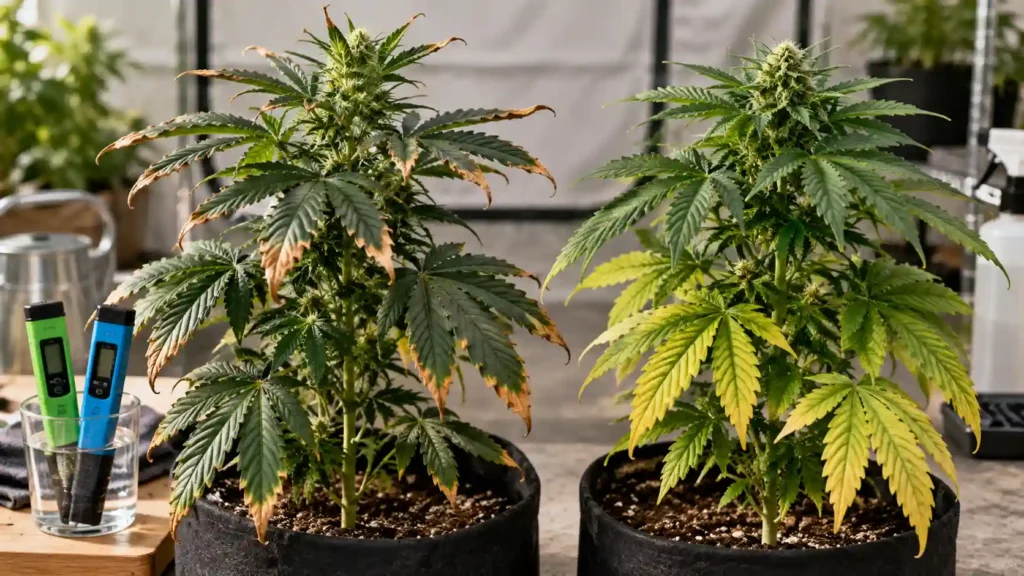
You’re standing over your plant looking at leaves that don’t look right maybe crispy brown tips, maybe yellow patches and you’re stuck on the same question every grower eventually asks: do I feed less, or do I feed more?
That’s not a small decision. Nutrient burn and nutrient deficiency are, mechanically, opposite problems. One means there’s too much salt in the root zone. The other means the plant can’t get enough of something it needs.
Treat burn like a deficiency and you dump more fertilizer onto an already-stressed root system. Treat a deficiency like burn and you flush away the little nutrition the plant had left. Either mistake buys you another week or two of a sick-looking plant.
The good news is that you don’t need a lab to tell them apart. Where the symptom shows up on the plant, and what it looks like up close, gives you most of the answer before you test anything. This guide walks through that diagnostic logic, backed by peer-reviewed cannabis nutrition research out of North Carolina State University and the University of Guelph, then shows you how to confirm your read with a simple pH and EC check and fix the right problem the first time.
Quick Answer
Burn tends to show up as crispy, dry tips and edges, often starting on newer growth, with the rest of the leaf still fairly green. Deficiency more often starts on older, lower leaves, spreads more diffusely across or between the leaf, and looks soft before it goes necrotic. Location and texture are more reliable than color alone. A runoff pH and EC check confirms which one you’re dealing with.
What Nutrient Burn Actually Is
Nutrient burn is what happens when the concentration of dissolved fertilizer salts in the root zone gets too high for the plant to handle. It isn’t really about “too much food” in the way that phrase suggests it’s an osmotic problem.
When the salt concentration outside the roots is higher than the concentration inside the plant’s cells, water gets pulled the wrong way, out of the roots instead of into them. The plant ends up dehydrated at the cellular level even while sitting in wet soil.
Nitrogen deserves a specific mention here, because excess nitrogen doesn’t just add to the general salt load it has its own toxicity pathway inside the plant, which is part of why nitrogen burn tends to show up faster and more dramatically than burn from other elements.
The visible result is necrotic (dead) tissue concentrated at leaf tips and margins, since those areas are furthest from the water supply and the first to lose the battle for moisture. A plant fed at the top of the label’s recommended strength for several weeks in a row is a classic setup for this the leaf tips go crisp and brown while the rest of the leaf often stays green, sometimes with the whole leaf taking on an unusually dark, almost waxy green from the excess nitrogen before the tips go.
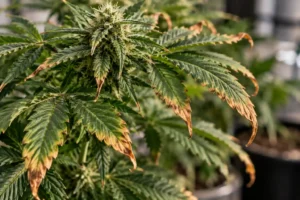
What nutrient burn looks like, in short: crispy, brittle, dry-to-the-touch tips and margins, frequently on leaves that were recently developing, with damage concentrated at the outer edge rather than spread evenly across the leaf.
What Nutrient Deficiency Actually Is (Including Lockout)
A plant showing deficiency symptoms is not necessarily short on nutrients in the reservoir or soil. In a lot of cases probably most, in an otherwise well-managed grow the nutrients are there, but the plant can’t take them up. That’s called nutrient lockout, and it’s almost always driven by root-zone pH.
Every nutrient has a pH range where it stays chemically available for the roots to absorb. Drift outside that range and specific nutrients become effectively locked out of reach, even though the fertilizer is sitting right there in the medium.
Research trials at North Carolina State University identified a substrate pH target of roughly 5.8 to 6.2 for cannabis, with readings outside about 5.5 to 6.5 flagged as a marginal zone where corrective action is worth taking.
This is the piece that trips people up: a well-fed plant at the correct EC can still show textbook interveinal yellowing because the pH drifted low or high and locked a nutrient out of solubility. The fix in that case isn’t more fertilizer. It’s correcting the pH.
True shortage where the nutrient genuinely isn’t in the feed at all happens too, especially with plain water-only regimens or heavily diluted feeding. But because most commercial fertilizers include a fairly complete nutrient spread, lockout is the more common real-world cause of “deficiency” symptoms in fed plants.
What nutrient deficiency looks like, in short: yellowing or paling that’s often more diffuse than burn, sometimes concentrated between the leaf veins while the veins themselves stay green, tissue that starts soft and only goes necrotic in later stages.
The Fastest Way to Tell Them Apart: Location and Pattern
Color alone won’t get you there both burn and deficiency can produce yellowing, browning, or both together. What actually separates them is where on the plant the symptom shows up and how it’s distributed on the leaf. This is the single most useful thing to learn from this article, because once you understand the logic, you can apply it to nutrients this article doesn’t cover by name.
Old growth vs. new growth
Nutrients move through a plant differently depending on their chemical role, and that movement called mobility determines where a shortage shows up first.
Mobile nutrients (nitrogen, phosphorus, potassium, magnesium) can be pulled out of older tissue and relocated to wherever the plant is actively growing. When one of these runs short, the plant essentially cannibalizes its older leaves to keep new growth fed. That’s why mobile-nutrient deficiencies show up on the lower, older fan leaves first, while the top of the plant can still look perfectly healthy.
Immobile nutrients (calcium, iron, manganese, zinc, boron) are built into cell structures mainly cell walls once they’re deposited, and can’t be pulled back out and shipped elsewhere. A shortage of one of these shows up in the newest growth, because that’s the tissue that’s currently trying to build cells and can’t get what it needs, while the older leaves that already finished building their walls look fine.
In practice: if the lowest fan leaves are yellowing while the top of the plant still looks vigorous, you’re most likely looking at a mobile-nutrient issue, commonly nitrogen. If the newest leaves near the top are the ones that look distorted, stunted, or burnt at the tips while lower growth is fine, that points toward an immobile element or a localized lockout affecting new tissue.
Tips and edges vs. whole leaf vs. between the veins
Burn concentrates at the outer boundary of the leaf the tips and margins because that’s the tissue furthest from the water supply and first to lose the osmotic tug-of-war. Deficiency-driven chlorosis is often more evenly spread, or specifically interveinal (yellowing between the veins while the veins themselves stay green), which is a classic sign tied to elements like iron and magnesium.
Texture: crispy vs. soft
This is a fast physical check you can do with your fingers. Burnt tissue is dry, brittle, and crumbles easily a direct consequence of the water being pulled out of those cells by osmotic stress. Deficiency-related discoloration usually starts soft and pliable, and only becomes crisp and necrotic in advanced stages, once the tissue has been without adequate nutrition for a while.
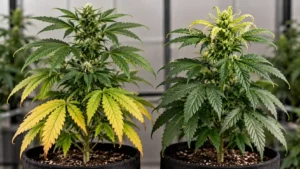
A side-by-side example: picture two plants. On the first, the newest top leaves have clawed downward and the very tips are dry and brown, while the rest of the plant is a deep, almost too-dark green that pattern points toward a calcium-related lockout or a toxicity issue concentrated in new growth. On the second, the lowest fan leaves are pale yellow, soft, and starting to fade from the tip inward while everything above looks green and healthy that’s a textbook mobile-nutrient deficiency, most often nitrogen.
Burn vs. Deficiency at a Glance
| Nutrient Burn | Nutrient Deficiency | |
| Typical location | Often newer/upper growth, but can appear plant-wide with chronic overfeeding | Usually older/lower growth first (mobile nutrients); new growth first for immobile nutrients |
| Pattern on the leaf | Concentrated at tips and outer margins | Diffuse, or specifically between the veins (interveinal) |
| Texture | Dry, crispy, brittle | Soft and pliable at first; necrotic only in advanced stages |
| Color | Tips brown/rust while rest of leaf often stays dark green | Pale yellow, sometimes with green veins remaining |
| Progression | Inward from the tip and edges | Often from the base of the leaf outward, or scattered between veins |
| Typical trigger | Feeding at or above label-max strength for an extended period | Low or high root-zone pH locking out a nutrient; true shortage; heavy leaching |
[Visual suggestion: the table above rendered as a simple side-by-side infographic with example leaf photos for each row.]
Confirm It: Check pH and Runoff EC
Reading the leaves gets you a strong hypothesis. A pH and EC check gets you a confirmed answer, and it takes a few minutes.
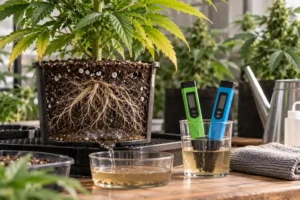
What normal ranges look like
Run plain water through the medium, collect what drains out, and test that runoff not just your feed solution. Runoff reflects what’s actually happening at the roots, which can be different from what you poured in, especially after several weeks of feeding in the same pot.
Based on North Carolina State University trials, the target substrate pH for cannabis sits around 5.8 to 6.2, with readings outside roughly 5.5 to 6.5 worth correcting. For EC, compare your runoff reading to your input EC a runoff EC noticeably higher than what you fed in suggests salt buildup, even if the input strength looked reasonable on paper.
If pH is off
A pH reading outside the target range points you toward deficiency-by-lockout rather than burn, even if the leaves also show some tip damage. Correct the pH first (see the fixing section below) before making any other changes.
If pH is fine and symptoms persist
This is the situation that trips people up, and it’s worth being honest about: a correct pH reading doesn’t rule out every deficiency-lockout scenario. Uneven watering or fertigation can create localized “hot spots” of concentrated salts in parts of the root zone that a single runoff sample won’t catch.
If your overall numbers check out but the plant still isn’t responding, it’s reasonable to suspect a hot spot, a calibration issue with your meter, or a nutrient ratio problem rather than assuming the numbers are lying to you. At that point, cross-referencing against a tissue sample or simply watching how the plant responds to a corrected feeding for a week is more reliable than chasing a single reading.
The Pair Everyone Confuses: Nitrogen Toxicity vs. Nitrogen Deficiency
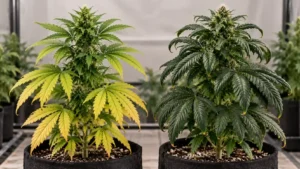
Nitrogen is involved on both ends of this problem more than any other nutrient, which is exactly why it causes so much confusion. Both toxicity and deficiency can produce yellowing but the direction and location of that yellowing tell you which one you’re facing.
Nitrogen deficiency starts as chlorosis on the lower, older fan leaves, since nitrogen is highly mobile and gets pulled from old tissue toward new growth. It progresses upward and inward as the shortage deepens, with the oldest leaves eventually yellowing and dropping while the plant redirects what nitrogen it has toward the top.
Nitrogen toxicity (excess) tends to produce the opposite visual signature: unusually dark, deep green foliage, leaves that claw or “taco” downward, and tip burn concentrated on the newer upper growth. In more advanced or prolonged cases, you can see a confusing mixed picture lower-leaf yellowing from general salt stress paired with tip necrosis up top which is part of why this pair gets mixed up so often.
| Nitrogen Deficiency | Nitrogen Toxicity | |
| Color | Pale yellow, fading | Unusually dark green |
| Location | Lower/older leaves first | Upper/newer leaves first |
| Leaf shape | Leaves may thin and droop | Leaves claw or curl downward (“taco’d”) |
| Progression | Bottom-up | Top-down, or general with tip burn |
Can You Have Both at Once?
Yes and this is the scenario that confuses growers the most, because it seems contradictory. A plant can show crispy tip burn on the newer growth and pale, deficient-looking lower leaves at the same time.
The mechanism is lockout. When salt concentrations in the root zone climb too high, that excess salt load can itself trigger the pH and osmotic conditions that lock other nutrients out of availability.
So the plant is dealing with a genuine excess of some things (which shows up as burn) while simultaneously being unable to access others (which shows up as deficiency symptoms) all from essentially the same root cause of an overloaded, imbalanced root zone.
This connection between lockout and simultaneous burn/deficiency symptoms is described by cultivation sources with moderate confidence and lines up with the peer-reviewed lockout mechanism from NC State research, though it hasn’t been studied in cannabis as a distinct, dedicated topic the way single-element deficiencies have.
If you’re seeing both sets o symptoms together, treat the excess first. Correct the salt buildup (flush and reduce feed strength see below) before trying to re-feed for what looks like a deficiency. Feeding into an already-overloaded root zone to “fix” the deficiency side usually makes the burn side worse.
Ruling Out Look-Alikes
Before you commit to a nutrient-based diagnosis, it’s worth ruling out two non-nutrient causes that produce similar-looking damage.
Light burn and heat stress
Light burn and heat stress concentrate on the upper canopy, closest to the light source, independent of your feed strength. The giveaway is the location: damage that’s worst at the very top of the plant and fades as you move down the canopy points toward light or heat rather than nutrients, which tend to follow the mobility-based patterns described above rather than a strict top-down gradient.
For a deeper look at telling these two environmental stressors apart from each other, see our guide on cannabis light burn vs. heat stress.
Overwatering and underwatering
Overwatering causes general drooping and yellowing tied to oxygen-starved roots rather than any specific leaf-zone pattern it tends to affect the whole plant fairly uniformly rather than concentrating on old or new growth the way nutrient issues do. Underwatering produces wilting and crispy leaf margins that can superficially resemble nutrient burn, but it responds to a normal watering rather than to any change in feed strength.
How to Fix Each One
Fixing burn: flush and reduce
- Flush with pH-correct plain water. Run enough water through the medium to substantially dilute and drain the built-up salts, checking that your runoff EC comes down closer to your target input level.
- Resume feeding at reduced strength, often around half of what you were using, rather than going straight back to full strength.
- Watch the new growth over the following week rather than the damaged leaves, since damaged tissue won’t recover.
- Step feed strength back up gradually only if the new growth stays healthy at the reduced rate.
Fixing deficiency: correct pH first, then feed
- Test and correct root-zone pH into the 5.8–6.2 target range before changing anything about your feed.
- Hold your current feeding schedule while the pH correction takes effect don’t add more fertilizer on top of a lockout problem.
- Reassess new growth after about a week. If the plant was genuinely locked out rather than truly short on nutrients, new growth should start looking normal without any change in feed strength.
- If new growth still looks deficient after pH is corrected, that points toward a true shortage rather than lockout, and a modest increase in feed strength (or a targeted supplement for the specific element involved) is the next step.
A word on flushing: flushing is genuinely the right move for burn and for lockout caused by salt buildup, but it isn’t a universal fix. Flushing a plant that’s dealing with a true nutrient shortage removes what little nutrition it had left, on top of the shortage it already had. Confirm which problem you’re dealing with before reaching for the watering can.
What Recovery Looks Like (and How Long It Takes)
Here’s the part worth being straightforward about: damaged leaf tissue doesn’t heal. A crispy tip stays crispy, and a yellowed patch doesn’t turn back to green. What you’re actually watching for is new growth coming in looking normal that’s the real signal that your fix worked, not any change in the existing damaged leaves.
As for how long that takes, a lot of grower content states a specific number of days or a specific success percentage. We’re not going to repeat those figures here, because we couldn’t find them tied to any actual research they appear to be repeated estimates rather than measured data.
What can be said honestly is that growers commonly report seeing improvement in new growth within roughly one to two weeks of correcting the underlying cause, though that will vary with how severe the problem was, the specific nutrient involved, and the plant’s overall health and growth stage. Treat any more precise number you read elsewhere with some skepticism.
Is nutrient burn permanent? No the plant itself isn’t permanently damaged, but the already-burnt leaf tissue is. New growth is where recovery actually shows up.
Frequently Asked Questions
What’s the first thing I should check if I’m not sure which one this is?
Where the symptom is on the plant older/lower growth or newer/upper growth and whether it’s concentrated at the tips and edges or spread more diffusely across the leaf.
Can I just look at the color to tell them apart?
Not reliably. Both burn and deficiency can cause yellowing or browning. Location and texture are better indicators than color alone.
Do I need a pH meter to figure this out?
Not strictly, but it’s close to essential for a confident answer, especially if lockout is a possibility. A basic pH meter and an EC/TDS meter are worth the investment for anyone growing regularly.
What’s a normal runoff pH for cannabis?
Research out of NC State points to a target of roughly 5.8 to 6.2, with anything outside about 5.5 to 6.5 worth correcting.
Is nutrient burn ever a sign I’m feeding correctly?
No. A small amount of tip burn doesn’t mean you’ve found the “efficient” feeding ceiling it means the plant is already under salt stress. There’s no meaningful upside to pushing feed strength until you see burn.
Why does my plant look deficient when my PPM/EC reading is correct?
Your input reading tells you what you fed, not what the roots can actually absorb. If pH is off, or if there’s a localized hot spot the runoff sample missed, the plant can look deficient even at a technically correct EC.
Can burn and deficiency happen on the same plant at the same time?
Yes, high salt levels can lock other nutrients out of availability, producing both burnt tips and deficiency-looking symptoms together. Treat the excess (flush and reduce) before feeding for the apparent deficiency.
Should I cut off the damaged leaves?
It doesn’t meaningfully help or hurt recovery. Removing already-dead tissue is mostly cosmetic focus your attention on how the new growth looks instead.
Is nitrogen toxicity or deficiency more common for beginners?
Both happen regularly. Deficiency is more common with light or infrequent feeding schedules; toxicity is more common when growers feed at or above label-max strength for extended periods, which is a common beginner instinct.
How long before I know if my fix is working?
Watch new growth, not the damaged leaves. Growers commonly report visible improvement within about one to two weeks, though this varies and isn’t something we can give you a precise number for.
Will burnt tips or yellow spots ever turn green again?
No. Damaged tissue stays damaged. New growth coming in healthy is the actual sign that your fix worked.
Does flushing always help?
No. It helps for burn and for salt-buildup-driven lockout, but flushing a true nutrient deficiency removes what nutrition the plant had left and can make things worse.
How is this different from light burn or heat stress?
Light burn and heat stress concentrate on the upper canopy nearest the light source and don’t respond to changes in feed strength. See our guide on light burn vs. heat stress for the full breakdown.
Why do only some leaves show symptoms and not others?
Because of nutrient mobility. Mobile nutrients get pulled from older leaves to feed new growth, so deficiencies in those elements show up on old growth first. Immobile nutrients stay put once deposited, so their deficiencies show up on new growth instead.
Once you’ve matched your plant against the table above and confirmed it with a pH and runoff check, you’ll know which direction to correct in. If symptoms stick around after that, it’s worth reading through why cannabis leaves turn yellow for a deeper breakdown of deficiency causes, or our guide to light burn and heat stress look-alikes if the damage pattern doesn’t quite fit the nutrient explanations here. And if you’re still getting your feeding routine dialed in generally, our general cannabis plant care guide is a good next stop.
Note: Laws and regulations around cannabis cultivation vary by location. Readers should check applicable local laws and official government sources before growing.
Sources referenced:
-
Cockson, P., Landis, H., Smith, T., Hicks, K., & Whipker, B. E. (2019). Characterization of nutrient disorders of Cannabis sativa. Applied Sciences, 9(20), 4432. https://doi.org/10.3390/app9204432
-
Llewellyn, D., Golem, S., Jones, A. M. P., & Zheng, Y. (2023). Foliar symptomology, nutrient content, yield, and secondary metabolite variability of cannabis grown hydroponically with different single-element nutrient deficiencies. Plants, 12(3), 422. https://doi.org/10.3390/plants12030422
-
Cockson, P., Veazie, P., Logan, D., & Whipker, B. E. (2024, April 18). How to troubleshoot cannabis nutrient disorders. Cannabis Business Times.
-
AROYA. (n.d.). Cannabis nutrient burn: Signs, causes, and solutions. https://aroya.io/education-guides/nutrient-burn
-
Grow Weed Easy. (2016, September 15). How to flush a sick cannabis plant. https://www.growweedeasy.com/flushing-sick-cannabis