If you have ever grown cannabis from seed, or you are just starting to learn about the plant, one of the first things you need to understand is the difference between male and female plants. It sounds simple enough, but for beginners, it can be surprisingly tricky. Miss it, and the whole growing process can go in a direction you did not plan for.
This guide is here to help. Whether you are a hobbyist grower, a student of botany, or just someone who is curious about how cannabis reproduces, you will walk away knowing exactly how to tell a male cannabis plant from a female one, when to look, and why it even matters.
A quick note before we dive in: Cannabis cultivation laws vary widely depending on where you live. Always check your local regulations before growing any cannabis plant. This article is purely educational and does not encourage any illegal activity.
Why Knowing the Difference Between Male and Female Cannabis Plants Matters
Cannabis is what botanists call a dioecious plant. That is a fancy way of saying the male and female reproductive organs grow on separate plants. Compare that to something like a tomato plant, where the same plant carries both the flower that produces pollen and the flower that produces fruit. With cannabis, you get one or the other.
Female plants are the ones that develop the resin-rich flower clusters that most people picture when they think of cannabis. Male plants, on the other hand, produce pollen sacs. Their job is pollination.
If a male plant pollinates a female, the female puts her energy into producing seeds rather than developing her flowers. For breeders, that is the whole point. For growers who want seedless flowers, it is something to avoid entirely.
So learning how to identify a male cannabis plant early is a genuinely practical skill.
The Basics: How Cannabis Plants Reveal Their Sex
Cannabis plants do not show their sex right away. For the first few weeks of life, a seedling is essentially neutral. You cannot tell a male from a female just by looking at the leaves or the overall shape of the plant.
Sex becomes visible during what is called the pre-flowering stage. This typically happens when the plant shifts its energy from growing taller to preparing for reproduction. In outdoor plants, this usually occurs as the days get shorter toward late summer. In indoor growing, it is triggered by changing the light schedule.
The key to identifying plant sex is to look closely at the nodes. Nodes are the points on the stem where branches and leaves emerge. This is where the first signs of sexual differentiation appear.
What Does a Male Cannabis Plant Look Like?
Here is what you are actually looking for when you want to know how to spot a male cannabis plant.
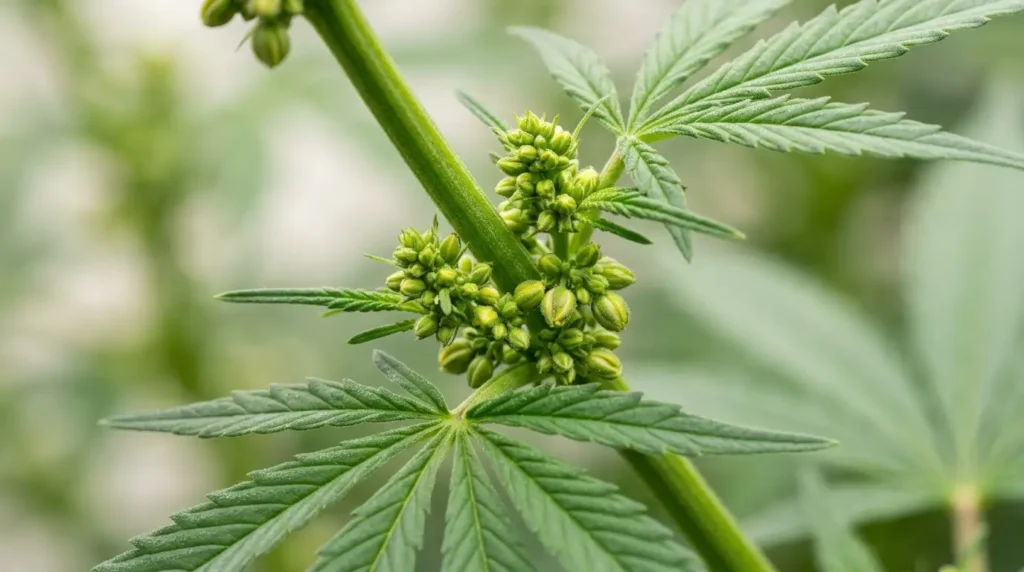
The pollen sacs. This is the defining feature of a male plant. Instead of developing the thin, hair-like strands called pistils (which are the early sign of a female plant), male plants grow small, round or oval-shaped pods. These are pollen sacs, and they cluster together on the branches near the nodes.
At first, they might look a bit like tiny green grapes or small balls hanging in clusters. As they mature, they swell and eventually open up to release pollen. If you have seen hop plants or certain ornamental flowering plants that produce small globe-shaped flowers, the visual is somewhat similar.
The overall structure. Male cannabis plants also tend to be taller and less bushy than female plants of the same age and strain. They put a lot of energy into growing upward, which makes evolutionary sense, as height helps the plant disperse pollen more effectively through the air.
Their branching pattern is generally looser, and the internodal spacing (the distance between nodes) is often longer compared to females. That said, this is a general tendency rather than a hard rule, especially early on when the plants still look fairly similar.
No pistils. This is just as important as knowing what to look for. Female plants show tiny white or pale cream-colored hairs called pistils emerging from a teardrop-shaped structure called a calyx. Male plants do not have these. If you look at a node and see small round pods with no wispy hairs, you are almost certainly looking at a male.
Step-by-Step: How to Identify a Male Cannabis Plant
Here is a practical process for checking the sex of your plants.
Step 1: Know the right time to look. Do not bother squinting at seedlings hoping to see something early. Wait until the plant is somewhere between four and six weeks old (from seed), or until you notice it has entered the pre-flowering phase. You are looking for the first signs at the nodes, not the general shape of the plant.
Step 2: Get close and use good light. The early signs of pre-flowers are small. Natural daylight or a decent flashlight helps. Some growers use a small magnifying loupe, the kind used for inspecting plants, to get a clearer look.
Step 3: Focus on the nodes. Look at the junction where a branch meets the main stem. This is the node. Gently move leaves out of the way if needed.
Step 4: Look for the pre-flowers. On a male plant, you will see a small, rounded structure beginning to form. It will look like a tiny bud or a small round pod, sometimes with what looks like a tiny stalk beneath it. On a female plant, you will see a slightly more elongated structure with fine hairs (pistils) starting to emerge.
Step 5: Compare across multiple nodes. Check several nodes on the plant, not just one. Sometimes one node will show clearer signs than another.
Step 6: Be patient before making a decision. If you are genuinely unsure, give it a few more days. The signs become more obvious as the plant develops. Do not discard a plant based on a guess if you are not confident.
Pro Tips From Experience
Here are some things that trip beginners up again and again.
Do not confuse new leaf growth for pre-flowers. In the early stages, stipules (small, spiky leaf-like structures at the nodes) can confuse new growers. They are not pre-flowers. True pre-flowers have a different shape and come from slightly deeper within the node junction.
Regular seeds mean roughly half your plants may be male. If you are starting with regular (non-feminized) seeds, statistically around half of your plants could be male. That is just biology. Plan accordingly.
Stress can cause a plant to develop male flowers on a female plant. This is called hermaphroditism, and it is different from a true male plant. A stressed female might grow a few pollen sacs alongside her regular flowers. This can happen due to temperature stress, light leaks during the dark period, or physical damage. These are not male plants, but they do carry pollen and should be monitored carefully.
Male plants are not useless. If you are interested in plant breeding, males are essential. Breeders carefully select male plants with desirable characteristics to cross with female plants and develop new varieties. In that context, identifying a good male plant is just as important as identifying a good female.
Feminized seeds largely eliminate the guessing game. Seeds sold as feminized are bred to almost exclusively produce female plants. This is popular among hobby growers precisely because it removes the need to identify and remove male plants. That said, understanding plant sex is still valuable knowledge.
Common Beginner Mistakes When Identifying Male Plants
Getting this wrong is understandable. Here are the most common errors.
Waiting too long to check. If a male plant matures fully and releases pollen before you catch it, the pollen can travel a surprisingly long distance indoors and outdoors. By the time you notice seeds forming on your female plants, the damage is already done. Checking regularly from week four onward helps avoid this.
Relying on plant height alone. Saying “that tall plant must be male” is not reliable. Plant height depends heavily on genetics and growing conditions. A tall plant can be female, and a shorter one can be male.
Misidentifying hermaphrodite plants. A female plant with a few pollen sacs is not the same as a true male plant, but the pollen sacs look similar. The difference is context: if you see pollen sacs on an otherwise female plant with pistils and developing flowers, that is a hermaphrodite situation, not a pure male.
Checking only once. Plant sex does not always reveal itself at the same time on every plant. Check your plants every few days during the pre-flowering phase, not just once.
Important Considerations for Growers
If you are growing cannabis in a place where it is legal to do so, here are some general plant care and awareness points worth keeping in mind.
Separation matters. If you are growing both male and female plants intentionally for breeding purposes, physical separation between the two is important to control which females get pollinated.
Pollen stays viable. Cannabis pollen can remain capable of fertilization for days to weeks, depending on humidity and temperature. Lower humidity tends to preserve pollen longer. This is something to be mindful of when handling male plants indoors.
Dispose of unwanted males responsibly. If you are removing male plants from your grow, do it before the pollen sacs open. Bag the plant before cutting it down if you can, especially indoors.
Keep detailed notes. If you are learning to identify plant sex, keeping a simple log with dates and photos helps you get faster and more accurate over time. Most experienced growers remember their early mistakes because they documented them.
Frequently Asked Questions
How early can you tell if a cannabis plant is male?
Most plants begin to show pre-flowers between four and six weeks after germination, though this varies by strain and growing conditions. Some plants take longer. It is generally not possible to determine sex reliably before this stage from seeds alone, unless you are using a lab-based DNA test, which some commercial operations use.
Can a male cannabis plant turn female?
In normal circumstances, no. True male plants do not become female. However, female plants can develop male pollen sacs under certain stress conditions, making them hermaphrodites. This is a separate situation and is caused by environmental stress rather than a change in genetic sex.
Do male cannabis plants have any value?
Yes. Male plants are essential for breeding and seed production. Breeders select males with traits like vigor, resistance to pests, or particular growth patterns to cross with females. Outside of breeding, male plants have significantly less of the compounds that make female flowers notable, but they are far from worthless in a cultivation context.
How do I know how to spot a male cannabis plant quickly?
The fastest method is to look at the nodes with good lighting. A male plant will show small, round, grape-like clusters forming at the nodes. A female will show tiny white hairs (pistils) emerging from a pointed calyx structure. The round vs. elongated shape, combined with the presence or absence of hairs, is the core distinction.
What happens if I miss a male plant and it pollinates my females?
The female plants will shift their energy toward producing seeds inside their flowers. The flowers themselves may become less developed, and the harvest will contain seeds. This is not ideal for growers who want seedless flowers. For breeders, of course, seed production is the entire goal.
Final Thoughts
Learning how to identify a male cannabis plant is one of those foundational skills that makes everything else in growing easier. It comes down to understanding a relatively simple biological process and knowing where to look on the plant.
The key takeaways are straightforward. Look at the nodes starting from week four. Males show rounded pollen sacs; females show white hairy pistils. Check regularly, not just once. Do not rely on plant height or overall shape as your primary indicator.
With a little practice, the difference becomes obvious quickly. Most experienced growers can tell a male from a female at a glance after seeing it a few times. Your eye develops, and what once seemed confusing becomes second nature.
Whatever your reason for learning about cannabis plant biology, whether you are a hobbyist grower in a place where it is legal, a student of horticulture, or just naturally curious, the plant follows the same biological rules as any other dioecious species. Understanding those rules gives you confidence and clarity.
Disclaimer: This article is written for educational purposes only. Cannabis cultivation is subject to laws that vary by country, state, and local jurisdiction. Always ensure you are in compliance with the laws applicable to your location before growing any cannabis plants.