If you have ever held a cannabis seed in your hand and wondered whether it was healthy, mature, or even viable, you are not alone. It is one of the most common questions among beginners who are just starting to learn about plant biology and horticulture.
The truth is, cannabis seeds have a set of very specific physical traits that tell you a lot about their quality and readiness. Just like you can pick out a ripe avocado by feel, or spot a bad egg before cracking it open, you can learn to assess cannabis seeds just by looking at them closely.
In this guide, you will learn exactly what a cannabis seed looks like, how to tell the difference between a healthy seed and a poor one, whether seeds come in different sizes, and what characteristics matter most when evaluating seed quality. By the end, you will have a clear, practical understanding you can apply with confidence.
Quick Summary: What to Look For at a Glance
- Healthy seeds are teardrop-shaped, firm, and symmetrical
- Color ranges from light tan to dark brown, often with a mottled or striped pattern
- A waxy sheen on the outer shell is a good sign of maturity
- Pale green, white, or crumbly seeds are generally underdeveloped
- Size varies by strain, but a good seed feels solid and does not crush easily
What Does a Cannabis Seed Look Like? The Full Picture
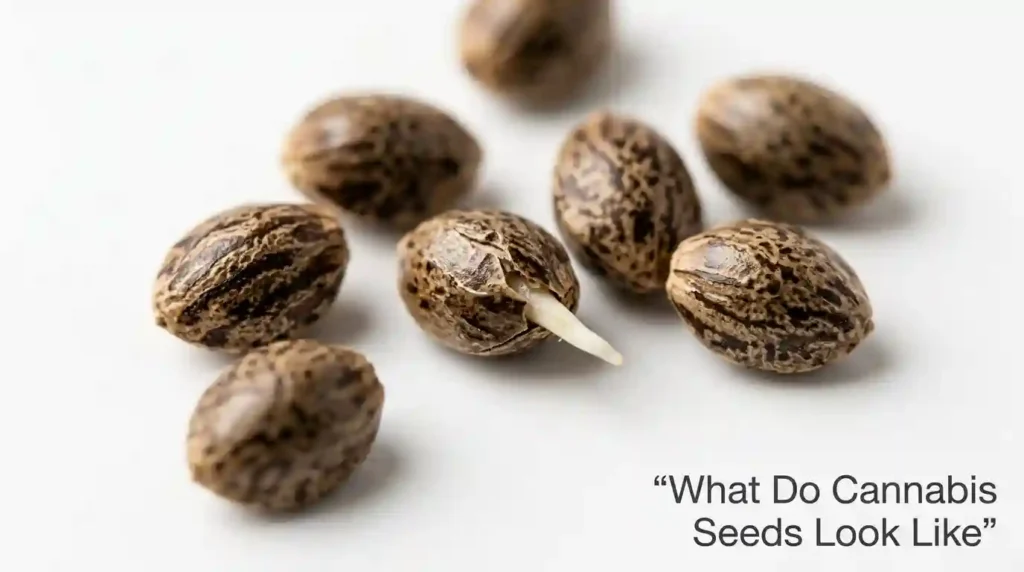
Cannabis seeds are small, roughly teardrop-shaped structures. Think of them as looking a bit like a miniature acorn without the cap, or similar to a small pumpkin seed but more compact and rounded at one end and pointed at the other.
Here is a breakdown of each visual characteristic:
Shape
A fully developed cannabis seed has a slightly oval, teardrop shape. One end is rounder and the other tapers to a subtle point. The seed is symmetrical when viewed from the side, meaning both halves look even and balanced. Any seed that looks distorted, misshapen, or flat on one side may not have developed properly.
Color
This is where things get interesting. Mature, healthy cannabis seeds range in color from light gray or tan to medium brown, dark brown, and even near-black. Many seeds have a mottled or tiger-striped appearance, with darker veining or patterns running along the shell. This natural variation in color is completely normal and does not indicate a problem.
What you want to avoid is seeds that are entirely pale, white, or bright green. Those colors typically indicate an immature seed that was harvested too early. Immature seeds rarely germinate successfully.
Surface Texture and Sheen
Run your finger over a healthy seed and you will notice a smooth, hard outer shell. In good light, the surface often has a subtle waxy or glossy sheen to it. That coating is a natural protective layer. It helps protect the embryo inside from moisture fluctuations and physical damage.
Seeds that look dull, feel rough, or have a cracked shell are concerning. Cracks can allow bacteria or moisture to reach the embryo, which reduces viability significantly.
The Ridge Line
If you look closely at a cannabis seed, you will notice a faint seam or ridge running along one side, from tip to tip. This is the natural join line of the seed’s outer shell. A well-defined, intact ridge is a positive sign. If the ridge is split open or the seed seems to be already cracking apart along that line, it is not in good condition.
Are Cannabis Seeds Big? Understanding Seed Size Variation
A lot of beginners expect cannabis seeds to be large, and then are surprised by how small they actually are. Most cannabis seeds fall somewhere between 3mm and 5mm in length, which puts them roughly in the same size range as a small apple seed or a sesame seed on the larger end.
Here is an important point: seed size on its own does not determine seed quality. Some perfectly healthy seeds are naturally smaller because of genetic variation between strains. Similarly, a large seed is not automatically a high-quality seed.
What matters more than raw size is uniformity within a batch and how the seed feels. A small seed that is firm, has good color, and a complete, intact shell can outperform a larger seed that is pale and fragile.
That said, if you are comparing seeds from the same strain and the same harvest, larger seeds often do indicate a more fully matured embryo with more stored energy reserves to fuel the germination process.
What Does a Female Cannabis Seed Look Like?
This is one of the most searched questions on the topic, and the honest answer might surprise you: you cannot reliably determine whether a cannabis seed will produce a female plant just by looking at it.
There is a widely circulated claim online suggesting that seeds with a perfect circular indentation at the base (the part that attaches to the calyx during growth) tend to produce female plants, while oval or irregular indentations indicate male plants. Botanically speaking, this theory has not been scientifically validated, and experienced growers generally do not rely on it.
Cannabis seeds carry genetic information, but that information is not visible on the outside of the shell. The sex of the plant is determined by genetics, not by the shape of the base of the seed.
The only way to reliably obtain female plants from seed is to use what are known as feminized seeds, which are produced through specific breeding techniques that create seeds with a very high probability of producing female plants. Regular seeds carry roughly a 50/50 chance. This is a matter of plant genetics and breeding science, not visual identification.
How to Tell If a Cannabis Seed Is Good: A Step-by-Step Assessment
Evaluating seed quality does not require any special equipment. Here is a straightforward process you can use:
- Visual Inspection in Good Light
Place the seed under a lamp or near a window with natural daylight. Look at the color first. You want to see medium to dark brown tones, potentially with a striped or mottled pattern. Pale, white, or uniformly green seeds are likely immature. Check the surface for any cracks, holes, or obvious damage. A smooth, intact outer shell is what you are aiming for.
- The Firmness Test
Gently place the seed between your thumb and index finger and apply very slight pressure. A healthy, mature seed should feel hard and solid. It should not collapse, crumble, or flatten easily. If it does, the embryo inside is almost certainly not viable. Think of it like testing whether a nut is full or hollow inside.
- Check the Shape and Symmetry
Hold the seed at eye level and look at both sides. A well-formed seed is symmetrical. Both halves should be even and the overall shape should be a consistent, smooth oval or teardrop. Misshapen or irregular seeds are more likely to produce poor germination results.
- The Float Test (Optional)
This test is sometimes used as a secondary check. Place seeds in a small glass of room-temperature water and wait about an hour. Seeds that sink are generally denser and more likely to be viable. Seeds that float may have hollow interiors, which can indicate an undeveloped embryo. However, this test is not perfectly reliable on its own since some healthy seeds float initially due to trapped air.
- Assess the Sheen
In good lighting, look for that faint waxy or polished appearance on the seed surface. It is subtle, not like a shiny marble, but it should be noticeable. A seed that looks powdery, dusty, or completely matte may have dried out beyond the point of viability.
Pro Tips: What Beginners Often Get Wrong
- Judging entirely by color: Color is a useful indicator but not the only one. Some naturally dark-shelled seeds from certain genetics might look almost black, while some lighter tan seeds are completely viable. Use color in combination with the firmness and shape assessment.
- Assuming bigger always means better: Size varies by genetics, not just by health. Focus on firmness and surface integrity rather than raw dimensions.
- Trusting the float test alone: The float test is a helpful secondary indicator but should never be the only criterion. A seed that floats is not automatically dead, and a seed that sinks is not automatically healthy.
- Keeping seeds in poor storage conditions: Even a perfectly viable seed can become unusable if stored incorrectly. Humidity, light, and temperature fluctuations all degrade seed quality over time. Seeds keep best in cool, dark, and dry conditions.
- Discarding seeds that look slightly different: Natural variation is normal. Not every seed in a batch will look identical. Minor differences in shade or patterning are expected and not a cause for concern.
Important Considerations: Storage, Age, and Legal Awareness
Seed Storage Matters
A seed that looked perfect six months ago might not be in the same condition today if it was stored improperly. Seeds are living organisms containing a dormant embryo. Exposure to heat, humidity, or direct light accelerates the degradation of that embryo over time. The outer shell can look fine while the internal material has already deteriorated.
Ideal storage conditions for cannabis seeds are similar to those used for other vegetable or herb seeds: cool temperatures between 6 and 8 degrees Celsius, low humidity around 20 to 30 percent, and complete darkness. Many people use an airtight container with a small desiccant packet placed in a refrigerator.
Age and Viability
Fresh seeds generally germinate more reliably than older ones. That said, cannabis seeds stored properly have been known to remain viable for several years. The physical indicators described in this article are your best practical tool for assessing current condition regardless of age.
A Note on Legal Compliance
Laws governing cannabis seeds, plants, and cultivation differ enormously from one jurisdiction to another. In some places, cannabis cultivation is fully legal for personal use. In others, even possessing seeds carries serious legal consequences. This article is purely educational in nature and does not constitute legal advice. Always research and understand the laws specific to your location before making any decisions related to cannabis seeds or plants.
Frequently Asked Questions
1. What color should a healthy cannabis seed be?
Healthy cannabis seeds typically range from light tan to medium or dark brown, and many have a darker striped or mottled pattern on the outer shell. A pale white or bright green color usually indicates an immature seed that was harvested before it fully developed, and those seeds rarely germinate successfully.
2. How big is a typical cannabis seed?
Most cannabis seeds measure between 3mm and 5mm in length, which is similar in scale to a small apple or pumpkin seed. Size varies by genetics, so different strains naturally produce smaller or larger seeds. Size alone does not determine seed quality, but a seed that feels solid and firm for its size is generally a better sign than one that feels light or hollow.
3. Can you tell if a cannabis seed is female just by looking at it?
No, not reliably. Despite popular claims online suggesting that the shape of the seed’s base can predict sex, there is no scientifically validated method for visually sexing a cannabis seed before it germinates and grows. The plant’s sex is encoded in its genetics and only becomes apparent as the plant matures. Feminized seeds, which are produced through selective breeding, offer a much more reliable route to female plants.
4. What does a bad cannabis seed look like?
Poor quality seeds are usually pale, white, or bright green in color. They may have a cracked or damaged outer shell, feel soft or hollow when gently squeezed, or appear visibly misshapen. Seeds that crumble under slight pressure have very low viability. Very old seeds may also look faded or have a chalky, dull surface instead of the subtle waxy sheen you see on healthy ones.
5. Does a shiny surface on a cannabis seed mean it is good quality?
A subtle waxy or glossy sheen on the outer shell is generally a positive sign. It indicates the seed’s natural protective coating is intact, which is associated with a mature, well-developed seed. However, it should be assessed alongside other factors like color, firmness, and shape. A shiny but hollow or cracked seed is still not a good candidate for germination.
Final Thoughts
Learning to identify a good cannabis seed is actually a skill that transfers well to horticulture in general. The principles are similar to assessing any seed: look for maturity in color and firmness, check for physical integrity, and understand that genetics play a role in natural variation.
A cannabis seed in good condition is firm, medium to dark brown, symmetrical in shape, and has a smooth surface with a faint waxy sheen. It does not crack under gentle pressure, and it has no obvious physical damage or discoloration associated with immaturity.
Knowing what to look for is the first step toward understanding cannabis as a plant from a biological and horticultural perspective. As with any area of plant science, the more you observe and learn, the more confident and accurate your assessments will become.
As always, whatever your reason for this interest, please ensure your activities remain within the boundaries of local laws and regulations. Education is always the right starting point.
Disclaimer: This article is intended for educational and informational purposes only. Cannabis cultivation laws vary significantly by country, state, and region. Always check and comply with your local laws before handling, possessing, or growing cannabis seeds or plants.