Introduction: Why Getting the Basics Right Matters
Every cannabis plant you have ever seen started the same way as a tiny seed, smaller than a peppercorn, sitting dormant and waiting for the right conditions to come alive.
If you are curious about how that process actually works, you are in the right place.
This guide is for beginners. It is for people who have searched for “how to grow cannabis seeds” and found mostly confusing jargon, vague steps, or information that assumes you already know things you do not. That is frustrating. So here, we are going to break the whole process down in plain language from what a seed actually is, to germination, to early plant care so you walk away with a clear, practical understanding.
A quick note before we start: growing cannabis is legal in some places and illegal in others. This guide does not encourage you to do anything outside the law. Think of it the way you would think of a gardening textbook. Knowledge is neutral. What you do with it is your responsibility.
With that said, let us get into it.
What You Are Actually Starting With: Understanding the Cannabis Seed
Before you can successfully grow a cannabis plant from seed, it helps to understand what a seed is doing during those first critical days.
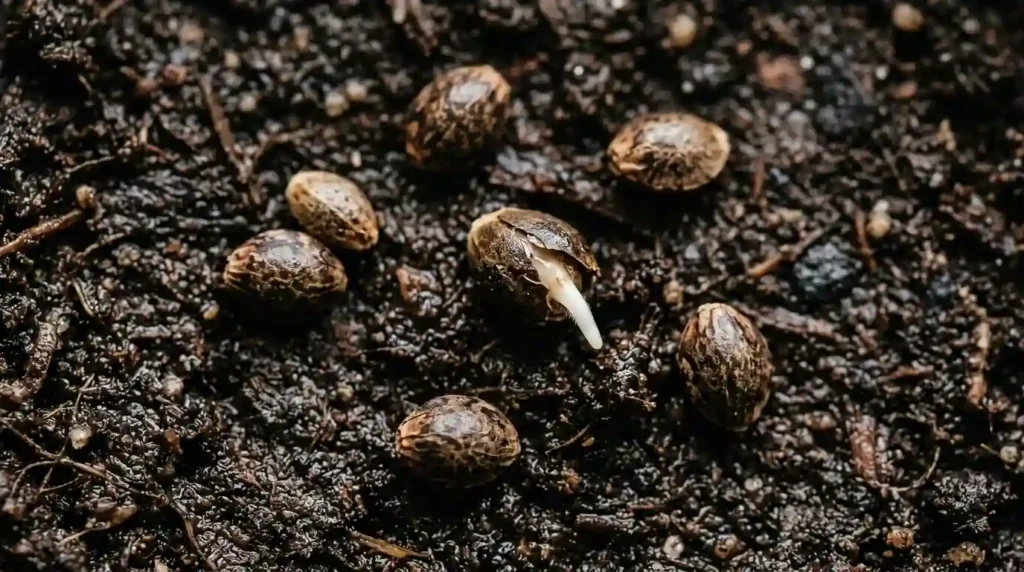
A cannabis seed is essentially a plant in a paused state. Inside that hard outer shell called the seed coat there is a tiny embryo, a built-in food supply called the endosperm, and a pair of starter leaves called cotyledons. The seed is waiting for three specific signals from its environment: moisture, warmth, and darkness. When those three conditions arrive together, the seed activates. It is not magic. It is plant biology.
Think of it like a power bank that has been sitting on a shelf. The energy is already there. It just needs to be plugged in.
The seed coat cracks open first. Then a small white root called the radicle emerges and pushes downward. Shortly after, a stem pushes upward, and those first cotyledon leaves unfold into the light. At that point, your plant has officially germinated. Now it needs to be in soil (or another growing medium) so those roots have somewhere to go.
Before any of this can happen, though, you need to start with a viable seed.
What a Healthy Seed Looks Like
Not every seed will germinate. Knowing how to spot a healthy one saves you time and frustration.
A viable cannabis seed is typically dark in color ranging from medium brown to dark gray, sometimes with a faint tiger-stripe pattern on the shell. It feels firm when you roll it gently between your fingers. It has a slightly waxy surface and a full, rounded shape.
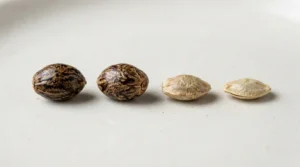
Seeds that are pale white or pale green are usually immature. Seeds that feel hollow or crush easily under gentle pressure are not viable. Seeds that are very flat, visibly cracked, or have been stored in warm or humid conditions for a long time are also poor candidates.
If you want a deeper understanding of seed types and quality indicators before you begin, the Cannabis Seeds Guide: Everything a Beginner Needs to Know is an excellent starting point that covers seed biology, seed types, and what to look for in detail.
Choosing the Right Type of Seed
There are a few main categories of cannabis seeds, and the one you choose will affect how you grow.
Regular seeds produce roughly half male and half female plants. Male plants do not produce flowers in the way most growers are looking for, so you would need to identify and remove them early. These seeds are generally preferred by breeders who want to work with genetics and create new varieties.
Feminized seeds are bred to produce almost entirely female plants. This removes the guesswork of sexing your plants and is why most beginner growers in legal regions prefer them.
Autoflowering seeds are perhaps the most beginner-friendly option of all. These plants flower automatically based on their age rather than the number of hours of light they receive per day. They tend to stay smaller, finish faster (often within 8 to 12 weeks from seed), and are generally more forgiving of minor mistakes with lighting.
Photoperiod seeds which includes most regular and feminized seeds require a change in the light cycle to trigger flowering. Indoors, this means manually switching from 18 hours of light per day to 12 hours. Outdoors, the natural shortening of days in late summer handles this automatically.
For a first-time grower, autoflowering feminized seeds typically offer the easiest experience. They are smaller, faster, and require less management.
Step-by-Step: How to Grow Cannabis from Seed
Here is the process broken into clear stages. Each one builds on the last.
Step 1: Germinate the Seed
Germination is the process of waking the seed up and encouraging that first root to emerge. There are a few methods that work well.
The paper towel method is the most common for beginners. Place your seed between two damp not soaking wet paper towels. Put the paper towels on a plate, cover with another plate to keep moisture in and light out, and set it somewhere warm. Room temperature around 70 to 77 degrees Fahrenheit (21 to 25 degrees Celsius) is ideal.
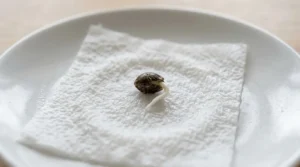
Check it every 12 hours without disturbing it too much. Within 24 to 120 hours, you should see a small white root emerge. Once that root is about a quarter to half an inch long, the seed is ready to plant. Handle it carefully at this stage that root is fragile.
Planting directly into a small cup of soil is another approach. Some growers skip the paper towel entirely and place the seed about half an inch deep into moist growing medium. The advantage here is that you never have to transfer the fragile seedling. The downside is you cannot see when germination has occurred.
Soaking in water for 12 to 24 hours before using the paper towel method can help with older or harder-shelled seeds. Do not soak for longer than 24 hours, as seeds can drown.
Step 2: Prepare Your Growing Medium
Cannabis seedlings are sensitive. They do not need heavy nutrients right away in fact, too many nutrients early on is one of the most common beginner mistakes. Start with a light, airy growing mix. A quality seedling or starter mix works well. It holds moisture without becoming waterlogged, and its looser texture lets young roots spread easily.
Avoid dense potting soils or garden soils that compact around roots.
Small containers a solo cup or a 3-inch pot are better to start in than large pots. In a small container, the roots can reach moisture without the surrounding soil staying wet for too long, which can cause problems.
Step 3: Plant the Germinated Seed
Once your seed has a small white root visible, it is ready to go into soil.
Make a small hole about half an inch deep in your moist growing medium. Use a pencil or the tip of your finger. Carefully place the seed root-down into the hole. Cover it gently with a small amount of loose soil do not pack it down. The seedling needs to push up through that soil easily.
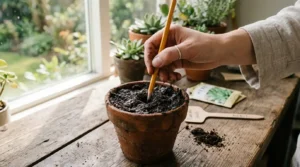
If you are planting a seed that has not yet germinated (skipping the paper towel), simply plant it half an inch deep, water lightly, and wait. Keep the soil consistently moist but never soggy.
Step 4: Provide the Right Environment for Early Growth
The seedling stage is the most delicate phase. Here is what your young plant needs:
Light: Once the seedling emerges above the soil, it needs light. Outdoors in a legal region, a warm, sunny windowsill or outdoor space works. Indoors, a gentle light source positioned a foot or more above the seedling is appropriate. Seedlings can burn under lights that are too intense or too close.
Temperature: Aim for 68 to 77 degrees Fahrenheit (20 to 25 degrees Celsius). Cannabis seedlings are sensitive to temperature extremes. Cold slows growth and stresses the plant. Excessive heat causes wilting.
Humidity: Seedlings thrive in moderate to slightly higher humidity around 60 to 70 percent relative humidity if you can measure it. Very dry air causes seedlings to lose moisture faster than they can take it in.
Watering: This is where many beginners go wrong. Water lightly and only when the top layer of soil begins to feel dry. Overwatering is far more common and more damaging than underwatering at this stage. When in doubt, wait another day.
Step 5: Watch the Seedling Develop
Within a few days of planting, the cotyledon leaves will emerge those are the small, round starter leaves. They are not the iconic cannabis leaf shape. Do not be alarmed. These are perfectly normal and are simply the seed’s built-in starter leaves providing energy while the plant gets established.
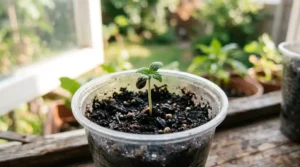
After the cotyledons, the first true leaves will appear. These will start to show the more recognizable fan-leaf shape of cannabis. Each set of leaves that follows will be slightly larger and more developed than the last.
From here, your plant will transition through the vegetative stage a period of leafy growth before eventually entering the flowering stage. But that is a topic for a more advanced guide. For now, focus on getting your seedling healthy, stable, and well-established.
Pro Tips from Real Growing Experience
These are the lessons that come from actually doing this not just reading about it.
Do not overwater. Say it again. Do not overwater. Roots need oxygen, and waterlogged soil suffocates them. The number one cause of seedling death in beginner grows is too much water, not too little. If the pot feels heavy when you lift it, there is still moisture in the soil. Wait.
Resist the urge to add fertilizer early. Seedlings do not need feeding for the first two to three weeks. A quality starter mix has everything they need. Adding nutrients to a young seedling can cause nutrient burn the tips of the leaves will turn yellow or brown, and growth will slow.
Handle the germinated seed by the seed shell, not the root. The radicle (that first white root) is extremely fragile. If it snaps during transfer, the seedling is unlikely to survive.
Do not transplant too soon. Wait until you can see roots coming out of the drainage holes of your starter container, or until the plant looks visibly crowded, before moving it to a larger pot.
Keep a simple log. Write down when you watered, what the temperature was, what you observed. This habit pays off enormously as you learn. When something goes wrong and occasionally something will your notes help you figure out what happened.
Stability beats perfection. A slightly imperfect but consistent environment is better than a perfectly calibrated setup that fluctuates wildly. Young plants stress under sudden changes in temperature, humidity, or light.
Common Beginner Mistakes to Avoid
You are going to make some mistakes. Everyone does. But knowing what to watch for helps you catch problems early.
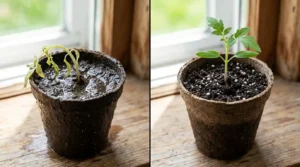
Planting in soil that is too wet. The soil should be moist, not saturated. If you squeeze a handful and water drips out, it is too wet.
Using garden soil from outside. Outdoor soil is often too dense, may contain pests or pathogens, and does not drain the way a cannabis seedling needs.
Putting the light too close. Seedlings can be bleached or heat-stressed by lights positioned too near. Start with more distance and observe the plant’s response.
Ignoring the environment entirely. Temperature and humidity matter more during the seedling stage than at almost any other point. A cold room or very dry air will visibly slow growth.
Giving up too soon. Germination can take up to five days. A seedling that looks a little pale or slow in week one may be perfectly fine. Patience is genuinely part of the skill.
Important Considerations
Legal Awareness
Cannabis cultivation laws vary enormously by country, state, province, and even city. In some places, growing a small number of plants for personal use is fully legal. In others, it remains completely prohibited. There are also places where the rules are actively changing.
Before you attempt to grow cannabis even for purely educational purposes research the laws in your specific location carefully. This guide is not a legal reference, and nothing here should be taken as an indication that growing is legal where you live.
Plant Care Basics
Cannabis is a real plant with real needs. It responds to light, water, temperature, humidity, and nutrients much like any other plant you might grow. Tomatoes, basil, and cannabis all have seedling stages, vegetative stages, and reproductive stages. The fundamentals of plant care apply across all of them.
If you understand how to care for a garden plant giving it appropriate light, not drowning it, feeding it as it matures you already have a foundation for understanding how cannabis grows.
Growing Environment Safety
Whether growing indoors or outdoors, think about your environment. Indoors, consider ventilation and air circulation. Stagnant air encourages mold and fungal issues. Outdoors, consider the plant’s exposure to extreme weather. Young seedlings in particular are vulnerable to late frost, heavy rain, and strong winds.
Frequently Asked Questions
How long does it take to grow a cannabis plant from seed?
The timeline varies depending on the seed type and growing conditions. Autoflowering varieties can complete their full life cycle in as little as 8 to 12 weeks from seed. Photoperiod varieties typically take longer often 4 to 6 months depending on how long the vegetative stage is allowed to run and the length of the flowering stage.
How deep should I plant a cannabis seed?
About half an inch (roughly 1 to 1.5 centimeters) deep is the general recommendation. Plant too shallow and the seedling may not be stable enough to stand. Plant too deep and it may struggle to push through the soil before running out of stored energy.
Why has my cannabis seed not germinated after several days?
Several factors can delay or prevent germination: the soil may be too cold, the seed may have been old or improperly stored, the growing medium may be too wet or too dry, or the seed itself may not have been viable. If a seed has not shown signs of germination after 7 days under appropriate conditions, it is unlikely to sprout.
Can I grow a cannabis plant from a seed I found?
Technically, yes if the seed is mature and viable. Seeds found in commercially purchased cannabis may not always be viable or of known genetics. Quality and germination rates can vary significantly compared to seeds from dedicated seed banks in regions where those are legal.
What is the difference between growing cannabis indoors versus outdoors?
Indoors, you control every variable light, temperature, humidity, and feeding schedule. This offers more precision but requires more equipment and attention. Outdoors, the sun provides free light and the natural environment does much of the work, but you have less control over weather and seasonal timing. Both approaches can work well. Beginners often find outdoor growing in a legal region to be a simpler starting point because there are fewer variables to manage manually.
Final Thoughts
Learning how to grow cannabis from seed is, at its core, learning how plants work. The seed stage, the seedling stage, the importance of roots getting oxygen, the sensitivity of young plants to overwatering and temperature stress these are universal principles of horticulture.
What makes cannabis interesting from a horticultural standpoint is how responsive it is. It gives you feedback quickly. You can observe day-to-day changes. That makes it an engaging plant to learn from, whether you are a curious beginner or someone with more gardening experience who wants to understand the specifics.
To recap the key points from this guide:
- Start with a healthy, viable seed color, firmness, and shape matter
- Understand your seed type before you begin autoflowering seeds are generally most beginner-friendly
- Germinate carefully, handling the fragile root with care
- Use a light, airy starter mix and a small container
- Provide appropriate light, warmth, and moderate humidity
- Water sparingly less is almost always more at the seedling stage
- Avoid nutrients in the first few weeks
- Keep the environment stable and consistent
And always, always verify that what you are doing is legal in your specific location.
For a broader foundation on cannabis plant biology and seed types, the Cannabis Seeds Guide: Everything a Beginner Needs to Know covers the science behind seeds, germination, and early plant development in even greater depth a natural next read if you want to keep building your knowledge.
Growing is a skill. It takes some patience, some observation, and a willingness to learn from what the plant tells you. But the fundamentals are learnable, and this guide gives you a solid place to start.
Disclaimer: This article is strictly educational and intended for adults in regions where cannabis cultivation is legal. Laws governing cannabis growing vary widely by country, state, and locality. Always verify what is permitted in your area before growing or handling cannabis seeds. Nothing in this guide constitutes legal, medical, or professional advice.