Finding an unusual bump, yellow growth, or unfamiliar structure on a flowering cannabis plant can trigger an immediate question: “Is my plant a hermaphrodite?”
Not necessarily.
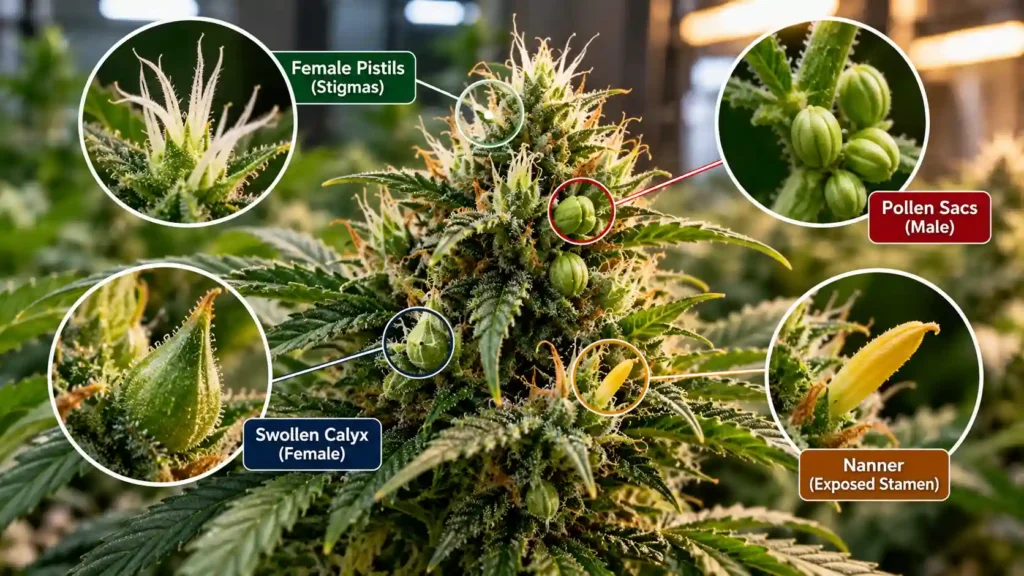
The most important step is to identify the structure before labeling the plant. A female pistil, swollen calyx, pollen sac, and exposed stamen can look surprisingly similar at first glance, but they have very different biological meanings.
Quick diagnosis at a glance
| If you see… | First thing to investigate |
| Thin, hair-like structures | Likely pistils/stigmas |
| Rounded, smooth structure without visible pistils | Possible pollen sac |
| Pointed or swollen structure integrated into the flower | Likely female floral tissue |
| Yellow or pale elongated structure emerging from a flower | Possible exposed stamen/anther, often called a “nanner” |
| Male and female reproductive structures on the same plant | Possible mixed sexual expression |
Don’t diagnose a hermaphrodite cannabis plant from one shape alone. Confirm the reproductive structure, inspect other flower sites, and then consider the plant’s developmental and environmental history.
What Is a Hermaphrodite Cannabis Plant?
A hermaphrodite cannabis plant is a plant that develops both female and male reproductive structures.
Cannabis sativa is predominantly dioecious, meaning male and female flowers normally develop on separate plants. However, cannabis also has considerable sexual plasticity. In other words, its floral sexual expression is not completely rigid and can change under particular genetic, developmental, hormonal, or environmental conditions.
That is why the simple statement that a “female plant turns male” does not fully describe what is happening.
A more precise way to think about a cannabis hermaphrodite or an intersex plant is that male reproductive structures appear alongside female reproductive structures on the same plant.
Dioecious vs. mixed sexual expression
In a typical dioecious population:
- A female plant produces female flowers.
- A male plant produces male flowers.
- The reproductive structures are separated between plants.
With mixed sexual expression, male and female structures can occur on the same plant.
Modern research shows that cannabis sex expression involves genetic regulation, developmental processes, hormone signaling, and environmental influences rather than a simple on/off switch. Research has also identified XX/XY sex chromosomes and sex-biased gene activity early in plant development.
How to Identify Signs of a Hermaphrodite Cannabis Plant
The strongest evidence is not simply that a structure looks unusual. It is that the structure has characteristics of a male reproductive organ.
1. Pollen sacs
Pollen sacs are one of the clearest structures to investigate.
They are typically:
- Rounded or oval
- Relatively smooth
- Lacking the hair-like pistils associated with female flowers
- Found around nodes or developing flower sites
- Capable of opening as they mature and releasing pollen
A group of rounded structures appearing where you would normally expect male floral development deserves closer inspection.
But there is an important catch: female cannabis flowers also contain structures that can become swollen or rounded.
That is why “I found a ball” is not enough to diagnose a hermaphrodite.
2. “Nanners” or exposed stamens
Growers commonly use the term “nanner” or “banana” for an exposed yellowish or pale stamen/anther that emerges from a cannabis flower.
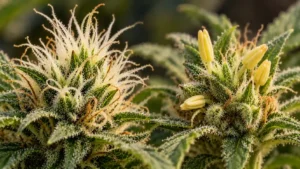
Botanically, the stamen is the male reproductive structure, while the anther is the pollen-producing part of that structure.
Nanners may appear:
- Inside developing female flowers
- Between floral tissues
- As elongated yellow or pale structures
- Without looking like a conventional round pollen sac
They are therefore easy to miss if you are only looking for spherical structures.
However, not every yellow or pale object in a flower is automatically a nanner. The structure’s shape, position, and relationship to the surrounding floral tissue matter.
3. Female pistils are not pollen sacs
Female flowers produce pistils, including the stigma, which is the pollen-receptive portion of the female reproductive structure.
To the naked eye, pistils usually appear as fine, hair-like strands emerging from the flower.
Their appearance changes as flowers develop and mature, so color alone should not be used as the diagnostic test.
A pale, orange, red, or darkening hair-like structure is still fundamentally different from a smooth, enclosed pollen sac.
4. Female calyxes and bracts
This is where many false alarms begin.
Female cannabis flowers contain calyxes and bracts, which are normal parts of the floral structure. As flowers develop, these tissues can become more prominent and swollen.
A rounded or enlarged floral structure therefore does not automatically mean a pollen sac.
The better question is:
Does this structure actually have the characteristics of male reproductive tissue, or is it part of the female flower?
That distinction can prevent a lot of unnecessary panic.
Hermaphrodite Cannabis Plant vs. Normal Female Plant
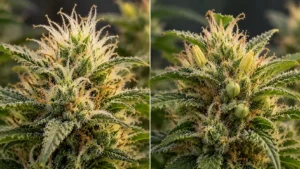
A normal female plant can have complex-looking flowers without producing male reproductive structures.
| Feature | Normal female expression | Possible mixed sexual expression |
| Pistils | Present | Present |
| Female floral tissue | Present | Present |
| Calyxes/bracts | Present | Present |
| Male reproductive structures | Not expected | Present |
| Pollen sacs | No | Possible |
| Exposed stamens/anthers | No | Possible |
| Pollen production | No male pollen production expected | Possible |
| Interpretation | Female floral development | Investigate for mixed sexual expression |
The important distinction is male reproductive tissue, not simply an unusual-looking flower.
A confirmed male reproductive structure on an otherwise female plant is evidence of mixed sexual expression at that location. It does not, by itself, tell you how widespread the expression is across the entire plant.
Pollen Sac vs. Swollen Calyx: How to Avoid Misidentification
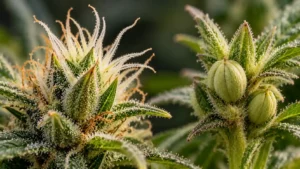
This is one of the most useful comparisons to understand.
| Feature | Female calyx | Pollen sac |
| Biological role | Female floral structure | Male reproductive structure |
| Appearance | Integrated into the flower; may become swollen | Often smooth, rounded, or oval |
| Pistils | Commonly associated with pistils | No pistils emerging from the sac itself |
| Location | Part of developing female flowers | Can appear around nodes or flower sites |
| Pollen | Does not produce pollen | Produces pollen when mature |
| Diagnosis | Normal female anatomy | Potential male expression |
A simple rule
Do not diagnose from shape alone.
Look at the whole structure:
- Is it attached as part of the female flower?
- Are pistils present nearby?
- Is it smooth and sac-like?
- Does it resemble a developing male floral structure?
- Are similar structures appearing elsewhere?
- Is there evidence of pollen-producing tissue?
One photograph or one unfamiliar bump may not provide enough context for a reliable diagnosis.
What Causes Hermaphroditism in Cannabis?
There is no single universal cause.
Current research supports a multifactorial model involving genetics, developmental stage, hormone signaling, and environmental conditions. A 2026 review specifically describes cannabis sexual expression as context-dependent rather than a simple “stress equals hermaphrodite” relationship.
Genetics
Genetic background can influence how stable sexual expression is.
This does not mean that every plant from a particular cultivar will develop male structures, nor is it responsible to label a commercial cultivar as “herm-prone” without reliable evidence.
Genetics are better understood as one part of the plant’s underlying susceptibility and developmental program.
Environmental stress
Environmental conditions may influence sexual expression, but this deserves careful wording.
Grower guides often list severe stress as a major cause of hermaphroditism. Scientific evidence supports environmental influence on sexual expression, but it does not justify the blanket claim that any stressful event automatically produces a hermaphrodite.
A plant’s genetic background, developmental stage, hormonal signaling, and environmental history can interact.
Light-cycle disruption
Photoperiod is part of the plant’s flowering environment, so disruptions to the expected light and dark pattern are commonly discussed in relation to unstable flowering.
However, avoid the oversimplified claim that every light leak causes hermaphroditism.
A light interruption is one environmental factor to investigate when the plant develops unexpected reproductive structures, not proof of causation.
Temperature and other environmental stress
Extreme or unstable environmental conditions may contribute to reproductive instability in some circumstances.
Again, context matters.
If a plant develops suspicious structures after experiencing major environmental problems, record the timing and history but do not assume that the stress event alone explains the entire phenomenon.
Root, physical, and nutritional stress
Severe problems involving roots, physical damage, or general plant stress may be relevant to the overall environmental history.
They should be treated as possible contributors rather than guaranteed triggers.
If the plant is also showing yellowing, drooping, nutrient symptoms, or root-zone problems, those issues may deserve separate diagnosis rather than being treated as evidence of hermaphroditism.
Developmental stage
Timing matters because reproductive development is dynamic.
Recent research has shown that cannabis sexual phenotype involves active molecular and hormonal regulation rather than a permanently fixed visible state. Experimental studies have demonstrated substantial sexual plasticity under controlled treatments, including changes involving ethylene signaling.
Those experiments are important for understanding the biology, but they should not be interpreted as proof that ordinary growing stress automatically causes a plant to become hermaphroditic.
Genetics and Sexual Plasticity: Why the Biology Is More Complicated
Cannabis has XX/XY sex chromosomes, but genetic sex determination does not mean that every aspect of visible sexual expression is permanently locked in place.
Research published in the Journal of Experimental Botany found sex-biased gene expression at very early developmental stages and identified candidate genes associated with male and female development.
More recent work in The Plant Journal has examined how ethylene-related pathways participate in sexual plasticity. In controlled experiments, both XX and XY plants were capable of changes in floral sexual phenotype under specific experimental treatments.
The useful takeaway for a grower is simple:
Genetics establish an important biological framework, but sexual expression can also involve developmental and regulatory responses.
Think of the process as an interaction:
Genetic background + development + hormone signaling + environment → sexual phenotype
That model is much more accurate than blaming every case on one event.
Can Feminized Cannabis Seeds Produce Hermaphroditic Plants?
Feminized seeds are produced with the goal of producing female plants, but “feminized” does not mean sexual expression is biologically incapable of variation.
Cannabis sexual expression remains biologically plastic, and the research literature documents the ability of plants to develop opposite-sex floral characteristics under particular conditions.
That does not mean feminized seeds routinely produce hermaphrodites. It means that “feminized” should not be interpreted as an absolute guarantee that male reproductive structures can never appear.
If a feminized plant develops suspicious structures, the first step is still the same:
Identify the structure before deciding what it means.
What Should You Do If You Find a Male Reproductive Structure?
Avoid making an immediate whole-plant decision based on an unidentified structure.
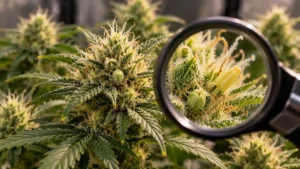
Use this sequence instead:
1. Confirm
Look closely at the structure.
Determine whether you are seeing:
- A pistil
- A swollen calyx or bract
- A pollen sac
- An exposed stamen/anther
- Another part of the flower
If you cannot confidently identify it, treat the diagnosis as uncertain.
2. Inspect nearby flower sites
Check several locations rather than relying on one suspicious spot.
Look for repeated male structures and note whether the finding is isolated or appears across multiple flower sites.
3. Assess pollen release
If a confirmed male reproductive structure has matured and released pollen, the situation is different from finding an immature structure that has not released pollen.
Do not assume you know how far pollen has traveled. Instead, treat confirmed pollen release as a reason to inspect the surrounding growing area carefully.
4. Monitor
Continue checking the plant for additional structures.
A single confirmed male structure deserves attention, but monitoring gives you more information about whether the expression is isolated or recurring.
5. Consider separation when appropriate
If there is credible evidence of pollen production and other plants are nearby, physical separation can be considered as a risk-management measure where practical and lawful.
The key is to base that decision on confirmed reproductive structures, not on every swollen or unusual flower part.
How to Reduce the Risk of Hermaphroditic Expression
There is no guaranteed way to eliminate biological variation, but you can reduce avoidable environmental stress.
Focus on:
- Stable environmental conditions rather than repeated major swings.
- Consistent photoperiods when growing photoperiod-sensitive plants.
- Avoiding severe, unnecessary stress during reproductive development.
- Reliable genetics from reputable sources.
- Regular inspection once reproductive structures begin developing.
- Early investigation when genuine male structures appear.
These practices reduce potential risk; they do not provide an absolute guarantee.
Common Hermaphrodite Misidentification Mistakes
Mistake 1: Calling every round structure a pollen sac
Shape is only one clue. Female floral structures can also become swollen.
Mistake 2: Confusing pistils with anthers
Pistils are hair-like female structures. Anthers are male pollen-producing structures. Their appearance and placement are different.
Mistake 3: Assuming every swollen calyx is male
A swollen female calyx is normal flower development.
Mistake 4: Treating one suspicious structure as a whole-plant diagnosis
A single structure should trigger inspection, not an automatic conclusion about the entire plant.
Mistake 5: Blaming stress before identifying the structure
Stress may be relevant, but it cannot tell you whether the object you are looking at is a pollen sac.
Mistake 6: Treating “herm,” “nanner,” and “banana” as interchangeable scientific terms
These are common grower terms. They can be useful shorthand, but botanical identification should focus on the actual reproductive structure.
Mistake 7: Relying on one photograph
A close-up image without the surrounding flower, node, or plant context may not be enough to distinguish a calyx from a pollen sac.
Before You Call It a Herm: A Quick Checklist
Ask yourself:
- What exactly is the structure?
- Does it have pistils?
- Is it smooth and rounded or thin and hair-like?
- Where is it attached?
- Is it part of a developing female flower?
- Is it elongated and yellow or pale?
- Does it resemble an exposed stamen/anther?
- Are similar structures appearing elsewhere?
- Is there evidence of pollen-producing tissue?
- Has the plant recently experienced major environmental stress?
The last question is useful but it should come after structural identification, not before it.
Hermaphrodite Cannabis FAQ
What is a hermaphrodite cannabis plant?
It is a cannabis plant that develops both female and male reproductive structures. In practical terms, female flowers may occur alongside male structures such as pollen-producing organs on the same plant.
What does a hermaphrodite cannabis plant look like?
It may show normal female pistils and flowers while also developing male reproductive structures. These can appear as rounded pollen sacs or exposed elongated stamens, commonly called “nanners.”
How do you tell a pollen sac from a female calyx?
A pollen sac is typically smooth and rounded and does not have pistils emerging from it. A female calyx is integrated into the female flower and is commonly associated with pistils. Because structures vary with development, position and surrounding anatomy should also be considered.
What are cannabis nanners?
“Nanners” is common grower terminology for exposed stamens or anthers that can appear as elongated yellow or pale structures within cannabis flowers. Because anthers are male reproductive structures, their presence deserves closer inspection.
Can a female cannabis plant develop male flowers?
Yes. Cannabis exhibits sexual plasticity, and research has demonstrated that plants can develop opposite-sex floral characteristics under particular genetic, developmental, hormonal, or environmental conditions.
Can feminized cannabis seeds produce hermaphroditic plants?
Feminized seeds are intended to produce female plants, but feminization does not mean sexual expression can never vary. Cannabis has documented sexual plasticity, so a feminized plant should still be assessed by its actual floral structures.
Can stress cause cannabis hermaphroditism?
Environmental stress can be part of the picture, but “stress causes hermaphroditism” is too simple. Current research supports a multifactorial model involving genetics, development, hormone signaling and environmental conditions.
Can a light interruption cause male flowers?
Light-cycle disruption is commonly investigated when unexpected reproductive structures appear, but it should not automatically be treated as the cause. The plant’s broader developmental and environmental history matters.
Are swollen calyxes a sign of a hermaphrodite?
No. Swollen calyxes can be completely normal female flower development. Swelling alone is not enough evidence of male reproductive tissue.
Does one pollen sac mean the entire plant is a hermaphrodite?
A confirmed pollen-producing structure on an otherwise female plant is evidence of mixed sexual expression at that location. It does not automatically establish how extensive the expression is across the entire plant, so additional flower sites should be inspected.
Can cannabis plants produce both male and female flowers?
Yes. This is an example of mixed sexual expression and reflects the sexual plasticity documented in cannabis.
Can hermaphroditism be completely prevented?
No absolute prevention can be promised. The practical goal is to reduce avoidable environmental stress, maintain stable conditions, use reliable genetics, and inspect reproductive development regularly.
The Bottom Line
The most useful way to approach a suspected hermaphrodite cannabis plant is not to panic at the first unusual shape.
Identify first. Confirm second. Assess third. Monitor fourth.
A pollen sac is different from a swollen calyx. A nanner is different from a pistil. And one suspicious structure does not automatically tell you the full story of the plant.
The science also supports a more nuanced explanation than the familiar “stress made my plant herm” story. Cannabis has genetically regulated sex determination, but its visible sexual expression can be influenced by developmental, hormonal, genetic and environmental factors.
So before you label a plant a hermaphrodite, look closely at the anatomy. The structure itself is your first piece of evidence.
Sources:
-
Monthony, A. S., Roy, J., de Ronne, M., Carlson, O., Murch, S. J., & Torkamaneh, D. (2026). Sex-specific ethylene responses drive floral sexual plasticity in Cannabis sativa. The Plant Journal, 125(3), e70721. https://doi.org/10.1111/tpj.70721
Use for: cannabis sexual plasticity; XX and XY plants developing opposite-sex floral phenotypes under controlled ethylene-modulating treatments; and the role of ethylene-responsive genes in sex expression.onlinelibrary.wiley+1 -
Adal, A. M., Doshi, K., Holbrook, C., & Mahmoud, S. S. (2021). Comparative RNA-seq analysis reveals constitutive expression of stress and defense-related genes in male Cannabis sativa flowers. Frontiers in Plant Science, 12, 746873. https://doi.org/10.3389/fpls.2021.746873
Use cautiously for: sex-biased gene expression and differences between male and female cannabis flowers. Do not use it as proof that ordinary grow stress causes hermaphroditism. -
Monthony, A. S., Page, J. E., Hesami, M., & Jones, A. M. P. (2021). The multifaceted influence of genotype and environment on sex expression in Cannabis sativa L. Frontiers in Plant Science, 12, 718958. https://doi.org/10.3389/fpls.2021.718958
Use for: cannabis being predominantly dioecious; genetic and environmental influences on sex expression; feminized seed production; and avoiding the oversimplified claim that one stressful event automatically causes male flowers.acsess.onlinelibrary.wiley -
Mohanty, A. S., et al. (2026). Revisiting sex plasticity in Cannabis sativa L.: A hormonal cross-talk perspective. Plant and Cell Physiology. https://doi.org/10.1093/pcp/pcag111
Use for: the modern multifactorial model genetic, epigenetic, developmental, hormonal, and environmental factors can collectively influence visible sexual phenotype.academic.oup -
Chandra, S., Lata, H., ElSohly, M. A., Walker, L. A., & Potter, D. (2017). Cannabis cultivation: Methodological issues for obtaining medical-grade product. Epilepsy & Behavior, 70, 302–312. https://doi.org/10.1016/j.yebeh.2016.11.029
Use only for broad cultivation context. It is not the best source for pollen-sacs-versus-calyxes identification or specific causes of mixed sexual expression.