The Question Most Beginners Get Wrong
If you are new to cannabis plant biology, one of the first things that trips people up is understanding the difference between male and female plants. It seems like a simple question on the surface. But the answer leads you into a genuinely interesting corner of plant science.
So, do male cannabis plants produce buds? The short answer is no, not in the way most people think. And do male cannabis plants produce seeds? Only when they come into contact with female plants. There is a lot of nuance here, and once you understand it, you will look at these plants very differently.
In this article, we will walk through exactly how male cannabis plants work, what they actually produce, how they differ from female plants, and why it matters whether you can tell them apart. We will also touch on THC content in male plants, since that comes up a lot too.
By the end, you will have a solid, practical understanding of cannabis plant biology at a beginner-friendly level.
Cannabis Is a Dioecious Plant: What That Actually Means
Before we get into the specifics, it helps to understand one key concept: cannabis is what botanists call a dioecious plant. This is just a fancy way of saying that male and female reproductive parts usually grow on separate plants entirely.
Think about how most vegetable garden plants work. A tomato plant, for example, has both male and female parts on the same flower. It can essentially pollinate itself. Cannabis does not work this way under normal circumstances. You have male plants over here and female plants over there, and reproduction requires both.
This matters a lot because the two sexes develop very differently, look different, and serve completely different roles in the plant’s life cycle.
What Do Male Cannabis Plants Actually Produce?
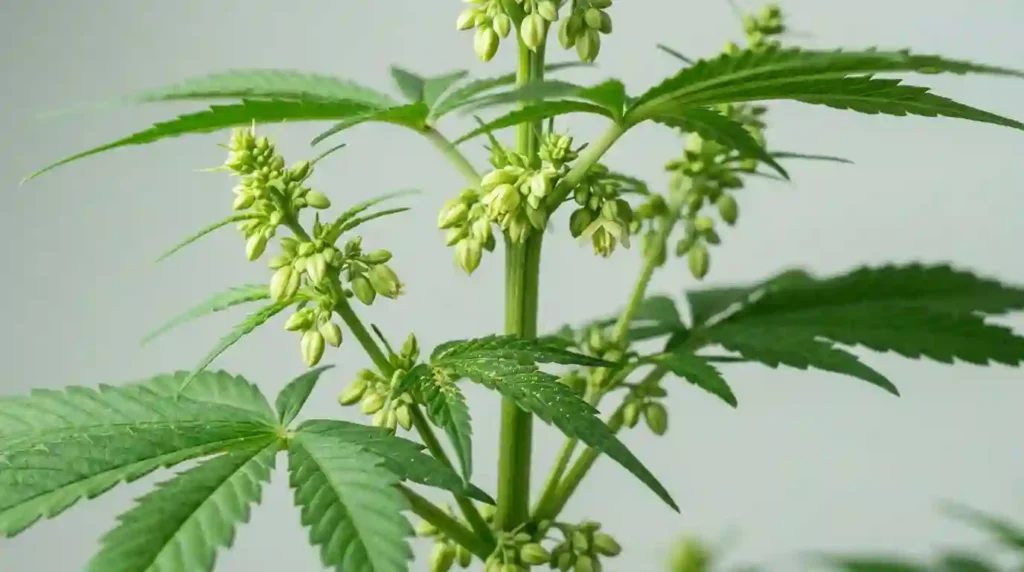
Here is where things get interesting. Male cannabis plants do not produce the dense, resinous buds that female plants are known for. Instead, they develop small, round structures called pollen sacs. These hang in clusters and look a bit like tiny bunches of grapes or miniature balls grouped together near the nodes of the plant.
When these pollen sacs mature, they open up and release pollen into the air. That pollen then travels, ideally landing on the white, hair-like structures (called pistils) of a nearby female plant. Once pollination occurs, the female plant shifts its energy away from producing resin and toward producing seeds.
So to directly answer the question: male cannabis plants produce pollen, not buds. They do contribute to seed production, but only as the pollen donor in the process. The female plant is the one that actually forms and carries the seeds.
A Simple Way to Think About It
If you have ever grown sunflowers or corn, you have seen this dynamic. Corn produces tassels at the top that release pollen, while the actual ears of corn develop lower on the plant and catch that pollen to form kernels. Male cannabis plants play a similar pollen-producing role, while female plants do the seed-bearing work.
Do Male Cannabis Plants Produce Seeds?
Technically, no. Male plants do not produce seeds themselves. Seeds are always formed inside the female plant’s flowers after successful pollination.
Here is how the process works step by step:
- The male plant develops pollen sacs during its reproductive stage.
- Those sacs mature and open, releasing pollen.
- Pollen reaches a female plant, either by wind or physical contact.
- The female plant’s unfertilized flowers (often called buds) receive the pollen at their pistils.
- Once fertilized, the female plant begins forming seeds inside those flower structures.
- Over the following weeks, seeds mature and can be harvested.
So when people ask whether male cannabis plants produce seeds, the more accurate way to frame it is: male plants trigger seed production in female plants through pollination. The male plant itself never contains seeds.
This is a subtle but important distinction, especially for anyone learning about plant breeding or trying to understand seed genetics.
Do Male Cannabis Plants Have THC?
This is probably the second most common question after the one about buds, and it deserves a clear answer.
Male cannabis plants do contain THC, but in much smaller amounts than female plants. The gap is significant enough that it is worth understanding.
Female cannabis plants concentrate their THC production in the trichomes that coat their flowers and surrounding leaves. These tiny, crystal-like structures are where the bulk of the plant’s cannabinoids, including THC, are produced.
Male plants do produce trichomes, and those trichomes do contain some THC. But male plants produce far fewer trichomes overall, and they do not develop the same dense flower structures that female plants are known for. Research and grower experience both point to male plants having substantially lower cannabinoid concentrations across the board.
The leaves of male plants contain the most cannabinoids compared to other parts of the male plant, but the overall THC content is still quite low compared to a mature, unpollinated female plant.
It is worth noting that cannabinoid content varies based on genetics, growing conditions, and plant health. But as a general rule, male plants are not known for high THC concentrations.
How to Tell Male and Female Cannabis Plants Apart
Knowing how to identify the sex of a cannabis plant is one of the most practical skills in plant biology related to this species. Here is a beginner-friendly guide to spotting the differences.
When Does Sex Become Visible?
Cannabis plants typically begin showing signs of their sex during the pre-flowering stage. This usually happens when the plant transitions from a vegetative growth phase to a flowering phase, which is often triggered by changes in light exposure.
Signs of a Male Plant
- Small, round pollen sacs develop at the nodes (where branches meet the main stem).
- These sacs cluster together and may look like tiny balls on short stems.
- They tend to appear earlier than female flowers.
- The plant often grows taller and less compact than female plants.
- No white hairs (pistils) emerge from the pre-flowers.
Signs of a Female Plant
- White, hair-like pistils emerge from the pre-flowers at the nodes.
- The plant develops more branching and a bushier structure.
- Flowers begin to cluster and form what growers refer to as buds.
- Trichomes (tiny resin glands) become visible on the flowers and nearby leaves.
What About Hermaphrodite Plants?
Occasionally, a cannabis plant will develop both male and female reproductive structures on the same plant. This is called a hermaphrodite. It can happen due to genetic predisposition, stress, inconsistent light, temperature extremes, or physical damage to the plant. Hermaphrodite plants can self-pollinate and can also pollinate nearby female plants, so they are something growers watch for carefully.
Pro Tips and Common Beginner Mistakes
Here are some practical insights based on what beginners commonly get wrong when first learning about cannabis plant biology.
Mistake 1: Confusing Pollen Sacs for Buds
Early pollen sac clusters can look a little like the start of bud development to an untrained eye. The key difference is shape and location. Pollen sacs are round and smooth. Female pre-flowers will typically show those telltale white hairs. When in doubt, give the plant a few more days and watch carefully.
Mistake 2: Assuming All Cannabis Plants Are the Same
People sometimes assume that all cannabis plants produce the same things. In reality, the sex of the plant determines almost everything about what it produces. Understanding this distinction is foundational to understanding cannabis biology at any level.
Mistake 3: Underestimating the Role of the Male Plant
Male plants get dismissed as useless by some beginners, but that is an oversimplification. In the context of plant breeding and seed production, male plants are essential. Breeders select male plants with desirable genetic traits to cross with female plants and create new varieties. The role of the male plant in the broader plant life cycle is significant.
Tip: Learn to Identify Early
The earlier you can identify plant sex, the better you understand the plant’s development stage. Early identification is a key skill in practical plant biology, and with cannabis plants, the differences become fairly recognizable with a bit of practice and careful observation.
Important Considerations
Legal Awareness
Cannabis cultivation is subject to varying laws depending on where you live. In many places, growing cannabis plants is heavily regulated or prohibited. Always research and understand the laws in your specific location before attempting to grow cannabis plants. This article is educational and does not encourage or endorse any illegal activity.
Plant Care Basics
Whether male or female, cannabis plants are fairly demanding in terms of care. They need appropriate light cycles, proper nutrition, good air circulation, and consistent temperature and humidity management. Neglecting any of these factors can lead to stressed plants, which may develop abnormally, including producing hermaphrodite characteristics.
Genetics Matter
The sex of a cannabis plant is determined by its genetics. Some seed types, known as feminized seeds, are bred to produce female plants at a very high rate. Regular seeds, on the other hand, can produce either sex. Autoflowering varieties introduce additional complexity to the equation. Understanding seed types is an important part of the broader topic.
Quick Summary
- Male cannabis plants do not produce the buds associated with female plants.
- Male plants produce pollen sacs, which release pollen when mature.
- Male cannabis plants do not produce seeds on their own; seeds form in female plants after pollination.
- Male cannabis plants do have some THC, but in significantly lower concentrations than female plants.
- Identifying plant sex early comes down to observing pre-flower development at the nodes.
- Male plants play an essential role in genetics and seed production.
- Cannabis cultivation laws vary by location; always know your local regulations.
Frequently Asked Questions
1. Can you get anything useful from a male cannabis plant?
Yes. Male cannabis plants are valuable in the context of plant breeding. Breeders use male plants to cross-pollinate female plants and create new genetic varieties. Some people also use the leaves of male plants for botanical purposes, though cannabinoid content is much lower than female plants.
2. At what point does a cannabis plant show its sex?
Most cannabis plants begin showing pre-flowers that indicate their sex during the transition to the flowering stage. This is typically influenced by light cycle changes. The pre-flowers usually become visible within a few weeks of this transition, though timing varies by genetics and growing conditions.
3. Do male cannabis plants produce any resin?
Male plants do produce some trichomes, which are the resin glands that contain cannabinoids. However, the quantity and density of trichomes on male plants is much lower than on female plants. As a result, the overall resin and cannabinoid production of male plants is minimal by comparison.
4. What happens if a male plant pollinates a female plant?
When a male plant pollinates a female plant, the female redirects its energy from producing resin-rich flowers toward producing seeds. This significantly reduces the resin and cannabinoid content of the resulting female flowers. This is why controlling pollination is so important in certain growing contexts.
5. Is it possible for a female cannabis plant to produce pollen?
Under significant stress or due to certain genetic traits, a female plant can develop hermaphrodite characteristics, which means it may produce some pollen sacs alongside its female flowers. This is not typical behavior but can happen. Stressors like irregular light, heat, or physical damage are common triggers.
Final Thoughts
Understanding what male cannabis plants produce, and what they do not produce, is one of the foundational building blocks of cannabis plant biology. These plants do not produce buds the way female plants do. They do not produce seeds on their own. They do contain small amounts of THC, but nothing like the concentrations found in female flowers.
What male plants do produce is pollen, which is the critical ingredient for seed formation and genetic inheritance. Without the male plant, there is no seed production and no new genetic development.
The more you understand how plant sex works in cannabis biology, the clearer the overall picture becomes. It is genuinely one of the more interesting aspects of this plant species, and it connects directly to broader concepts in botany that apply well beyond cannabis.
Whether your interest is purely academic, rooted in botany, or tied to understanding seeds and genetics, knowing the basics about male versus female cannabis plants is a practical and educational foundation worth having.
Disclaimer: This article is for educational and informational purposes only. Cannabis cultivation laws vary significantly by country, state, and region. Always check your local laws before growing or handling cannabis plants. Nothing in this article constitutes legal, medical, or agricultural advice.
Legal Notice: Cannabis laws differ widely across countries and regions. This content is educational only and does not promote, encourage, or endorse the cultivation of cannabis where it is prohibited by law. Readers are responsible for understanding and complying with their local regulations.