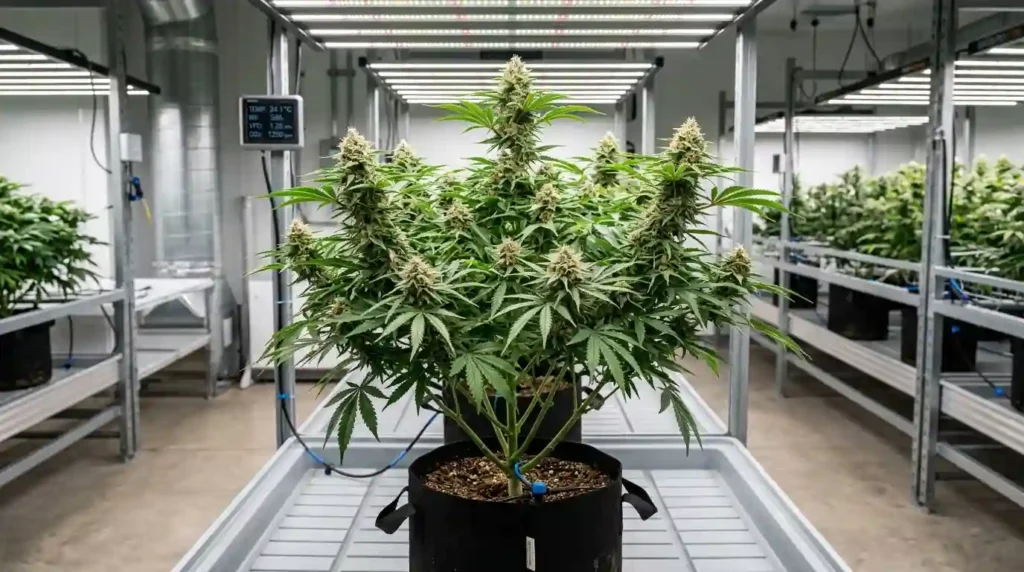
Temperature and humidity are two of the most important environmental factors affecting cannabis plant growth. They influence how plants manage water, how they respond to environmental stress, and how comfortable the growing environment is throughout the plant’s development.
There is no single temperature or humidity number that works perfectly for every cannabis plant. The ideal environment can vary depending on the growth stage, cultivar, growing system, airflow, and other environmental conditions.
For beginners, the goal is simple: keep conditions reasonably stable, understand how they change as the plant develops, and avoid extreme fluctuations.
For a complete overview of cannabis growing conditions, including light, temperature, humidity, airflow, water, soil, pH, and nutrients, see our Ideal Conditions for Cannabis Growth guide.
Why Temperature and Humidity Matter
Cannabis plants continuously respond to the environment around them.
Temperature affects processes such as growth, transpiration, and nutrient uptake, while relative humidity describes how much moisture is present in the surrounding air.
These two factors are closely connected. The same relative humidity can create a different environment at different temperatures, which is why more advanced growers sometimes consider VPD, or vapour pressure deficit, alongside humidity.
Research on controlled cannabis production shows that environmental requirements can change between developmental stages and that environmental management is also important for reducing disease pressure.
Ideal Temperature for Cannabis
Cannabis generally performs well in a moderately warm environment, but temperature preferences can change as the plant develops.
A useful beginner reference is:
| Growth Stage | General Temperature Range |
|---|---|
| Seedling / Young Plant | About 20–25°C (68–77°F) |
| Vegetative Growth | About 20–28°C (68–82°F) |
| Flowering | About 18–28°C (65–82°F) |
These are general reference ranges rather than strict rules. Research has used different environmental setpoints depending on cultivar, developmental stage, production system, and research objectives.
Seedling Stage
Young plants generally benefit from a stable, moderately warm environment.
Avoid sudden temperature changes, cold drafts, and strong direct heat sources. At this stage, consistency is often more useful than trying to maintain one exact temperature.
Vegetative Stage
During vegetative growth, cannabis generally performs well under moderately warm conditions.
Excessive heat can increase water loss and cause visible stress. Very low temperatures can also slow normal plant processes and development.
If your plant is already showing symptoms such as yellowing, drooping, or curling, our Cannabis Plant Problems & Solutions guide can help you investigate possible environmental causes.
Flowering Stage
Flowering plants can generally tolerate slightly cooler conditions than plants in active vegetative growth.
Temperature management becomes particularly important during flowering because temperature, humidity, and airflow interact with disease risk.
For a broader look at how environmental needs change throughout the plant’s lifecycle, see our Cannabis Growth Stages & Harvest Guide.
Ideal Humidity for Cannabis
Relative humidity, or RH, is the amount of moisture in the air expressed as a percentage.
Cannabis can tolerate different humidity levels, but humidity generally needs to be managed differently as the plant matures.
A practical beginner reference is:
| Growth Stage | General RH Range |
|---|---|
| Seedling / Young Plant | Around 65–75% |
| Vegetative Growth | Around 50–70% |
| Early Flowering | Around 40–60% |
| Late Flowering | Around 40–50% |
These values should be treated as general guidance rather than universal limits. Published studies have reported different environmental combinations depending on cultivar, growth stage, and production environment.
Seedling and Young Plants
Young plants can generally tolerate higher humidity than mature flowering plants.
The goal is to avoid an environment that is excessively dry while also preventing stagnant, overly wet conditions.
Good air movement remains important even when humidity is relatively high.
Vegetative Growth
As the plant develops a larger root system and more foliage, humidity can gradually be reduced.
Dense foliage can create small pockets of humid air around leaves, so humidity readings should always be considered together with airflow.
Flowering
Humidity management becomes increasingly important during flowering.
Dense flowers can retain moisture, and prolonged humid conditions can increase the risk of fungal problems such as Botrytis.
For this reason, many controlled growing environments use lower humidity targets as flowering progresses.
If you are dealing with mold, leaf symptoms, or other environmental problems, see our Cannabis Plant Problems & Solutions guide.
Temperature and Humidity Work Together
Temperature and humidity should not be considered completely separate measurements.
For example, 60% RH at one temperature does not create exactly the same environmental conditions as 60% RH at a substantially different temperature.
This relationship is why horticultural researchers and experienced growers sometimes use VPD.
VPD combines temperature and humidity to describe the atmospheric demand placed on the plant for transpiration.
You do not need to master VPD to understand the basics.
For beginners, focus on:
- Keeping temperature reasonably stable
- Maintaining appropriate humidity for the growth stage
- Avoiding sudden environmental changes
- Maintaining good air movement
- Watching the plant for signs of stress
Published research also shows that environmental recommendations are not completely uniform across cannabis cultivars and production systems, so one temperature, RH, or VPD number should not be treated as a universal target.
How to Monitor Temperature and Humidity
Guessing environmental conditions makes it much harder to identify problems.
A basic digital thermometer and hygrometer can measure temperature and relative humidity.
For more useful readings:
- Measure conditions close to the plant canopy.
- Check readings at different times of the day.
- Pay attention to both daytime and nighttime conditions.
- Watch for sudden fluctuations.
- Keep sensors away from direct heat sources.
- Avoid placing the sensor directly in the path of a fan.
Indoor growing environments can change considerably depending on lighting, ventilation, room temperature, and other equipment.
For broader environment and watering guidance, see our How to Care for Cannabis Plants guide.
Common Temperature Problems
Too Hot
Excessive heat can increase water loss and cause visible stress.
Leaves may curl upward along their edges, and growth may slow if high temperatures persist.
Instead of immediately assuming a nutrient problem, check the temperature and the rest of the growing environment first.
Too Cold
Cold conditions can slow normal biological processes and plant development.
Sudden temperature drops can also create an unstable environment, particularly when combined with excess moisture.
Large Day-to-Night Temperature Changes
Some difference between daytime and nighttime temperature is normal.
However, large or sudden changes can create additional environmental stress.
A reasonably stable environment is generally more useful than constantly trying to achieve a perfect number.
Common Humidity Problems
Humidity Too High
Persistently high humidity can increase disease pressure, particularly when airflow is poor.
This becomes especially important during flowering when dense flowers can retain moisture.
Humidity Too Low
Very dry air can increase water loss and place additional demand on the plant.
Young plants may be particularly sensitive to dry conditions while their root systems are still developing.
Stagnant Air
A humidity reading can appear acceptable while small areas around dense foliage remain much more humid.
That is why humidity control and air circulation should be considered together.
Temperature & Humidity by Growth Stage
For a quick reference:
| Stage | Temperature | Relative Humidity |
|---|---|---|
| Seedling | 20–25°C / 68–77°F | 65–75% |
| Vegetative | 20–28°C / 68–82°F | 50–70% |
| Early Flower | 18–28°C / 65–82°F | 40–60% |
| Late Flower | 18–28°C / 65–82°F | 40–50% |
Important: These are general educational ranges, not rigid requirements. Actual conditions can vary with cultivar, growing system, lighting, airflow, and other environmental factors.
A Simple Beginner Checklist
Instead of trying to optimize every environmental variable at once, focus on the basics:
- Temperature: Keep it within a reasonable range for the plant’s stage.
- Humidity: Gradually adjust it as the plant matures.
- Stability: Avoid large, sudden changes.
- Measurement: Use a thermometer and hygrometer instead of guessing.
- Air Movement: Avoid stagnant pockets around foliage.
- Observation: Pay attention to both environmental readings and plant symptoms.
Environmental factors interact with each other, so one measurement should never be considered completely in isolation.
For the complete environmental picture, see our Ideal Conditions for Cannabis Growth guide.
Frequently Asked Questions
What temperature is best for cannabis?
A moderately warm environment is generally suitable, but the preferred range changes with plant stage and growing conditions.
As a general reference, around 20–28°C (68–82°F) is commonly used during active vegetative growth, while flowering environments may use somewhat cooler conditions.
What humidity is best for cannabis?
Humidity generally starts higher when plants are young and is reduced as they mature.
A practical beginner reference is approximately 65–75% for young plants, 50–70% during vegetative growth, and lower humidity during flowering.
Exact recommendations vary between cultivars and growing environments.
Should humidity be lower during flowering?
Generally, humidity is managed at lower levels during flowering because dense flowers can retain moisture and prolonged high humidity can increase disease risk.
Good airflow is also important.
What is VPD?
VPD, or vapour pressure deficit, describes the atmospheric demand for water from the plant by combining temperature and humidity.
It can be useful for more precise environmental management, but beginners can start by learning how to keep temperature and humidity within sensible ranges.
Is one temperature and humidity range right for every cannabis plant?
No.
Cultivar, growth stage, growing system, airflow, lighting, and other environmental factors can all influence appropriate conditions.
Published research also shows that environmental requirements can vary between cannabis varieties and production systems.
Final Thoughts
Temperature and humidity are not about finding one magical number.
The goal is to create a stable and appropriate environment that changes gradually as the plant develops.
Keep temperature within a reasonable range, adjust humidity as the plant matures, avoid stagnant conditions, and measure the environment instead of guessing.
For the complete picture—including light, temperature, humidity, airflow, watering, pH, growing medium, nutrients, and indoor versus outdoor environments—continue to our Ideal Conditions for Cannabis Growth guide.
Disclaimer: Educational information only. Cannabis laws vary by location. Always verify and follow the laws and regulations that apply where you live.
Sources & Further Reading:
- An Update on Plant Photobiology and Implications for Cannabis Production — peer-reviewed review covering cannabis environmental and photobiology research.
PubMed Central - Integrated Management of Pathogens and Microbes in Cannabis sativa L. under Greenhouse Conditions — research covering environmental management, temperature, humidity, VPD, and disease pressure across growth stages.
MDPI — Plants - The Impact of Planting Density and Vegetative Duration on Yield Optimization and Cannabinoid Stability in Medicinal Cannabis Under Controlled-Environment Cultivation — recent controlled-environment research reporting stage-specific temperature and humidity conditions.
MDPI