If you have ever tried to grow something from seed and ended up staring at a pot of dry soil for two weeks wondering what went wrong, you are not alone. Germination is one of those stages that looks simple on paper but trips up beginners more than almost anything else in plant cultivation.
Cannabis seeds are no different from other plant seeds in this respect. They need the right conditions to wake up, crack open, and send out that first tiny root. Get those conditions right, and you are off to a strong start. Get them wrong, and even the best seed in the world will sit there doing nothing.
This guide walks you through everything you need to know about how to germinate cannabis seeds. You will learn the most reliable methods, the science behind why they work, how long the process actually takes, what mistakes to avoid, and what to do once your seed has sprouted. Whether you are a complete beginner or someone who has had a few failed attempts, this is the guide to bookmark and come back to.
Understanding Germination: What Is Actually Happening Inside the Seed
Before jumping into the how, it helps to understand the what. When a seed germinates, it is essentially waking up from a dormant state. Think of it like a bear coming out of hibernation. The seed has everything it needs stored inside it already. It just needs the right environmental signal to start moving.
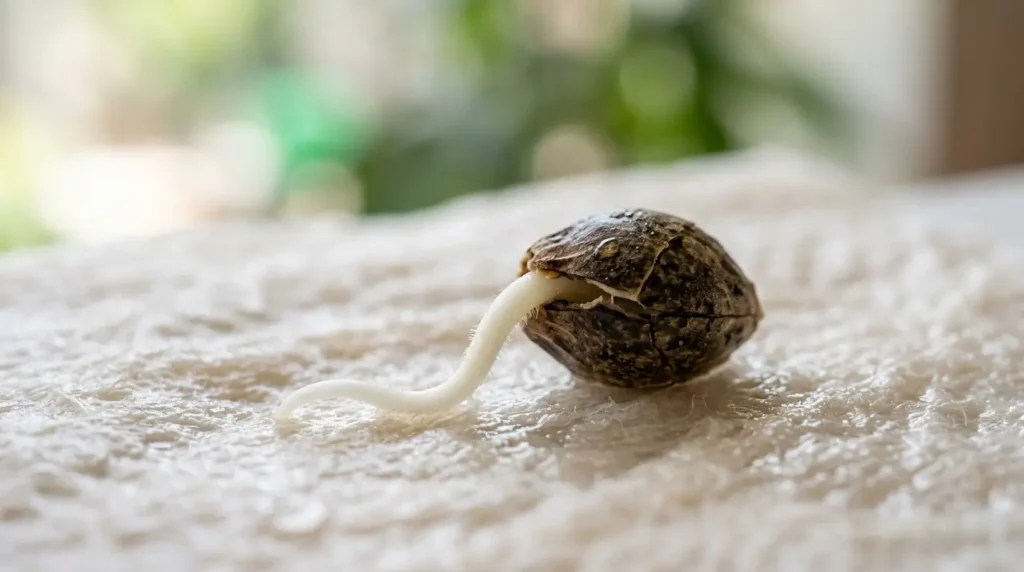
Inside a viable cannabis seed, there is a tiny embryonic plant. Surrounding that embryo is a food supply called the endosperm. When moisture reaches the seed, enzymes activate and begin breaking down those food stores. The embryo starts growing. A root called the radicle pushes downward, and a shoot pushes upward.
Three things are required for this process to begin: moisture, warmth, and darkness. That is it. No fertilizer, no special soil, no complicated equipment. Just water, the right temperature, and low light.
A healthy cannabis seed is usually dark brown or grey, sometimes with tiger-stripe patterns. It will feel firm when you press it gently between your fingers. Seeds that are pale green or white are typically immature, and seeds that crumble are dead. Always start with healthy, viable seeds from a reputable source.
How Long Does It Take Cannabis Seeds to Germinate?
This is one of the most common questions beginners ask, and the honest answer is: it depends.
Under ideal conditions, most cannabis seeds will show a taproot within 24 to 72 hours. However, some seeds take up to 5 to 7 days. Older seeds or seeds that have been stored improperly may take even longer, and some simply will not germinate at all.
The main factors that affect germination speed are:
Temperature: The sweet spot is between 70 and 85 degrees Fahrenheit (21 to 29 degrees Celsius). Below 65 degrees, germination slows dramatically. Above 90 degrees, you risk damaging the seed or drying it out too quickly.
Moisture: The seed needs to be consistently moist, not soaking wet. Too much water is just as harmful as too little. Soggy conditions invite mold and can suffocate the embryo before it even gets started.
Seed age and quality: Fresh, properly stored seeds germinate faster and at higher rates than old or improperly stored ones. A seed that has been sitting in a hot car for six months may still germinate, but it will take longer and is more likely to fail.
Seed hardness: Some seeds have very thick shells. These can take longer simply because moisture has a harder time penetrating. Lightly scuffing the seed on sandpaper or soaking it for a longer period can help.
Do Cannabis Seeds Need Light to Germinate?
No. Cannabis seeds do not need light to germinate. In fact, darkness is generally preferred during the germination phase.
This makes biological sense when you think about it. In nature, a seed falls to the ground and gets covered by soil, leaves, or debris. It germinates in darkness before the shoot has even reached the surface. Light becomes important only once the seedling has emerged and needs to start photosynthesizing.
So if you are using the paper towel method or a germination tray, keep it in a dark, warm location. A drawer, a cabinet above the refrigerator (which tends to be warm), or a dedicated seedling heat mat in a dark environment all work well.
Once you see a taproot and the seedling breaks through the soil surface, that is when light becomes critical. At that point, you will want to introduce a gentle light source.
How to Germinate Cannabis Seeds: Three Proven Methods
There is no single “best” method. Each one has its strengths, and growers develop preferences over time based on their setup and experience. Here are the three most widely used approaches.
Method 1: The Paper Towel Method
This is probably the most popular method among home growers, and for good reason. It is simple, cheap, and allows you to see exactly when the taproot has emerged, so you know the seed is ready to be planted.
What you need:
- Two paper towels
- Two plates
- Filtered or pH-neutral water
- Your seeds
- A warm, dark location
Step-by-step:
Step 1 – Moisten the paper towels. Wet both paper towels thoroughly, then wring them out. They should be damp but not dripping. If water pours out when you squeeze them, they are too wet.
Step 2 – Place the seeds. Lay one paper towel flat on a plate. Place your seeds on it with about an inch of space between each one. Fold the other damp paper towel over the top to cover them.
Step 3 – Cover and store. Place the second plate upside down on top of the first to create a dark, humid dome. Set this in a warm location, ideally between 70 and 80 degrees Fahrenheit.
Step 4 – Check daily. Peek at your seeds once a day. Do not let the paper towels dry out. If they are starting to dry, add a small amount of water. Do not flood them.
Step 5 – Wait for the taproot. In 24 to 120 hours (1 to 5 days), you should see a small white root emerging from the seed. Once the taproot is about 0.2 to 0.5 inches long (5 to 10 millimeters), it is ready to plant.
Step 6 – Transfer carefully. Use tweezers to handle the sprouted seed. Plant it taproot-down, about a quarter inch deep in your growing medium. Handle it gently. The taproot is very delicate at this stage.
One common mistake with this method: letting the paper towels dry out completely between checks. Consistency is key. The seeds need uninterrupted moisture to keep the germination process going.
Method 2: Germinating Directly in Soil
This is the most natural method and, arguably, the gentlest on the seedling. When you germinate directly in soil, there is no transplant shock because you never have to move the seedling from one environment to another.
What you need:
- A small pot or seedling plug
- Lightly moistened growing medium (seedling soil or a cannabis-specific starter mix works well)
- A pencil or dowel for making holes
- Filtered or pH-neutral water
Step-by-step:
Step 1 – Prepare your medium. Fill your pot or seedling tray with lightly moistened soil. It should feel like a wrung-out sponge. Not bone dry, not waterlogged.
Step 2 – Make a planting hole. Use a pencil, toothpick, or your finger to make a small hole about half an inch (1.5 centimeters) deep.
Step 3 – Place the seed. Drop the seed into the hole, point-side down if you can identify which end is which (though honestly it does not matter much – the plant will find its way). Cover it lightly with soil. Do not pack it down.
Step 4 – Water gently. Use a spray bottle or a gentle pour to moisten the top layer of soil without disturbing the seed. You want moisture but not a puddle.
Step 5 – Create warmth and humidity. Place a clear plastic dome or even a zip-lock bag over the pot to trap humidity. Keep the whole setup in a warm location between 70 and 80 degrees Fahrenheit.
Step 6 – Wait and watch. In 3 to 7 days, you should see the seedling pushing through the soil surface. Once you see green, remove the humidity dome and introduce gentle light.
The downside of this method is that you cannot see what is happening underground. Some growers feel anxious not knowing if the seed has cracked yet. If you are a visual person who wants confirmation before planting, the paper towel method might suit you better.
Method 3: Germinating Cannabis Seeds in Water
Soaking seeds in water before planting is a method borrowed from general horticulture. It can work very well for seeds with harder shells that struggle to absorb enough moisture through other methods.
What you need:
- A small glass or cup
- Filtered or room-temperature water (avoid cold water)
- Your seeds
How long to soak cannabis seeds: The general recommendation is 12 to 24 hours. Do not exceed 32 hours. Seeds that soak too long can become waterlogged and oxygen-deprived, which is fatal to the embryo.
Step-by-step:
Step 1 – Fill the glass. Use lukewarm, filtered water. Room temperature is ideal. Cold water stresses the seed.
Step 2 – Drop in the seeds. Let them float at first. After a few hours, viable seeds will usually sink. If a seed is still floating after 12 hours, gently tap it down. If it floats back up immediately, it may not be viable.
Step 3 – Keep it warm and dark. Place the glass in a warm, dark spot. Do not let the water temperature drop below 65 degrees.
Step 4 – Check at 12 to 24 hours. By this point, many seeds will already have cracked open and a small white root tip will be visible. These are ready to plant.
Step 5 – Plant promptly. Once you see the taproot, get the seed into soil or your chosen growing medium as soon as possible. Plant it about a quarter inch deep with the taproot pointing down.
The water method is best used as a pre-soak followed by either planting directly in soil or finishing in a paper towel. Using water alone as the entire germination environment is not ideal because the seed needs more stability and oxygen exchange once the taproot starts developing.
Pro Tips From Experience: What Beginners Usually Get Wrong
After going through the germination process many times, certain patterns of mistakes come up repeatedly. Here is what to watch out for.
Using tap water without checking pH. Tap water in many areas is either too alkaline or too acidic for optimal seed germination. Ideally, you want a pH between 6.0 and 7.0 for germinating cannabis seeds. If your tap water has a very high or low pH, it can slow or even prevent germination. Using filtered water or letting tap water sit out overnight to off-gas chlorine helps.
Handling the taproot with bare fingers. The taproot is incredibly fragile. Even mild heat from your fingers can damage it. Always use clean tweezers and work slowly. One careless grab can snap the taproot and ruin an otherwise healthy seed.
Planting too deep. A quarter inch is plenty. If you plant the seed an inch deep, it has to work much harder to push through, and it may exhaust its stored energy before the shoot reaches the surface.
Overwatering after planting. Once the seed is in the ground, it does not need much water. The goal is to maintain consistent moisture in the surrounding soil, not to keep it saturated. Overwatering is the number one killer of seedlings at every stage, including this one.
Giving up too early. Some seeds take a full week. If the conditions are right, wait it out. Check for mold, make sure moisture levels are consistent, and give the seed time to do its thing. Many growers have tossed seeds on day four only to realize they just needed another day.
Not keeping the environment warm enough. This is especially common in cooler climates or during winter. If your germination environment drops below 65 degrees Fahrenheit at night, germination will stall. A seedling heat mat is an inexpensive and effective solution.
Quick Summary: Cannabis Seed Germination at a Glance
- Seeds need moisture, warmth (70-85F / 21-29C), and darkness to germinate
- Most seeds sprout in 24 to 120 hours; some take up to 7 days
- Light is not needed during germination
- Paper towel method: damp but not soaked, check daily, plant when taproot is 5-10mm
- Soil method: half-inch deep, light watering, cover for humidity
- Water soak: 12-24 hours max, then plant immediately
- Handle the taproot with tweezers only
- Do not overwater, do not plant too deep, do not give up too early
Important Considerations Before You Start
Know the laws in your area. Cannabis cultivation regulations vary enormously. In some places, growing any cannabis plant is completely illegal. In others, adults are allowed to grow a limited number of plants for personal use. In still others, cultivation requires a license. Before you germinate a single seed, understand the legal framework in your jurisdiction. This article cannot and does not provide legal guidance on this.
Source your seeds legally. In jurisdictions where cannabis cultivation is legal, seeds should be purchased from licensed, reputable sources. Buying seeds through legal channels typically ensures they are accurately labeled for variety, feminization, and expected traits.
Think about your growing environment. Germination is only the very first step. Before you start, consider where and how the plant will grow after the seedling stage. An indoor setup requires lighting, ventilation, and space planning. An outdoor setup requires appropriate climate conditions, security, and local compliance with any restrictions on plant height or visibility.
Hygiene matters. Use clean containers, fresh water, and clean tools throughout the germination process. Mold and bacterial contamination can kill seedlings quickly.
Frequently Asked Questions
How long does it take cannabis seeds to germinate? Under ideal conditions, most cannabis seeds will show a taproot within 24 to 72 hours. Some seeds, particularly older or harder-shelled ones, can take 5 to 7 days. If a seed has not sprouted after 10 days despite correct conditions, it is likely not viable.
Do cannabis seeds need light to germinate? No. Cannabis seeds do not need light to germinate. Darkness is actually preferred during the germination phase. Light only becomes important once the seedling has emerged above the soil surface and needs to begin photosynthesizing.
How long should you soak cannabis seeds in water? The recommended soaking time is 12 to 24 hours. Going beyond 32 hours is not advisable because prolonged soaking can deprive the seed of oxygen and cause it to rot. Once you see the taproot beginning to emerge, the seed is ready to plant regardless of how long it has been soaking.
Can you germinate cannabis seeds directly in soil? Yes, and many experienced growers prefer this method because it avoids transplant stress. Plant the seed half an inch deep in moist but not waterlogged seedling soil, cover lightly, and maintain a warm and humid environment. The seedling should emerge from the soil surface within 3 to 7 days.
Why are my cannabis seeds not germinating? The most common reasons are: temperature is too low (below 65 degrees Fahrenheit), the seeds are too wet or too dry, the seeds are old or were improperly stored, or the seeds were simply not viable to begin with. Check your temperature and moisture levels first. If conditions are correct and nothing has happened after 10 days, the seeds are likely not going to sprout.
Final Thoughts
Germinating cannabis seeds is genuinely one of the simpler parts of plant cultivation once you understand what the seed actually needs: consistent moisture, warmth, and darkness. The biology is doing all the work. Your job is just to create the right conditions and stay out of the way.
The paper towel method gives you the most control and visibility. The soil method is the most natural and gentle. The water soak is a useful tool for stubborn seeds or as a pre-germination step before moving to another method. Choose the one that fits your setup and comfort level, and do not be afraid to try a different approach if your first attempt does not go as planned.
Pay attention to the details that matter most: temperature, moisture consistency, and gentle handling of the taproot. Avoid the common mistakes of overwatering, planting too deep, and handling the seedling carelessly.
Most importantly, make sure everything you are doing is within the legal framework of your location. Laws around cannabis cultivation continue to evolve, and what is permitted in one place may be restricted or prohibited in another.
With the right knowledge and a bit of patience, germination is a manageable and even satisfying process to observe. Watching a seed crack open and send out its first root is a small but genuinely impressive moment of plant biology at work.
Legal Disclaimer: Cannabis cultivation laws vary widely by country, state, and local jurisdiction. This article is written purely for educational and informational purposes. Always research and comply with the laws in your area before attempting to grow any plant, including cannabis. Nothing in this article constitutes legal, medical, or agricultural advice.
This article is for educational and informational purposes only. The author and publisher do not encourage or endorse any illegal activity. Cannabis cultivation laws vary by location. Always consult your local laws before cultivating any plant species.