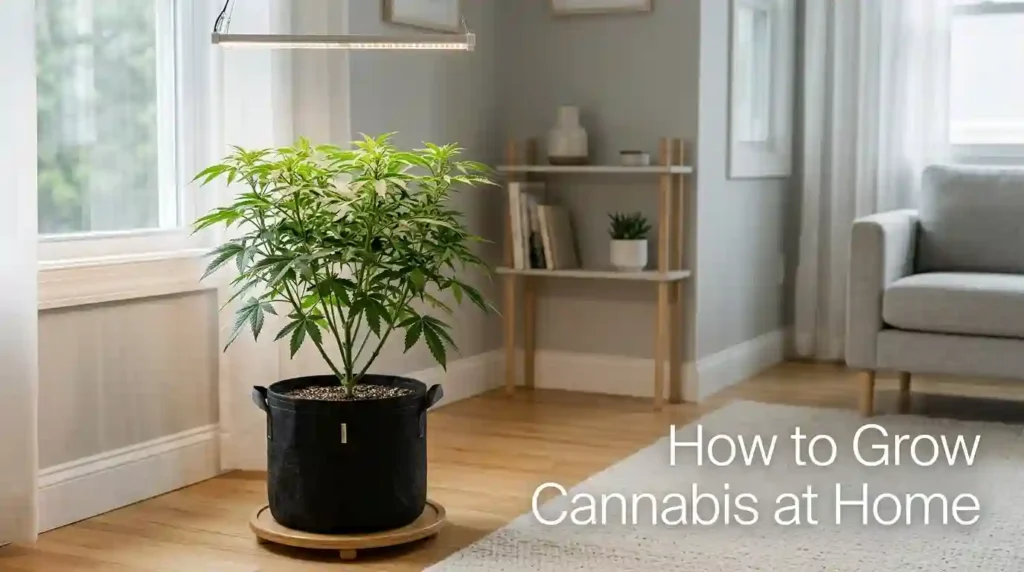
Growing cannabis at home can be an interesting way to learn about plant biology, environmental management, and responsible horticulture. But successful home growing involves more than simply placing a seed in soil. Your local laws, available space, growing environment, plant care, and safety considerations all matter.
This beginner-friendly guide explains the fundamentals of growing cannabis at home, including how to choose a suitable growing approach, prepare your space, understand the plant’s growth cycle, and avoid common beginner mistakes.
This is a broad home-growing guide rather than a detailed guide to every stage of cultivation. For deeper information on individual stages and techniques, explore our related cannabis growing guides throughout the site.
Can You Grow Cannabis at Home?
The first question is not about equipment or seeds. It is whether home cultivation is legally permitted where you live.
Cannabis cultivation laws vary considerably between countries, states, provinces, and municipalities. Some jurisdictions permit limited personal cultivation under specific conditions, while others prohibit cultivation entirely.
Before making any plans, check the current rules that apply to your location, including:
- Whether personal cultivation is permitted
- Who is legally allowed to cultivate
- Maximum plant limits
- Where plants may be grown
- Whether plants must be kept out of public view
- Any security or storage requirements
A home grow should always begin with understanding and following the applicable law.
What Does Growing Cannabis at Home Involve?
Home cannabis growing generally means managing a plant through several stages of its natural life cycle in a private residential environment.
The broad progression is:
Seed → Germination → Seedling → Vegetative Growth → Flowering → Harvest
Each stage has different environmental and care considerations.
You do not need to understand everything before getting started. A better approach for beginners is to understand the overall process first and then learn about individual topics as they become relevant.
For a complete overview of the plant’s lifecycle, see our Cannabis Growth Stages & Harvest Guide.
Choosing Your Home Growing Approach
One of the first decisions is where and how the plant will be grown.
At a broad level, home cultivation can involve:
Indoor Growing
Indoor growing takes place inside a controlled environment such as a dedicated grow space, room, or tent.
Its biggest advantage is environmental control. Light, temperature, humidity, and airflow can be managed more consistently than they typically can outdoors.
However, indoor growing also requires more planning and equipment.
For a dedicated indoor guide, see: How to Grow Cannabis Indoors Step by Step
Outdoor Growing
Outdoor growing uses natural sunlight and the surrounding climate.
This can reduce the need for artificial lighting and some equipment, but the grow becomes much more dependent on weather, seasonal conditions, privacy, and local regulations.
The right approach depends on your legal situation, available space, climate, and personal circumstances.
Planning Your Home Growing Space
Before thinking about the plant itself, consider the space available to you.
A suitable home growing area should be:
- Legally appropriate
- Private and secure
- Clean and organized
- Suitable for managing environmental conditions
- Away from children and pets
- Able to accommodate the needs of the chosen growing approach
For indoor environments, ventilation and environmental monitoring become particularly important.
For outdoor environments, sunlight, weather exposure, privacy, and seasonal conditions become more important.
The goal is not necessarily to create the biggest or most complicated setup. A simple, well-managed environment is easier for a beginner to understand and maintain.
Understanding the Basic Needs of a Cannabis Plant
Like other plants, cannabis depends on several fundamental environmental factors.
Light
Light provides the energy plants need for photosynthesis and influences development throughout the plant’s lifecycle.
Indoor growers have to manage artificial lighting, while outdoor plants depend primarily on natural sunlight.
Water
Water is essential, but more is not always better. Excess moisture around roots can create problems, while insufficient water can also stress a plant.
Understanding the difference between healthy watering and overwatering is an important part of basic plant care.
Learn more in our guide to Overwatered vs Underwatered Cannabis.
Growing Medium
The growing medium provides physical support for the roots and influences water, air, and nutrient availability.
Common approaches include soil-based growing and other specialized media.
Beginners should understand how their chosen medium behaves rather than assuming every growing method requires the same care.
Temperature and Humidity
Environmental conditions can influence plant development and plant health.
Temperature and humidity should be considered together because changes in one can affect the overall growing environment.
For more information, see our Cannabis Temperature & Humidity Beginner Guide.
Nutrients
Plants require nutrients for normal growth and development.
The important lesson for beginners is that more nutrients do not automatically mean better growth. Nutrient problems can also be confused with watering, pH, or environmental problems.
For a deeper introduction, see our guide to Cannabis Plant Food.
Understanding the Cannabis Growth Cycle
You do not need to memorize every detail of every stage, but understanding the overall lifecycle makes the rest of cannabis care much easier.
1. Germination
The seed begins the process of becoming a plant.
During this stage, moisture and suitable environmental conditions are important.
For a dedicated overview, see How to Germinate Cannabis Seeds.
2. Seedling
Once the seed has successfully germinated, the young plant begins developing its first leaves and establishing its root system.
Seedlings are relatively delicate, so excessive watering, environmental stress, or inappropriate conditions can cause problems.
3. Vegetative Growth
During vegetative growth, the plant develops its main structure, including stems, branches, and leaves.
This is generally the period of active structural growth before flowering begins.
4. Flowering
Flowering is the reproductive stage of the plant.
For photoperiod plants, changes in the light environment can influence the transition into flowering. Autoflowering varieties follow a different flowering response.
Environmental stability remains important throughout this stage.
5. Harvest
Eventually, the plant reaches maturity and can be harvested.
Determining when a plant is ready requires understanding maturity indicators rather than relying only on a calendar.
For a dedicated resource, see our When to Harvest Cannabis Plants guide.
Home Growing: What Beginners Often Get Wrong
Many beginner problems come from trying to do too much too quickly.
Overwatering
More water does not mean faster growth.
Excess moisture can reduce healthy root-zone conditions and contribute to plant problems.
Changing Too Many Things at Once
When a plant develops a problem, changing several variables simultaneously makes it difficult to understand what caused the issue.
Observation and consistency are generally more useful than constantly changing the environment.
Ignoring the Environment
A plant can receive adequate water and nutrients while still struggling because of environmental stress.
Temperature, humidity, airflow, and light all interact.
Overcomplicating the Setup
A complicated setup can create more variables for a beginner to manage.
Start by understanding the fundamentals before adding unnecessary equipment or techniques.
Expecting Every Plant to Grow the Same Way
Genetics, environment, growing conditions, and plant development can all influence how a plant grows.
There is no single result that every cannabis plant will produce under every condition.
Home Growing and Plant Safety
Responsible home cultivation also means considering the people and animals around the growing area.
Keep plants, growing materials, nutrients, and other gardening products away from children and pets.
Indoor growing spaces should also be kept clean and appropriately ventilated.
If you use any gardening product, follow its label instructions and storage requirements.
How Much Does It Cost to Grow Cannabis at Home?
There is no single cost for a home growing setup.
Expenses can vary depending on:
- Indoor or outdoor growing
- Available space
- Lighting requirements
- Growing medium
- Environmental monitoring
- Ventilation
- Containers
- Nutrients
- Other gardening equipment
A larger or more controlled indoor setup will generally require more equipment than a simple outdoor growing environment.
For beginners, the better approach is to understand what each piece of equipment actually does rather than buying equipment simply because another grower uses it.
Indoor vs Outdoor Cannabis Growing
The biggest difference between the two approaches is environmental control.
| Factor | Indoor | Outdoor |
|---|---|---|
| Light | Artificial | Natural |
| Climate control | High | Limited |
| Weather exposure | Low | High |
| Equipment needs | Usually higher | Usually lower |
| Seasonal dependence | Lower | Higher |
| Privacy considerations | Important | Very important |
| Environmental consistency | Easier to control | More variable |
Neither approach is automatically right for everyone.
Your location, climate, available space, legal restrictions, and ability to manage the environment should guide the decision.
A Simple Beginner Roadmap
If you are learning about home cannabis growing for the first time, think about it in this order:
1. Check the law
Understand whether cultivation is permitted where you live.
2. Choose your growing approach
Consider indoor versus outdoor growing.
3. Understand the plant lifecycle
Learn what happens from seed through flowering and maturity.
4. Learn the environmental basics
Understand light, water, temperature, humidity, airflow, and the growing medium.
5. Learn one topic at a time
Use dedicated guides for germination, plant care, growing conditions, training, problems, and harvesting.
6. Observe rather than guess
Plant development provides useful signals. Learn to recognize changes before reacting.
Frequently Asked Questions
Can you grow cannabis at home?
In some jurisdictions, adults may legally cultivate cannabis at home under specific conditions. In others, home cultivation is prohibited. Always check the current laws that apply to your location.
Is indoor or outdoor growing easier?
Neither is universally easier.
Indoor growing provides greater environmental control but usually requires more equipment and management. Outdoor growing can be simpler from an equipment perspective but introduces weather and seasonal variables.
What does a cannabis plant need to grow?
At a basic level, cannabis requires suitable light, water, air, an appropriate growing medium, nutrients, and a suitable environment.
The exact requirements vary with plant genetics and developmental stage.
How long does it take to grow cannabis at home?
There is no universal timeline. The duration depends on the plant’s genetics, growing environment, developmental stages, and growing approach.
For stage-specific information, see our Cannabis Growth Stages & Harvest Guide.
What is the biggest beginner mistake?
Overwatering is one of the most common beginner plant-care problems. Other common issues include environmental instability, overfeeding, and changing too many variables at once.
Can cannabis be grown in a small home?
The physical space required depends on the chosen growing approach and local regulations. Indoor cultivation can be adapted to smaller spaces, but environmental management, privacy, ventilation, and legal requirements still need to be considered.
Final Thoughts
Growing cannabis at home is ultimately an exercise in understanding plants and managing an environment.
You do not need to know every cultivation technique from day one. Start with the fundamentals: understand the law, choose an appropriate growing approach, learn the plant’s lifecycle, and become familiar with the environmental factors that influence plant health.
From there, specialized guides can help you explore individual topics in greater depth.
If you are looking for a complete overview of cannabis cultivation, start with our How to Grow Cannabis: Complete Step-by-Step Guide.
Sources & Further Reading
– Penn State Extension — Seed and Seedling Biology: https://extension.psu.edu/seed-and-seedling-biology
– University of Missouri Extension — Germination 101: https://extension.missouri.edu/news/germination-101
– Langa et al. (2024)— Cannabis Germination and Seedling Establishment: https://www.sciencedirect.com/science/article/pii/S0926669023016266